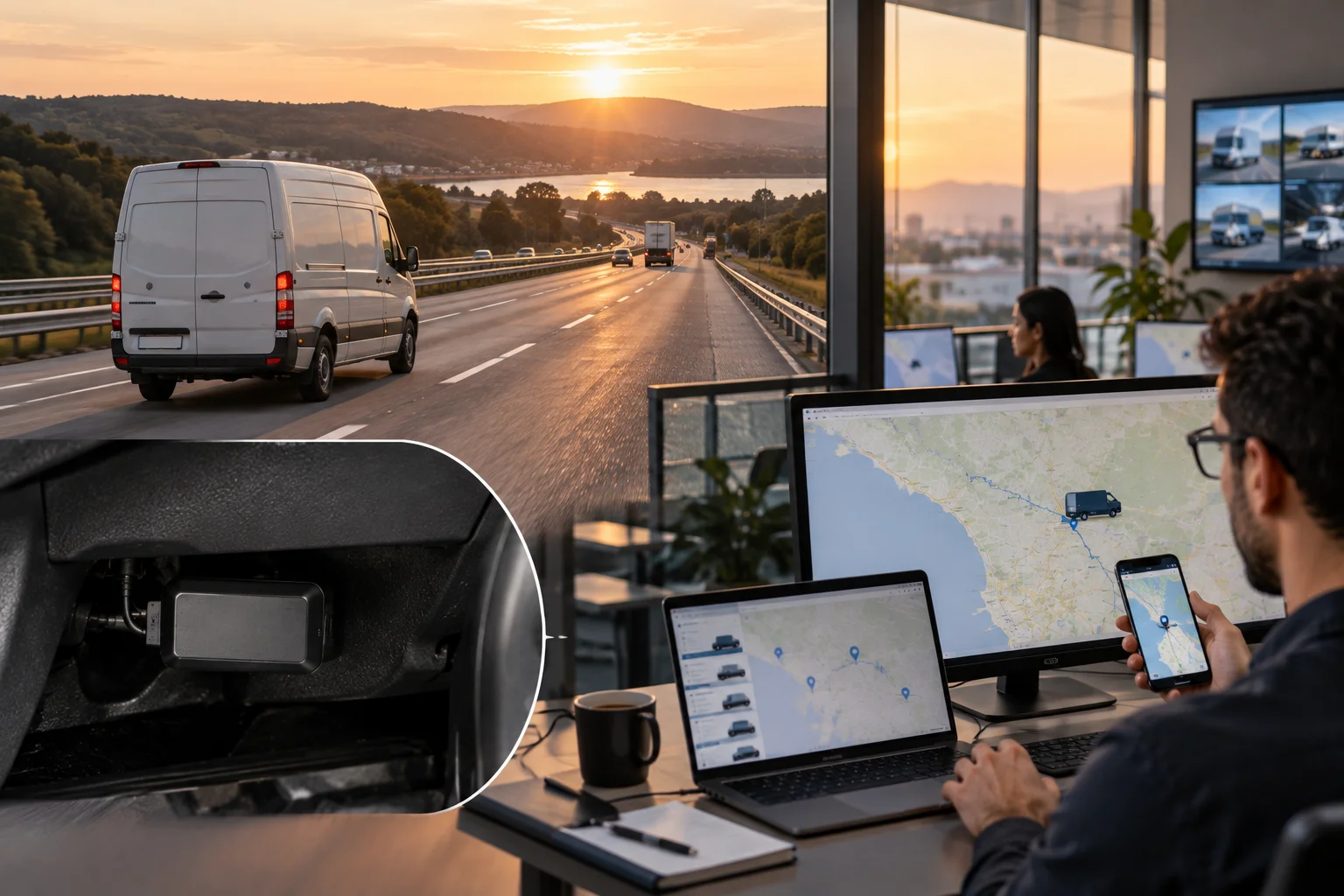
A GPS tracker doesn't need to be connected to your phone to determine its location. That's because GPS positioning and phone connectivity are two separate functions.
The GPS receiver inside the tracker listens to signals broadcast by navigation satellites and calculates the device's position. The tracker then needs another communication method to send that position somewhere you can access it, such as a tracking platform or app. GPS satellites themselves don't receive the tracker's location or send it to your phone. They are one-way transmitters.
For most real-time GPS trackers, that second connection is provided by a cellular modem and SIM or eSIM. The tracker calculates its coordinates, connects to a mobile network and sends a small data packet to a server. Your phone then accesses that server through the internet.
That's why a tracker can work thousands of kilometres away from your phone.
Does a GPS Tracker Need a Phone Connection?
No. A GPS tracker can calculate its position independently of a smartphone, provided it has access to GPS or another compatible positioning system.
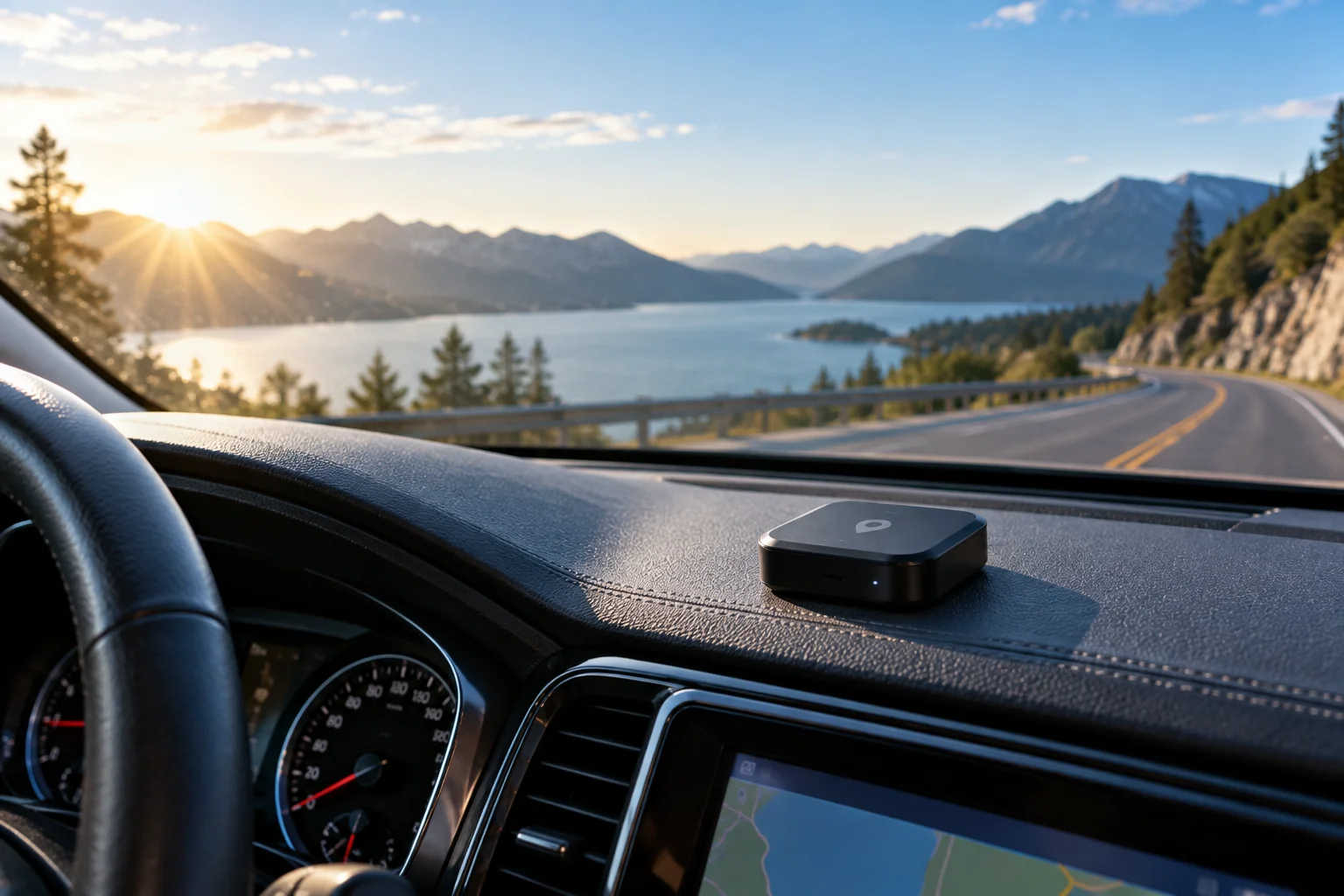
The confusion comes from the fact that many consumer trackers are controlled through smartphone apps.
Your phone might be used to:
Set up the tracker
View its current location
Change tracking intervals
Receive alerts
Review location history
Configure geofences
But the phone doesn't necessarily communicate directly with the tracker.
A typical cellular tracker has its own GPS receiver, cellular modem and connectivity subscription. The tracker communicates with a remote server, and your phone communicates with that server.
Think of it as:
Tracker → cellular network → internet/server → your phone
rather than:
Tracker → Bluetooth → phone
How Does GPS Know Where the Tracker Is?
The GPS receiver calculates location by measuring signals from multiple navigation satellites.
GPS satellites continuously broadcast timing and orbital information. A receiver measures the signals it receives and uses that information to calculate its position.
A simplified sequence looks like this:
Satellites broadcast navigation signals.
The tracker's GPS antenna receives them.
The receiver determines how long the signals took to arrive.
It calculates distances to multiple satellites.
It uses those measurements to calculate latitude, longitude and, with sufficient satellite geometry, altitude.
The resulting coordinates become the tracker's current location.
The GPS receiver does not transmit anything back to the satellites. Garmin's technical documentation describes the receiver as collecting satellite information and calculating its own position without sending information back to the satellites.
This is the key to understanding how GPS trackers work.
If GPS Doesn't Transmit Location, How Does the Tracker Send It to You?
A cellular modem provides the communication link that GPS itself doesn't provide.
Once the tracker calculates its coordinates, its cellular modem can connect to a nearby mobile network.
The device may then send information such as:
Latitude and longitude
Time
Speed
Direction
Battery status
Device status
Alarm or geofence events
The data travels through the cellular network to the tracker's backend server.
Your tracking app retrieves the information from that server over the internet.
So GPS determines where the tracker is, while cellular connectivity determines how that information gets to you.
What Does the SIM Card Do in a GPS Tracker?
The SIM identifies and authenticates the tracker on a cellular network and provides the cellular subscription needed to transmit data.
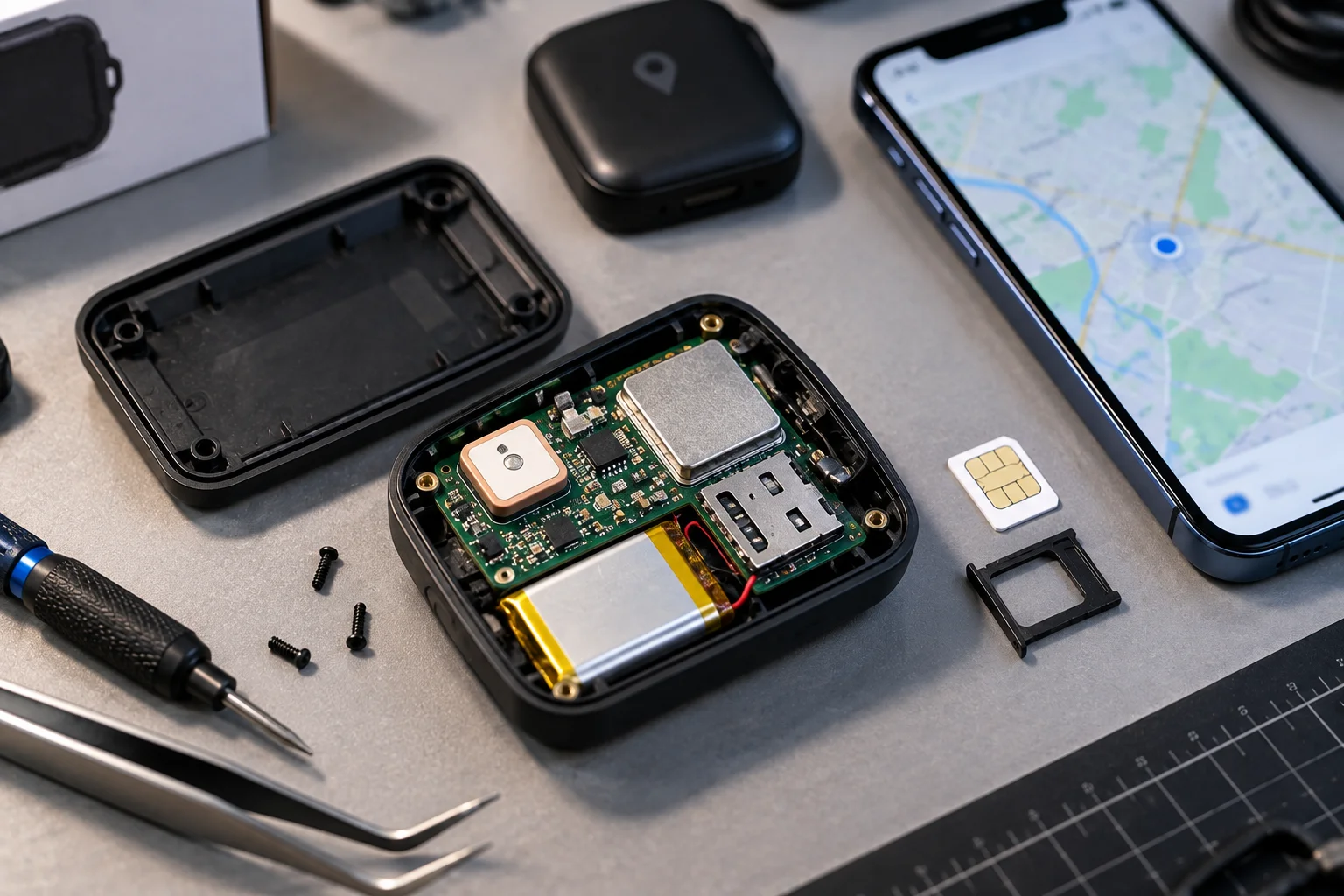
It's essentially the tracker's mobile identity.
A conventional tracker might contain a physical SIM, while newer IoT devices can use an eSIM or iSIM.
The GSMA describes cellular IoT technologies such as LTE-M and NB-IoT as cellular networks designed for devices that need low power consumption, long range and relatively small amounts of data.
That makes them well suited to trackers.
The SIM doesn't calculate GPS coordinates. Instead, the GPS receiver handles positioning while the cellular system handles communication.
Does a GPS Tracker Need Its Own Data Plan?
A cellular GPS tracker generally needs some form of cellular connectivity subscription if it is expected to transmit its location remotely.
This might be:
A traditional SIM with a mobile data plan
An IoT SIM
An embedded eSIM
An iSIM-based service
A proprietary connectivity subscription bundled with the tracker
The exact arrangement depends on the manufacturer and network.
An eSIM can be particularly useful for IoT because the cellular profile can be provisioned remotely rather than requiring someone to physically replace a SIM card. The GSMA's IoT eSIM architecture is specifically designed for network-constrained devices that may have no conventional user interface.
Can a GPS Tracker Work Without Cellular Coverage?
It can still calculate its location, but a conventional cellular tracker may not be able to transmit that location to its server until it reconnects.
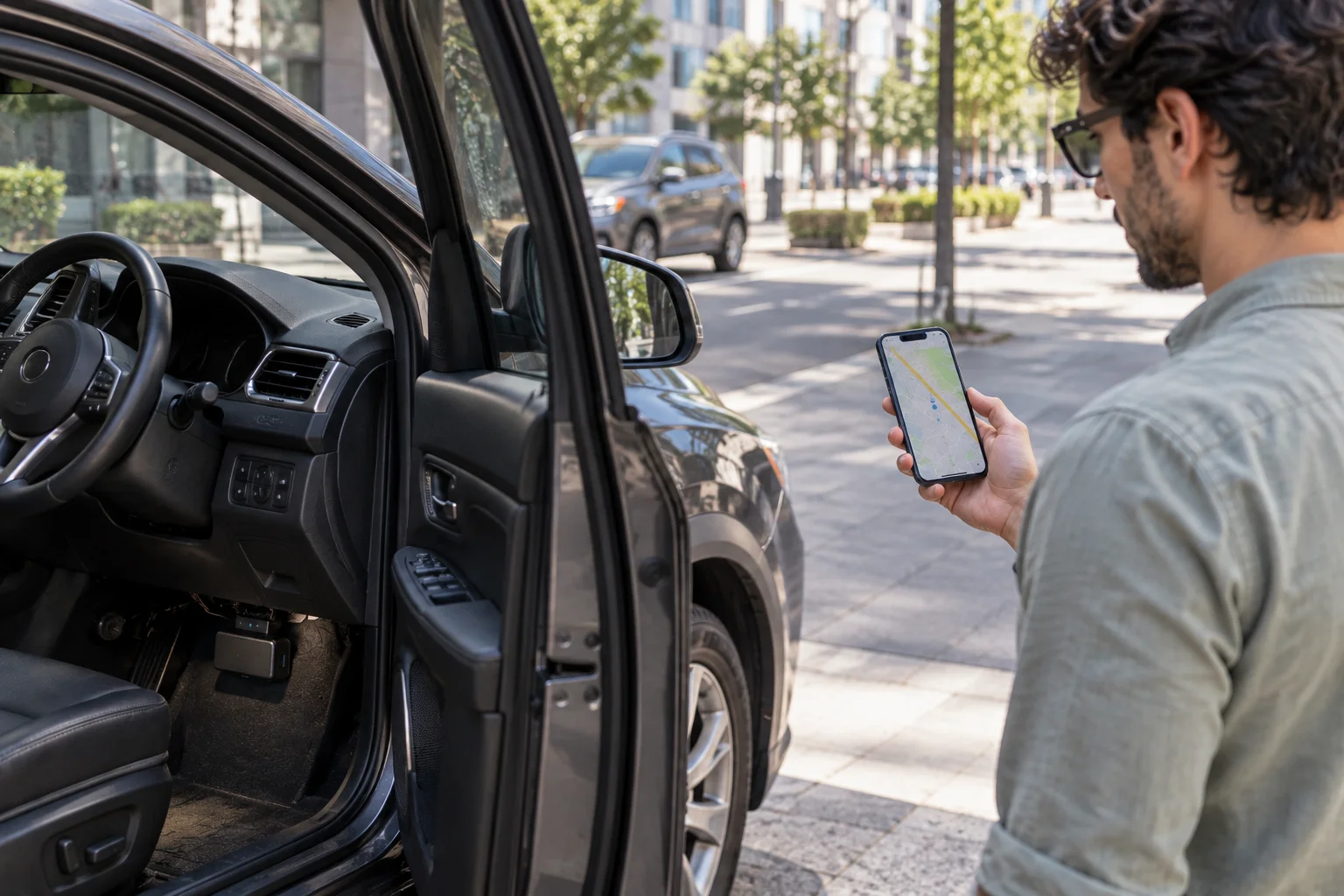
This is an important distinction.
Imagine a vehicle enters an underground parking garage.
The GPS signal may become weak or unavailable because buildings and structures can obstruct satellite signals. GPS.gov notes that indoor and underground environments, buildings, trees and reflected signals can reduce positioning accuracy.
At the same time, cellular coverage may also disappear.
The tracker might therefore know its last valid position but be unable to send new data.
Some devices store location records locally and upload them when connectivity returns.
That means “no live location” doesn't necessarily mean “the tracker stopped working.”
How Does Real-Time GPS Tracking Actually Work?
Real-time tracking is really a chain of several technologies working together.
A simplified example:
1. GPS receiver
Calculates the tracker's coordinates.
↓
2. Tracker processor
Packages the coordinates with time and other information.
↓
3. Cellular modem
Connects to a mobile network.
↓
4. SIM/eSIM
Provides network authentication and connectivity.
↓
5. Cellular network
Carries the data to the service provider's infrastructure.
↓
6. Tracking server
Stores and processes the location information.
↓
7. Internet
Makes the information available to your app or web dashboard.
↓
8. Phone or computer
Displays the tracker's location on a map.
That's why the phrase “GPS tracking” can be misleading. GPS is only one part of the complete tracking system.
Why Do GPS Trackers Sometimes Show an Old Location?
The displayed location can become stale when the tracker cannot obtain a good position, cannot transmit data or deliberately reduces its communication frequency to save battery.

Battery-powered trackers don't necessarily communicate continuously.
IoT networks such as LTE-M and NB-IoT include power-saving mechanisms that allow devices to spend extended periods in low-power or sleep states. During deep sleep, an IoT device can become temporarily unreachable.
A tracker might therefore operate on a schedule such as:
Wake → obtain position → transmit → sleep → repeat
This dramatically reduces power consumption compared with keeping the GPS receiver and cellular modem active continuously.
The result isn't always a continuously moving dot. It may be a series of location updates separated by intervals.
Does a GPS Tracker Use GPS All the Time?
Not necessarily. Many trackers activate their positioning hardware only when they need a new location.
Constantly operating the GPS receiver and cellular modem consumes considerably more energy than periodically waking the device.
Manufacturers can therefore balance:
Update frequency
Battery life
Location accuracy
Cellular availability
Device size
Cost
A vehicle tracker connected to permanent power can afford a different strategy from a small battery-powered asset tracker.
This is one reason two devices advertised as “real-time GPS trackers” can have very different battery life and update behaviour.
Can GPS Trackers Use Cellular Networks Other Than 4G?
Yes. Cellular IoT can use technologies specifically designed for low-power connected devices, including LTE-M and NB-IoT, depending on the tracker and network.
The GSMA identifies LTE-M and NB-IoT as complementary cellular IoT technologies designed for applications that prioritize characteristics such as low power consumption, long battery life, wide-area coverage and relatively low data rates.
Some trackers use conventional cellular technologies instead, particularly when they need higher data rates, broader compatibility or features such as voice.
The important point is that the cellular technology used by the tracker depends on its hardware and the networks supported in its target market.
What Happens When a Tracker Crosses a Country Border?
A cellular IoT tracker can potentially continue working through roaming agreements, but international coverage isn't automatic.
The SIM or eSIM service needs access to compatible networks in the destination country.
GSMA documentation describes LTE-M and NB-IoT roaming as allowing an IoT device to connect across participating networks while retaining its home service relationship.
That's why international trackers often advertise multi-network or global connectivity.
But “global” doesn't mean literally every location. Network compatibility, roaming agreements, frequency bands, coverage and local regulations can all affect operation.
GPS vs Cellular: What's the Difference?
GPS tells the tracker where it is; cellular connectivity tells the outside world where it is.
Technology | Main job | Needs a subscription? |
|---|---|---|
GPS/GNSS | Calculates position | No |
Cellular modem | Sends data remotely | Usually yes |
SIM/eSIM | Identifies/authenticates cellular service | Part of connectivity service |
Bluetooth | Short-range device connection | Usually no |
Wi-Fi | Local/network connectivity | Depends on network |
Tracking server | Stores/processes location data | Usually part of service |
Phone app | Displays and manages tracking data | Usually requires internet |
This distinction also explains why a GPS navigation device can work without a SIM while a remote vehicle tracker generally needs cellular connectivity.
What If the Tracker Has No Phone, Wi-Fi or Cellular Connection?
It can still determine its own GPS position, but it cannot normally provide that position to a remote user in real time without some communication path.
It could instead:
Store coordinates internally
Record a travel history
Display the position on its own screen
Transfer data later through USB
Upload data once cellular connectivity returns
Use another communication technology
Some specialized tracking systems can also use satellite communications instead of cellular networks, which is useful in areas without terrestrial mobile coverage.
The broader principle is simple:
Positioning and communication are separate problems.
Frequently Asked Questions About GPS Trackers
Can a GPS tracker work without a smartphone?
Yes. A tracker with its own positioning receiver and communication service can operate independently of a smartphone. The phone is usually just the interface used to view the tracker's data.
Does GPS require mobile data?
No. The GPS receiver can calculate its position from satellite signals without mobile data. Mobile data is needed when the device has to send that position remotely through a cellular network.
Does a GPS tracker need a SIM card?
A cellular tracker needs cellular authentication and service, but that doesn't necessarily mean a removable physical SIM. It may use an eSIM or iSIM instead.
Can a GPS tracker work without internet?
It can calculate and potentially store its location without internet access. However, a conventional connected tracker generally needs some communication path to send live location information to a remote server.
How accurate is a GPS tracker?
Accuracy varies with receiver quality, satellite geometry, atmospheric conditions and signal obstruction. GPS.gov says typical smartphone GPS positioning can be within about 4.9 metres under open sky, while accuracy can worsen around buildings, bridges and trees.
Can GPS work indoors?
Sometimes, but performance can deteriorate significantly indoors because satellite signals are weak and can be blocked or reflected.
The Bottom Line
A GPS tracker doesn't need your phone because your phone isn't what makes GPS work.
The GPS receiver calculates the tracker's position by listening to satellites. A cellular modem then uses a SIM, eSIM or similar connectivity mechanism to send that position through a mobile network to a remote server. Your phone simply accesses that server and displays the information.
The complete system is therefore better understood as:
GPS/GNSS = positioning
SIM + cellular network = communication
Server = data processing and storage
Internet + app = remote access
Once you separate those functions, the technology becomes much easier to understand. A tracker can be completely independent of your smartphone while still reporting its location hundreds or thousands of kilometres away.