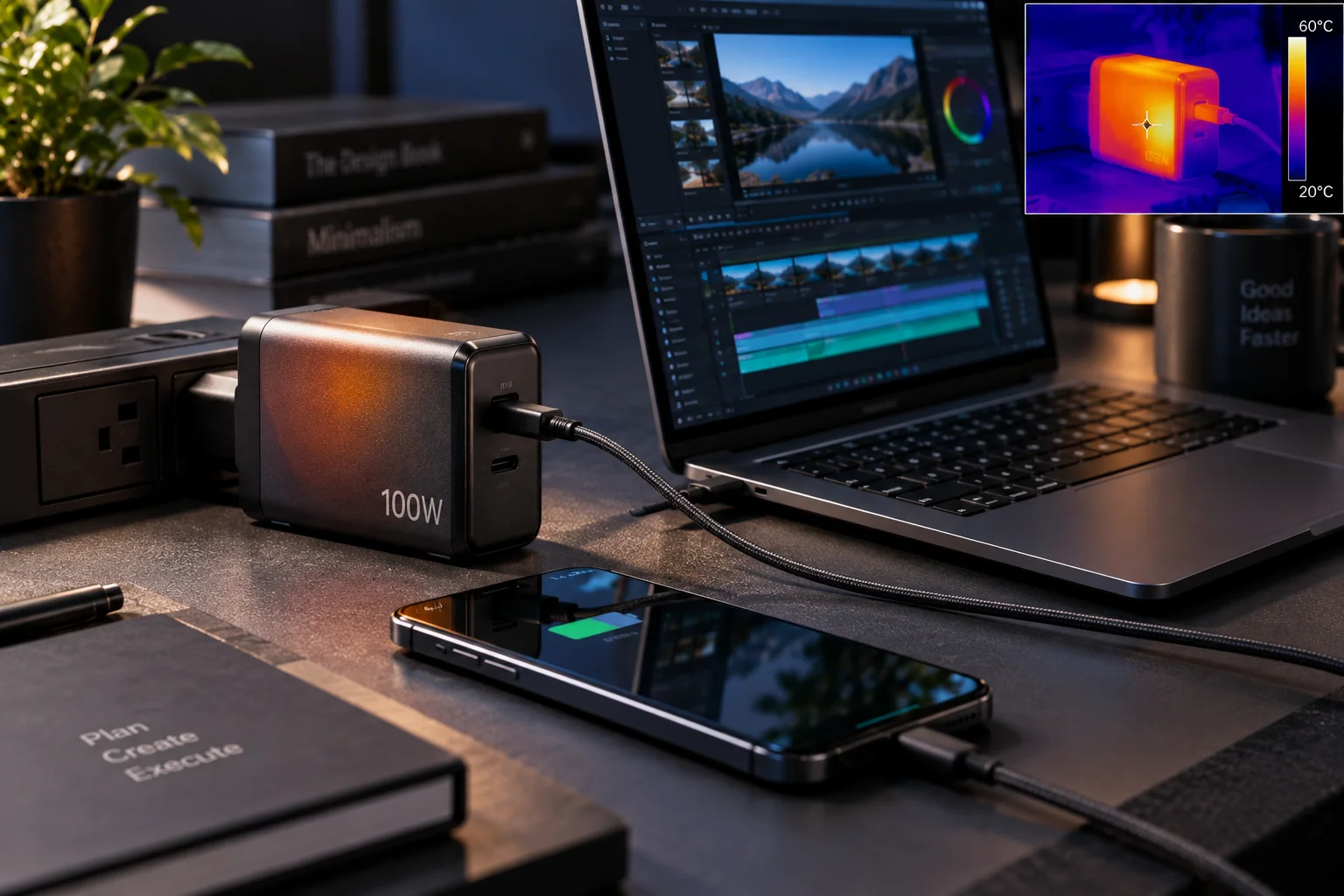
If you've compared modern USB-C chargers with the bulky adapters that came with older laptops, you've probably noticed something strange: today's tiny chargers can sometimes deliver 65W, 100W, 140W or even more.
The reason is partly GaN, or gallium nitride.
GaN chargers replace some traditional silicon power transistors with gallium nitride semiconductor technology. GaN devices can switch at high frequencies with lower switching losses, allowing manufacturers to build power supplies with smaller supporting components and higher power density. Infineon says modern GaN chargers can reach power densities of 9–18+ W/in³, while its broader GaN technology overview notes that GaN chargers can be substantially smaller than equivalent silicon designs.
But there's an important misconception to clear up.
GaN itself isn't a charging protocol. It doesn't determine whether your phone charges at 20W, 45W or 100W. Charging speed depends on the charger, device and charging protocol they support, such as USB Power Delivery (USB PD) and Programmable Power Supply (PPS).
So what exactly does GaN change?
What Is a GaN Charger?
A GaN charger is a power adapter that uses gallium nitride semiconductor devices in its power-conversion circuitry instead of relying entirely on conventional silicon power transistors.
Gallium nitride is a wide-bandgap semiconductor material with electrical properties that make it particularly useful for high-frequency power switching.
Inside a conventional charger, power has to be converted from AC electricity from the wall into the controlled DC voltage required by your phone, tablet or laptop.
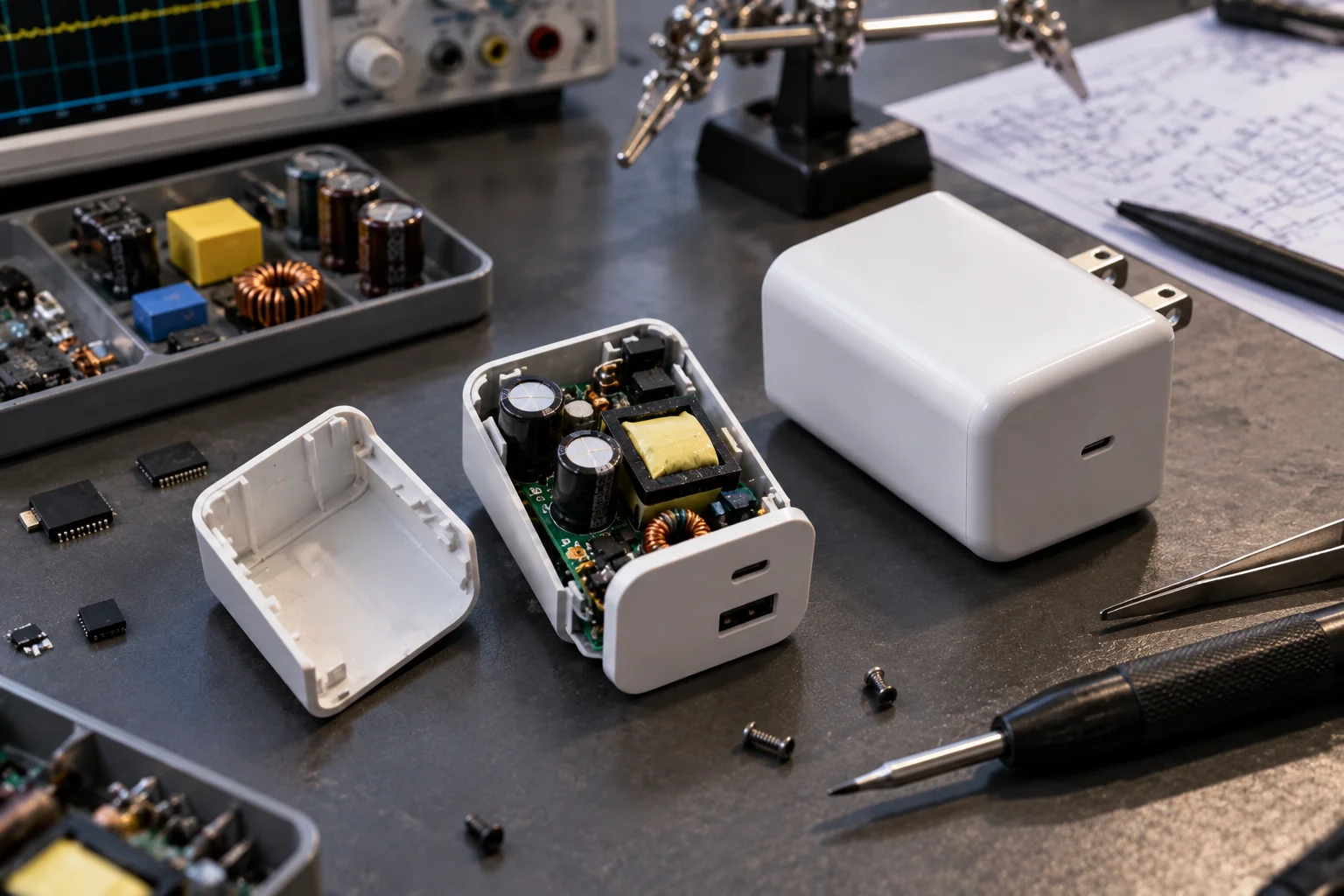
That conversion involves switching transistors, transformers, capacitors, inductors and control circuitry.
GaN doesn't eliminate those components.
Instead, its high-speed switching characteristics can allow the power-conversion stage to operate more efficiently and at higher frequencies, which can reduce the size of other components and increase the amount of power that fits into a given volume.
Why Are GaN Chargers Smaller?
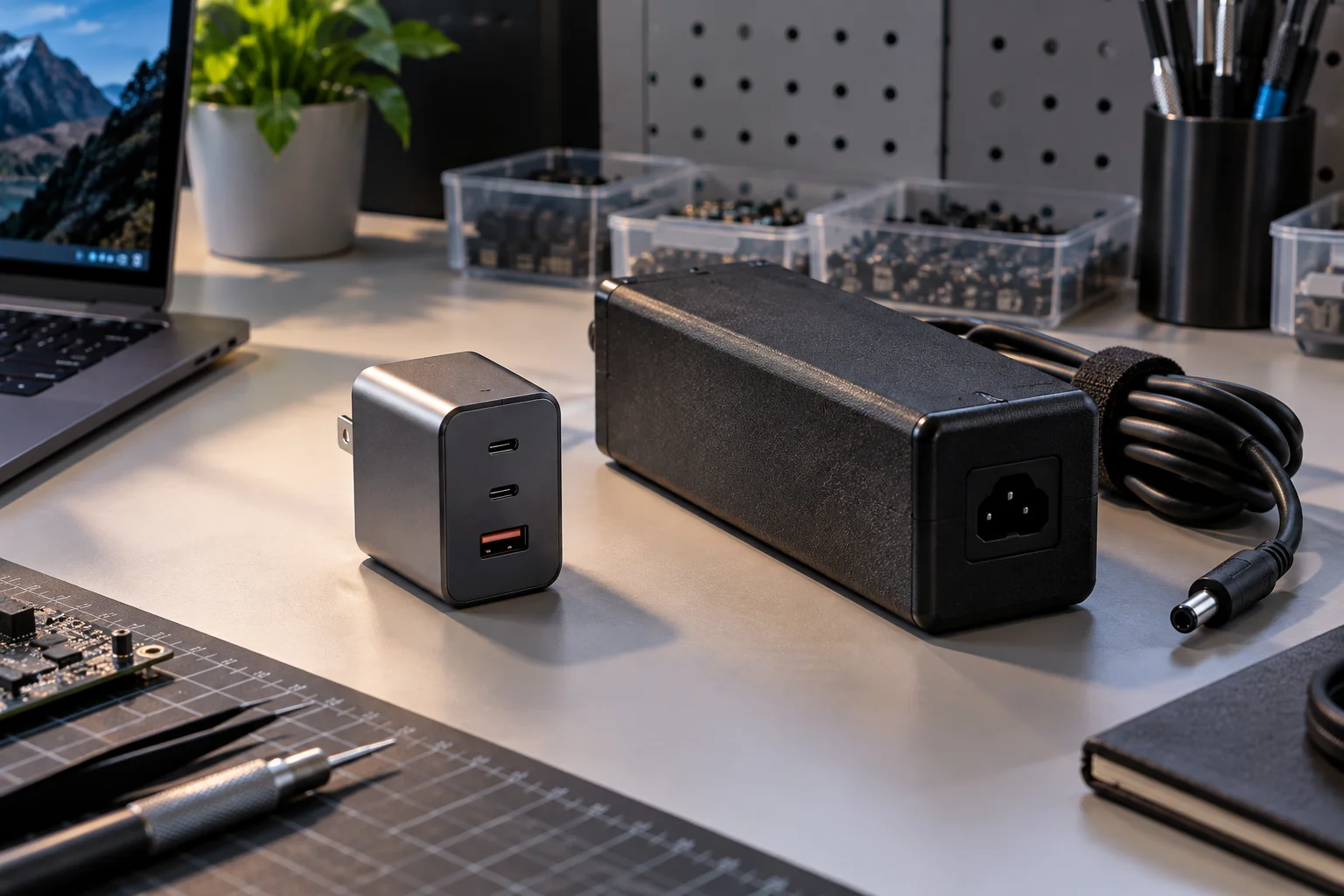
GaN chargers can be smaller because faster, more efficient switching allows manufacturers to reduce the size of some components used in the power-conversion circuit.
One of the important components affected is the transformer.
At higher switching frequencies, magnetic components can generally be made smaller for a given power-conversion task.
GaN transistors are particularly well suited to high-frequency operation because they can switch rapidly while keeping switching losses relatively low.
That creates a chain reaction:
Faster switching → smaller passive components → higher power density → smaller charger
This doesn't mean every GaN charger will be tiny.
The final size still depends on:
Output power
Number of ports
Thermal design
Safety requirements
Power-conversion architecture
Component selection
Housing design
A 30W single-port GaN charger can be extremely small, while a 240W multi-port charger still needs considerably more hardware.
Why Do GaN Chargers Run Cooler?
GaN can reduce certain power losses, meaning less electrical energy is converted into unwanted heat inside the charger.
Every power supply loses some energy during conversion.
That lost energy generally appears as heat.
Reducing switching losses improves efficiency and can reduce the thermal burden on the charger.
However, “GaN chargers don't get hot” isn't accurate.
A 100W charger delivering close to 100W is still handling substantial electrical power. Some heat is unavoidable, and the charger's efficiency varies with load, voltage and design.
Thermal performance therefore depends on the complete charger, not simply the presence of a GaN transistor.
Infineon describes lower losses and reduced heat generation as major benefits of GaN power designs.
Does GaN Make Your Phone Charge Faster?
Not by itself. GaN makes the charger more compact and efficient; the charging protocol and the device determine how much power actually reaches the device.
Imagine two chargers:
65W silicon charger
65W GaN charger
If both support exactly the same charging standards and deliver the same output conditions, the GaN charger isn't automatically faster.
The difference is that the GaN design may achieve that output in a smaller, lighter or more thermally efficient package.
USB Power Delivery allows a charger and device to negotiate the power required by the device. USB-IF's current USB PD specification supports power delivery up to 240W with compatible USB-C hardware and cables.
So think of it this way:
GaN = power-conversion technology
USB PD/PPS = charging and power-delivery protocols
Phone/laptop = determines how much power it can accept
All three matter.
What Is USB Power Delivery and Why Does It Matter With GaN?
USB Power Delivery is the communication and power-delivery standard that allows compatible USB-C devices and chargers to negotiate appropriate power levels.
USB PD is designed to provide flexible power delivery over USB-C.
USB-IF's current documentation describes PD 3.1 and later capabilities extending USB power delivery to as much as 240W, using higher fixed voltage levels and adjustable voltage operation.
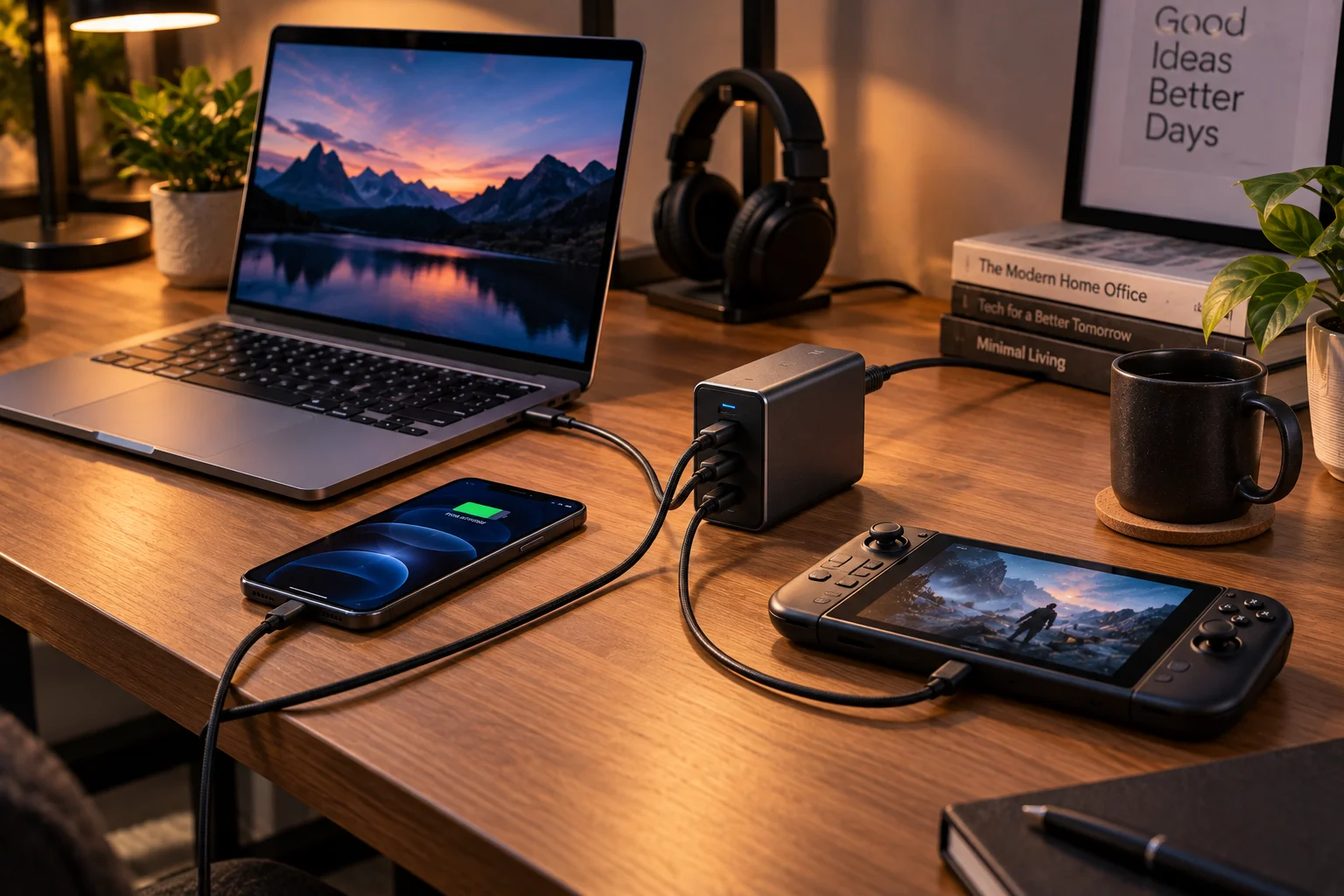
This is one reason a single modern charger can potentially power several different devices.
For example, the same USB-C charger could be used with:
Smartphone
Tablet
Laptop
Handheld gaming console
Wireless earbuds
USB-C monitor
The device requests an appropriate power level rather than simply receiving the charger's maximum wattage.
A 100W charger doesn't force 100W into a phone designed to accept substantially less.
What Is PPS and Why Do Some GaN Chargers Support It?
PPS, or Programmable Power Supply, allows compatible USB PD systems to adjust charging voltage more dynamically rather than relying only on fixed voltage levels.
USB-IF's Certified USB Fast Charger program identifies PPS support as part of USB Power Delivery 3.0 fast-charging implementations and notes that both the charger and device need to support PPS to take full advantage of it.
This matters particularly with devices that use sophisticated USB-C fast-charging systems.
So when shopping for a GaN charger, don't look only for:
“100W GaN”
Also check:
“USB PD” + “PPS” + supported output profiles
The exact combination matters more than the GaN label alone.
Why Can a Small GaN Charger Power a Laptop?
Higher power density allows manufacturers to fit substantial power-conversion capability into a relatively small enclosure.
A modern laptop might require 65W, 90W, 100W or more depending on the model and workload.
Older laptop adapters often used relatively large silicon-based power supplies.
Modern GaN designs can package comparable output capability into considerably smaller adapters.
Infineon gives the example of 65W–100W GaN chargers as a mainstream use case for laptops and multi-device charging and reports substantial size and weight reductions for some multi-port designs compared with equivalent silicon-based chargers.
That doesn't mean every 100W GaN charger is equally capable.
A laptop may require a particular USB PD voltage, sufficient sustained power and an appropriate cable.
Can One GaN Charger Charge Multiple Devices?
Yes, multi-port GaN chargers can distribute available power across several devices, although the maximum output is shared according to the charger's design.
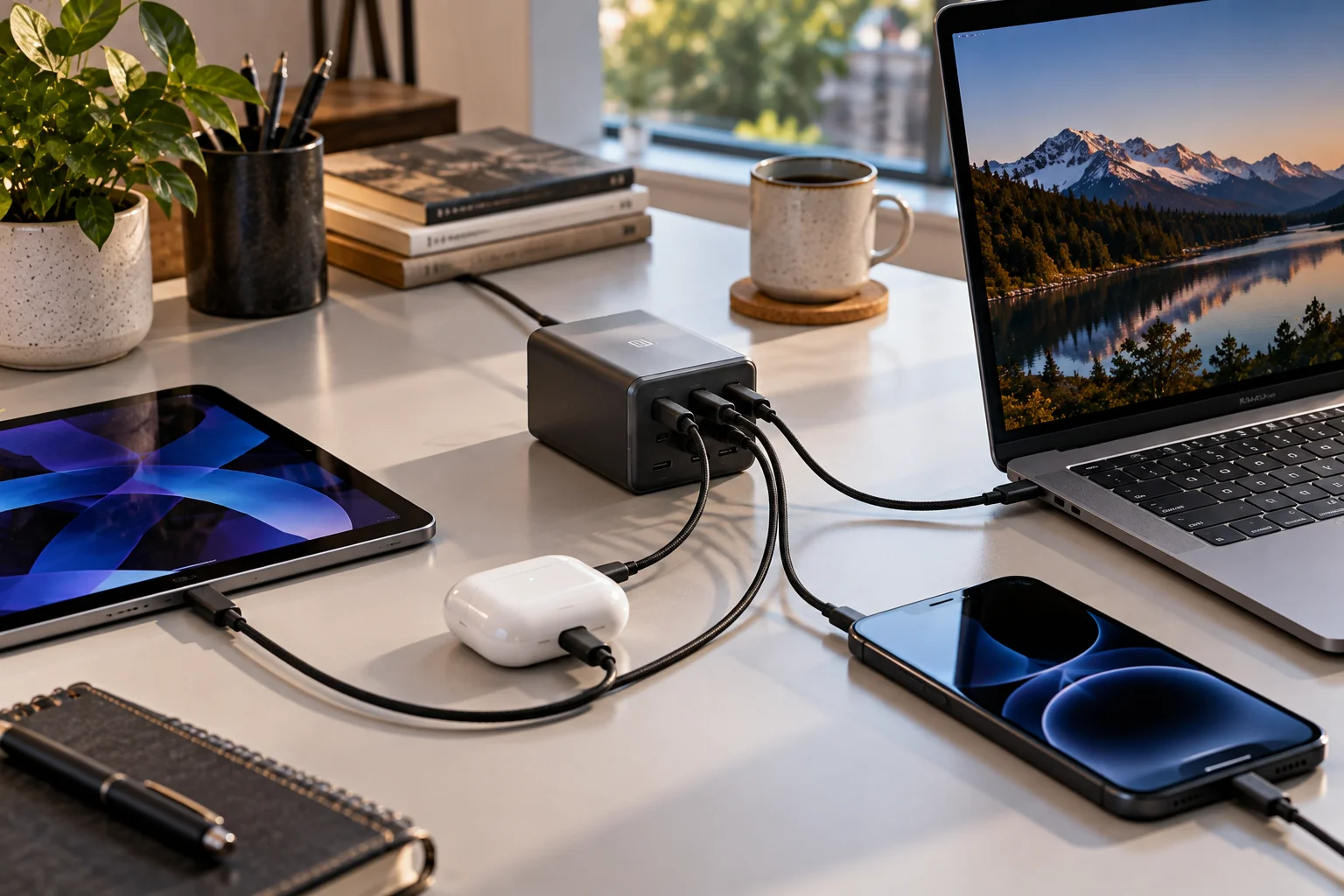
For example, a 100W multi-port charger might allocate power between a laptop and phone rather than delivering 100W independently to both.
The exact distribution can change depending on:
Which ports are occupied
Device power requests
Charger firmware
Thermal conditions
Manufacturer configuration
This is why you should check the power-allocation table in the specifications rather than assuming every port can simultaneously deliver its headline maximum.
USB PD itself is designed to let connected devices request the power they require.
Are GaN Chargers More Efficient Than Traditional Chargers?
GaN can improve power-conversion efficiency, but the actual efficiency of a charger depends on its complete circuit design.
It's tempting to assume:
GaN = automatically efficient
But that's too simplistic.
A charger is a system containing multiple conversion stages and control circuits.
Good thermal design, switching topology, transformer design, control algorithms and component quality all influence the final result.
Two GaN chargers can therefore have different efficiency and thermal characteristics.
The semiconductor material provides an advantage, but engineering determines how much of that advantage reaches the finished product.
Are GaN Chargers Safer?
A well-designed GaN charger from a reputable manufacturer can be safe, but GaN itself isn't a guarantee of safety.
A charger needs protection against conditions such as:
Over-voltage
Over-current
Short circuits
Over-temperature
Abnormal operating conditions
It also needs to meet the relevant electrical safety and compatibility requirements for its market.
USB-IF encourages consumers to choose compliant USB products from trusted sources and points buyers toward certified products and USB-IF logos where applicable.
The practical lesson is simple:
Don't choose a charger solely because the box says “GaN.”
Look at the manufacturer, certification information, output specifications, charging protocols and cable requirements.
Does a Higher-Wattage GaN Charger Damage a Phone?
A compatible higher-wattage USB-C charger does not normally force its maximum rated power into a device.
The charger advertises its available power capabilities, and compatible USB Power Delivery systems negotiate an appropriate power level.
A 100W USB PD charger can therefore be used with a phone designed to accept much less than 100W, assuming the charger and cable are compliant and compatible.
USB PD is specifically designed around negotiated power delivery, including low-power devices requesting only what they require.
That doesn't mean every cheap charger is safe. Poor-quality or non-compliant products remain a concern.
Do You Need a GaN Charger?
You don't need GaN to charge modern devices, but it becomes particularly useful if you want a compact charger capable of powering several devices or a laptop.

GaN makes the most sense if you:
Travel frequently
Carry a laptop and phone
Want one charger for several devices
Need 65W or more in a compact package
Want to reduce charger clutter
Prefer smaller power adapters
For a basic phone charger, the difference may be less dramatic.
A good conventional silicon charger can still perform perfectly well.
The biggest practical advantage appears when power requirements increase and physical size starts becoming inconvenient.
GaN vs Traditional Silicon Chargers
Feature | GaN charger | Traditional silicon charger |
|---|---|---|
Semiconductor | Gallium nitride | Silicon |
Switching capability | Very high | Lower |
Potential power density | Higher | Generally lower |
Size at high power | Often smaller | Often larger |
Heat losses | Can be lower | Can be higher |
Charging protocol | Depends on design | Depends on design |
USB PD support | Optional | Optional |
PPS support | Optional | Optional |
Maximum power | Depends on design | Depends on design |
Safety | Depends on implementation | Depends on implementation |
Faster charging automatically? | No | No |
The important phrase throughout this table is “depends on design.”
GaN is an enabling technology, not a guarantee of every desirable charger feature.
What Should You Look for When Buying a GaN Charger?
Choose the charger based on power requirements, USB PD/PPS support, port configuration and certification rather than GaN branding alone.
Check these specifications:
1. Maximum wattage
A phone may need 30W, while a laptop could need 65W, 100W or more.
2. USB PD support
This is particularly important for USB-C laptops and many modern fast-charging devices.
3. PPS support
If your device benefits from PPS, make sure the charger explicitly supports it.
4. Port allocation
A 100W charger doesn't necessarily provide 100W from every port.
5. Cable capability
High-power USB PD charging can require an appropriate USB-C cable. USB PD 3.1 introduced higher-power applications up to 240W with the corresponding cable and connector requirements.
6. Manufacturer and compliance
Don't sacrifice electrical safety to save a few dollars.
Frequently Asked Questions About GaN Chargers
What does GaN stand for?
GaN stands for gallium nitride, a semiconductor material used in power electronics.
Are GaN chargers better than normal chargers?
They can offer major advantages in size, power density and efficiency, particularly at higher power levels. But charger quality depends on the complete electrical design, not just whether it uses GaN.
Does GaN charge phones faster?
Not automatically. Charging speed depends on the device's maximum input power and the charging protocols supported by both the charger and device.
Can a GaN charger charge a laptop?
Yes. Many GaN chargers are specifically designed for laptop-class USB-C power levels, including 65W, 100W and higher.
Is 100W GaN safe for a 30W phone?
A compliant USB PD charger can provide a lower negotiated power level to a compatible phone rather than automatically forcing 100W into it.
Does GaN mean the charger won't get hot?
No. GaN can reduce losses and improve thermal performance, but any high-power charger can produce heat.
Is GaN the same as USB-C?
No. GaN describes semiconductor technology inside the charger. USB-C describes the connector and associated specifications. A GaN charger may use USB-C, but the two terms refer to different things.
The Bottom Line
GaN doesn't make electricity behave differently at the USB port. It makes the power-conversion hardware more efficient and compact.
That's why a modern 65W or 100W GaN charger can be dramatically smaller than older high-power adapters.
The real breakthrough is the combination of high-frequency GaN switching, improved power-conversion design, USB Power Delivery and compact thermal engineering.
And that's also why you shouldn't shop by the word “GaN” alone.
If you're choosing a charger, look at the complete specification: wattage, USB PD, PPS, port allocation, cable requirements, safety certification and manufacturer quality.
GaN is what helps put more power into a smaller box. USB PD and related charging technologies determine how that power is actually delivered.