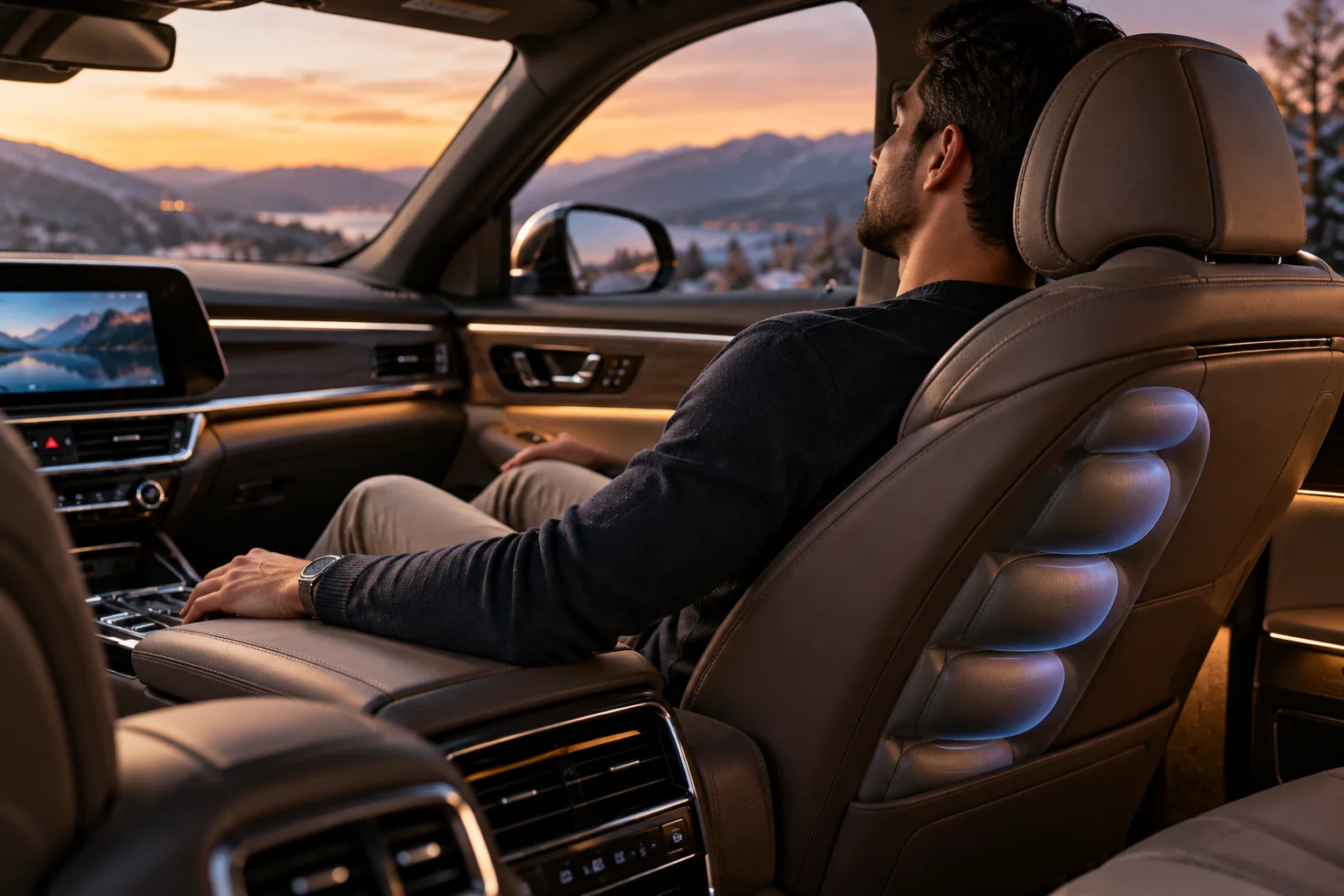
Car massaging seats are more than ordinary seats with a vibration motor attached underneath. Modern systems can use inflatable air chambers, vibration motors, electrically adjustable support elements and coordinated massage programs to create different sensations across your back, hips and thighs.
The exact mechanism depends on the vehicle.
Some seats use pneumatic bladders that inflate and deflate in sequence, creating pressure waves that move across the body. Others use electric vibration motors. More sophisticated multi-contour seats can combine several technologies and adjust different areas independently.
Mercedes-Benz, for example, currently uses pulsating air chambers in the lumbar area for some massage functions, while its higher-end seats can extend the massage effect across the backrest. Other Mercedes systems use vibration motors in the seat cushion.
That's why one car's “massage” can feel like gentle pressure moving up your back while another feels more like a series of vibrations.
What Are Car Massaging Seats?
Car massaging seats are electrically controlled seats that create programmed pressure or movement against the occupant's body to produce a massage-like sensation.
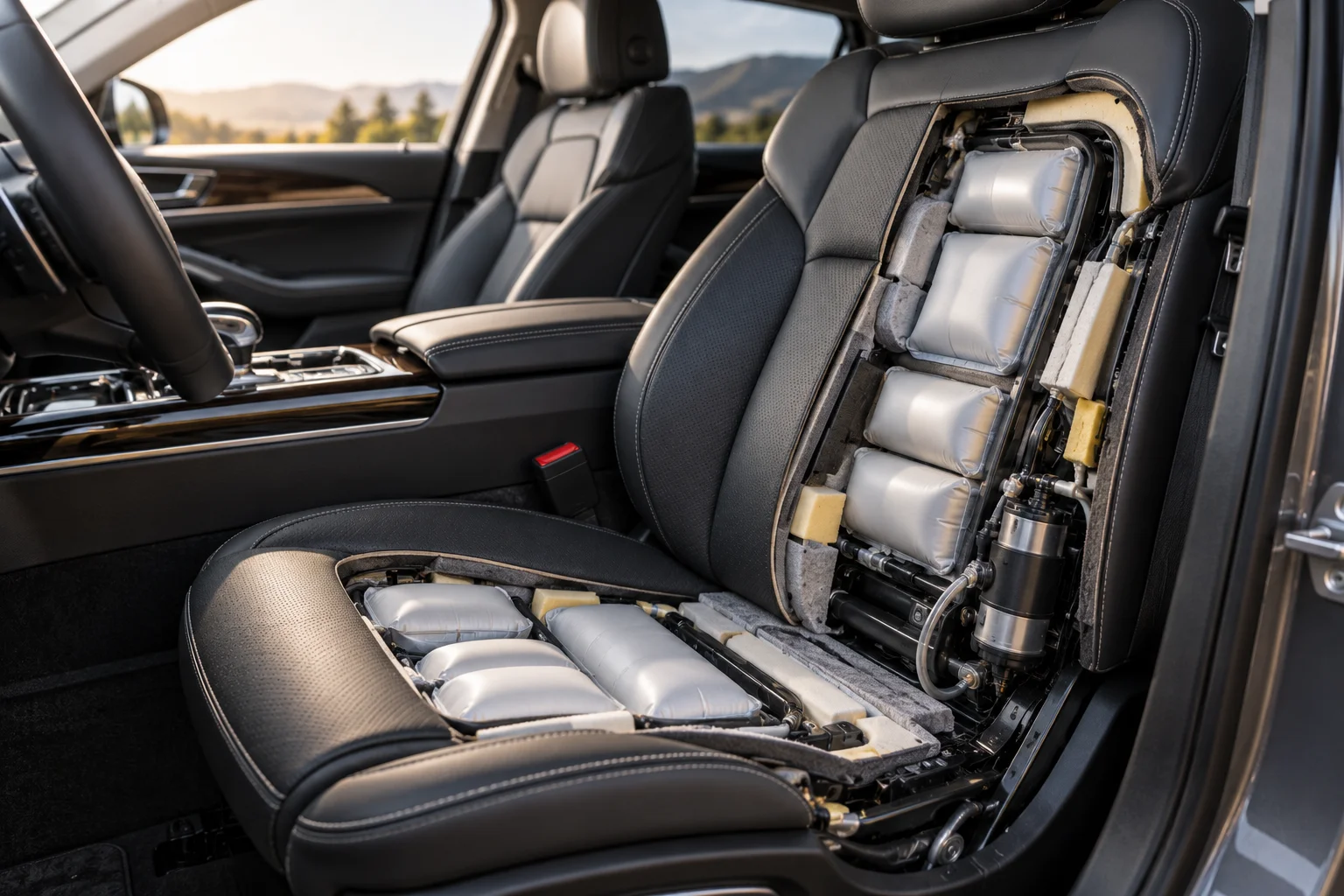
The system is generally built into the seat rather than being a separate massage device.
Depending on the design, the seat may contain:
Air-filled chambers
Small electric motors
Pressure-control valves
Pumps
Seat-position motors
Electronic control modules
Heating elements
Ventilation components
Contoured support structures
Ford's Multi-Contour seats, for example, have used multiple inflatable cushions to create a massaging effect across areas including the thighs, seat and lower back.
Modern systems can therefore behave more like a programmable mechanical system than a simple vibrating cushion.
How Do Car Massage Seats Actually Work?
The basic idea is to create controlled changes in pressure or movement at different points in the seat.
A pneumatic system might work like this:
Pump → air valve → chamber inflates → pressure increases → chamber deflates → next chamber activates
By repeating that sequence across several chambers, the system can create the sensation of a massage wave traveling through the seat.
Mercedes-Benz describes current massage systems that use pulsating air chambers in the lumbar region, while extended versions can operate across the seatback.
Another approach uses vibration motors.
In that case:
Motor → vibration → seat structure → body
The motors can be activated individually or in programmed sequences to produce different patterns.
Mercedes-Benz's current Maybach GLS, for example, uses vibration massage in the seat cushions, demonstrating that not every modern automotive massage system relies on inflatable chambers.
What Are the Air Chambers Inside a Massage Seat?
Air chambers are flexible pockets embedded within the seat cushion or backrest.
When the control system sends air into one of these chambers, it expands and pushes against the upholstery. Releasing the air reduces that pressure.
Several chambers can operate independently.
Imagine five chambers arranged vertically along your back:
1 → 2 → 3 → 4 → 5
If they inflate and deflate sequentially, you can feel what seems like a pressure wave moving upward.
Reverse the sequence:
5 → 4 → 3 → 2 → 1
and the sensation can travel in the opposite direction.
This is one reason manufacturers can offer different massage programs without physically moving a mechanical roller through the seat.
Do Car Massage Seats Have Motors?
Some do, but the motors aren't necessarily the part creating the massage sensation.
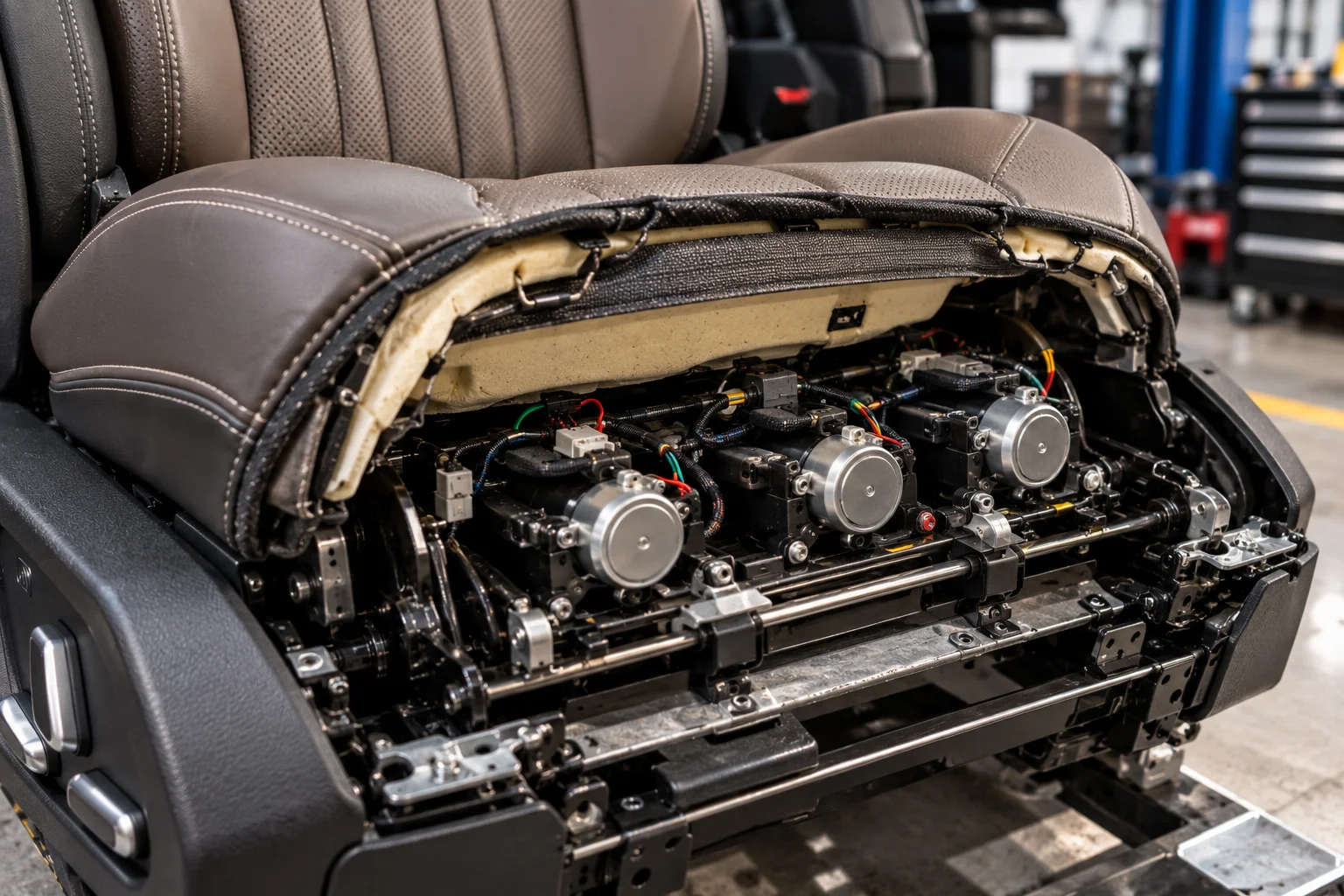
A pneumatic system can use an electric pump and electronically controlled valves to operate air chambers. The pump supplies the air, while valves determine which chamber receives or releases it.
Other seats use dedicated vibration motors.
Mercedes-Benz's S-Class documentation, for example, describes massage programs using vibration motors, while also combining massage with inflatable air chambers and seat heating for certain programs.
So when someone asks, “What motor is inside a massage seat?”, the answer depends on the design.
The seat may contain several motors for adjustment and separate hardware for the actual massage function.
How Do Different Massage Programs Work?
Massage programs are essentially different control sequences.
The hardware may remain the same while the software changes:
Which chamber activates
How strongly it inflates
How long it remains active
The order of activation
Which areas receive pressure
Whether heat is added
Whether the seat cushion or backrest moves
Mercedes-Benz offers programs such as Classic Massage, Wave Massage and Mobilizing Massage on some vehicles. Its documentation describes Wave Massage as massage waves moving through the back and seat cushion, while other programs use different movement patterns.
That means “massage mode” isn't necessarily a completely different mechanical system.
It's often a different recipe for controlling the same hardware.
Why Does a Car Massage Feel Like Pressure Moving Up Your Back?
The sensation comes from sequential activation of different areas of the seat.
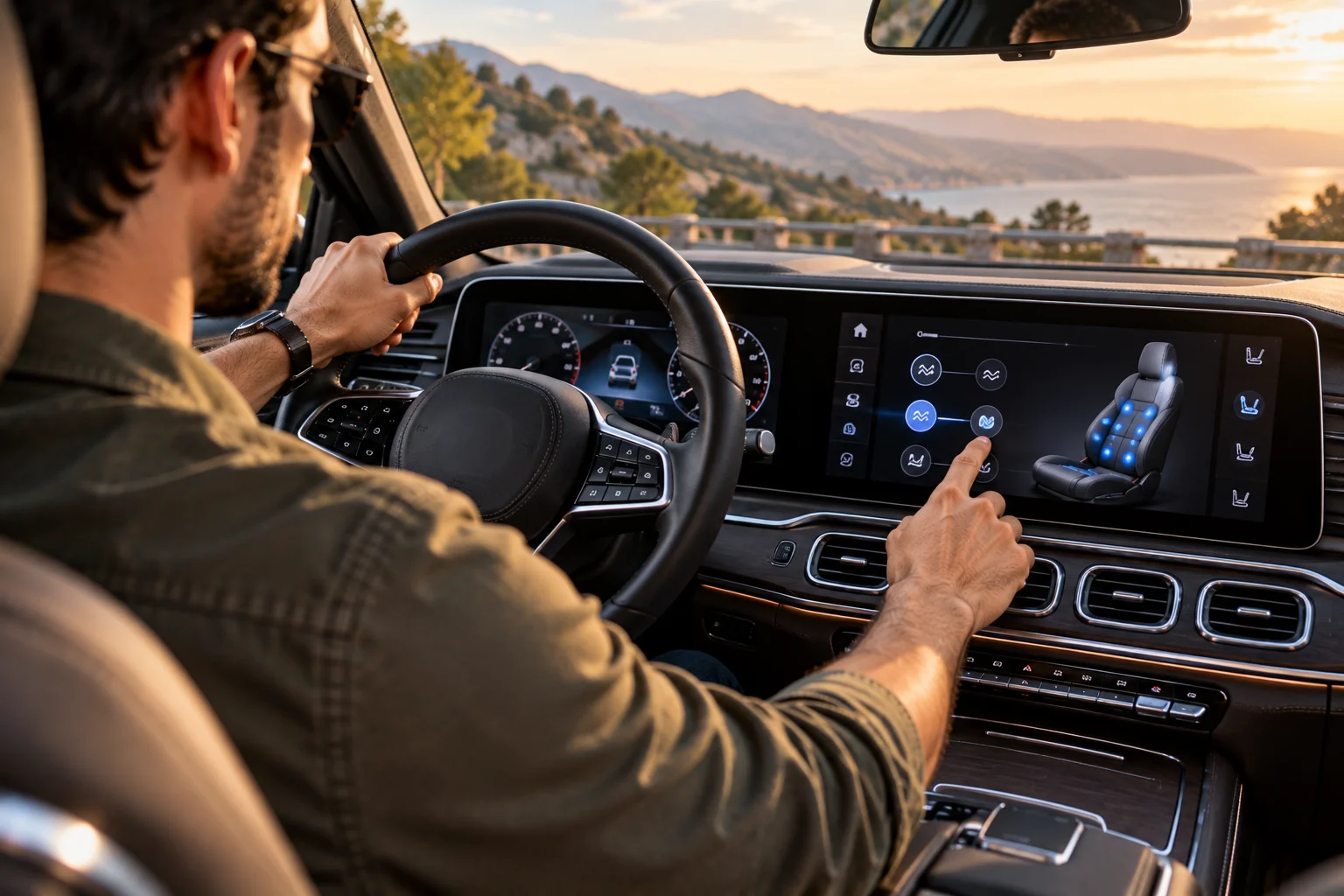
Suppose the seat contains several air chambers behind your back.
If the lower chamber inflates first, you feel pressure around your lower back. When it deflates and the chamber above it activates, the pressure appears to move upward.
Your body interprets the changing pressure as movement.
The seat doesn't necessarily contain something physically rolling from your lower back to your shoulders.
Instead:
Pressure location changes → your brain perceives movement.
This is one of the clever aspects of pneumatic massage-seat design.
Do Car Massage Seats Actually Move?
Some do.
There are two different ideas that are sometimes grouped together under the same comfort features.
Massage: creates pressure or vibration against the body.
Seat kinetics: physically changes the position or angle of parts of the seat.
Mercedes-Benz's current ENERGIZING seat-kinetics system, for example, makes small changes to the tilt of the seat cushion and backrest rather than simply inflating massage chambers.
These movements can be combined with massage, heating, ventilation and other comfort functions.
So a sophisticated seat may not just “massage” you. It can continuously make small adjustments to how your body is supported.
Why Do Some Massage Seats Feel Stronger Than Others?
The sensation depends on several factors:
Number of air chambers or motors
Chamber size and position
Maximum air pressure
Motor strength
Massage sequence
Seat upholstery
Seat shape
Your body size and position
Available intensity settings
A system with more independently controlled zones can create more complex patterns.
But more hardware doesn't automatically mean a better experience. The location of the pressure points and how the system's control software uses them matter just as much.
Can Massage Seats Combine Heat With Massage?
Yes. Some premium systems combine seat heating with massage programs.
The combination can make the massage feel different because warmth changes the overall sensation of the seat.
Mercedes-Benz's current systems include programs that combine massage and heat, while its S-Class documentation describes “Hot Relaxing” programs that combine heat with massage.
This is generally an integrated comfort function rather than a separate heating pad placed on top of the massage system.
Can Car Massage Seats Adjust to Your Body?
Some advanced seats can provide more personalized support through adjustable contours.
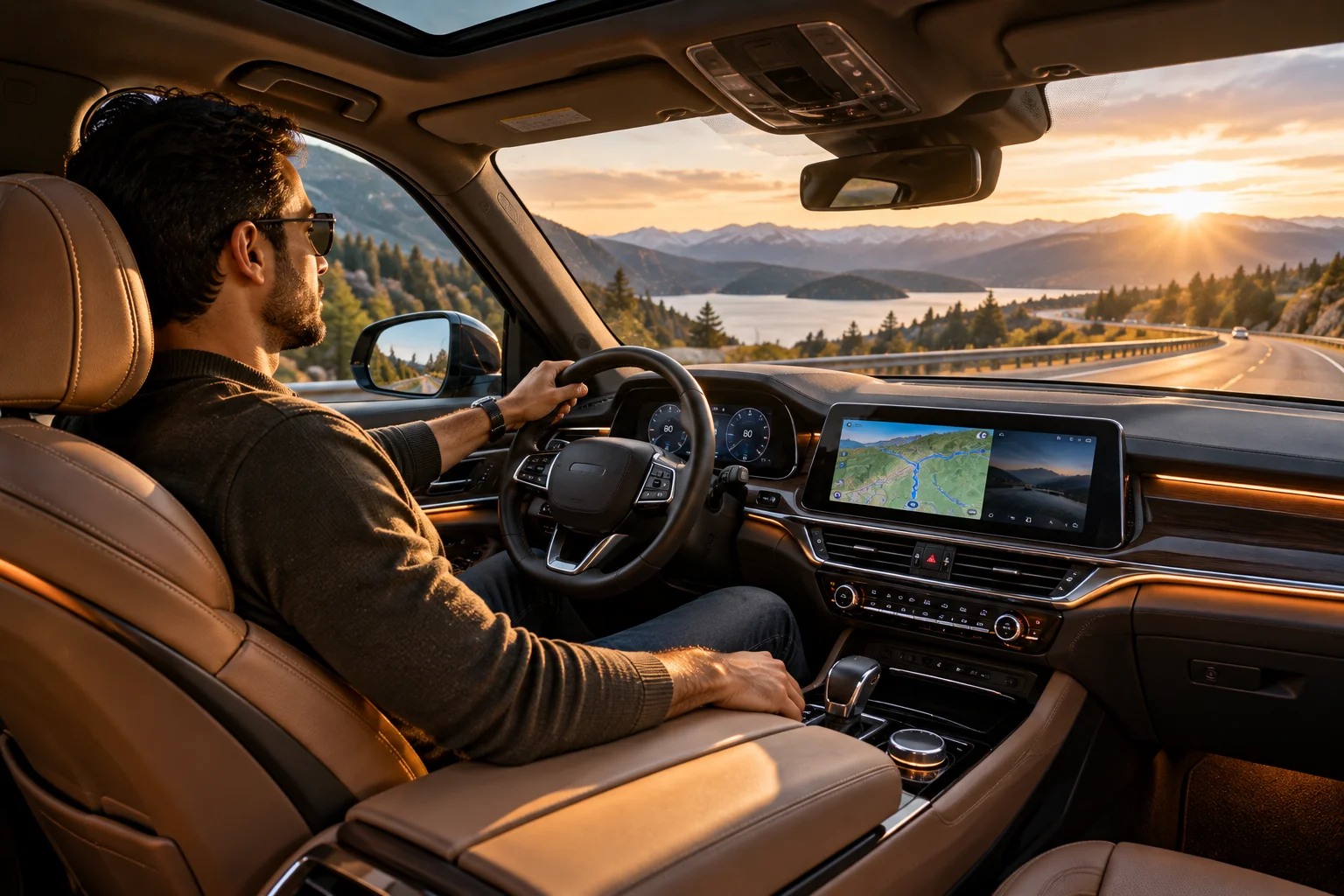
Multi-contour seats can change lumbar support and side bolsters, while electric seat adjustments establish the basic position of the occupant.
Mercedes-Benz currently describes electro-pneumatic four-way lumbar support that adapts the backrest to the natural curvature of the spine.
However, this doesn't necessarily mean the massage program is scanning your entire body in real time.
In most systems, personalization comes from adjustable seat geometry, stored driver profiles and selectable massage settings rather than continuous medical-style body mapping.
Are Car Massaging Seats the Same as a Massage Chair?
No.
A dedicated massage chair can use larger mechanical mechanisms designed specifically for massage, including rollers and more extensive body coverage.
A car seat has to perform several jobs simultaneously:
Support your body + protect you in a crash + allow driving controls + provide heating/ventilation + provide massage
That puts significant constraints on its design.
Automotive massage seats therefore tend to use compact pneumatic systems, vibration motors and carefully integrated support structures rather than the large mechanisms found in some dedicated massage chairs.
Are Car Massaging Seats Useful on Long Drives?
They can make long journeys more comfortable, particularly because the system can periodically change the pressure points against your body.
The value isn't simply the massage sensation itself.
A well-designed seat can combine:
Proper lumbar support
Adjustable cushioning
Heating
Ventilation
Massage
Small changes in seat position
Mercedes-Benz specifically describes its high-end seats as being designed for long-distance comfort and combines massage with adjustable lumbar support and other comfort functions.
However, a massage function shouldn't be considered a substitute for taking appropriate breaks during a long journey.
FAQs About Car Massaging Seats
Do car massage seats use real rollers?
Usually not. Many automotive systems use inflatable air chambers or vibration motors rather than the large mechanical rollers found in dedicated massage chairs.
How does a pneumatic car massage seat work?
A pump and electronically controlled valves inflate and deflate different air chambers inside the seat. Activating the chambers in sequence creates changing pressure against the body.
Can you control the intensity?
Many systems offer selectable massage programs and intensity settings, although the controls vary by manufacturer and vehicle.
Do massage seats use a lot of electricity?
They use electrical power to operate pumps, valves, motors and control electronics, but they are designed to operate within the vehicle's electrical system. The actual power consumption varies significantly by design.
Can the driver use the massage function while driving?
In vehicles that provide driver-seat massage, the feature may be designed for use while driving. However, the driver should always prioritize safe vehicle control and follow the vehicle's instructions regarding available comfort functions.
The Bottom Line
Car massaging seats work by creating controlled pressure, vibration or movement inside the seat.
Pneumatic systems use inflatable air chambers that can expand and contract in sequence. Vibration-based systems use small motors to create carefully controlled movements. More sophisticated seats combine these technologies with adjustable lumbar support, heating, ventilation and changing seat geometry.
The important part is that the seat doesn't need a conventional massage mechanism like a human therapist or a large massage-chair roller.
Instead, software controls a network of small mechanical components, changing where pressure or vibration is applied and how quickly the pattern moves.
That's what allows one seat to offer multiple programs such as wave, classic, relaxing or mobilizing massage without requiring a completely different mechanism for each mode.