
The way people build professional skills has changed considerably. Learning no longer has to happen inside a classroom, during a fixed semester, or through a traditional degree program.
Today, someone can learn data analysis before work, study digital marketing during a lunch break, practice coding in the evening, or complete a professional certificate over several weekends.
That flexibility has made Online learning an increasingly important part of professional development.
In 2026, the biggest change is not simply the number of courses available. Learning platforms are becoming more personalized, interactive, and closely connected to the skills employers actually use. Artificial intelligence is also becoming part of the learning experience, helping learners search for information, practice concepts, summarize material, and receive additional guidance.
But having thousands of courses available does not automatically make learning easier.
The real challenge is choosing a platform that matches a person's goals, experience level, budget, schedule, and preferred learning style.
Why Online Learning Matters for Upskilling

Upskilling means developing new abilities that can improve someone's effectiveness in an existing role or prepare them for a different opportunity.
For some learners, that could mean learning Excel or project management.
For others, it might involve artificial intelligence, cybersecurity, software development, data science, design, finance, or digital marketing.
Online learning makes this process more accessible because learners can choose courses around their existing schedules.
Instead of committing to a fixed timetable, they can often learn in shorter sessions and return to the material when convenient.
This is particularly useful for working professionals.
A person with a full time job may not have several hours every day available for formal education. A flexible online course can make it easier to divide learning into manageable sessions.
What Makes a Good Learning Platform?

The number of courses available is only one factor.
A useful platform should make it relatively easy to discover appropriate material, understand the expected difficulty, follow a structured learning path, and measure progress.
Important factors include:
Course quality
Look for clear explanations, current examples, practical exercises, and instructors with relevant expertise.
Learning format
Some people learn best from video lessons. Others prefer reading, projects, quizzes, coding exercises, or interactive simulations.
Skill level
A beginner course can be frustrating for an experienced professional, while an advanced course may overwhelm someone who is just starting.
Practical application
The strongest upskilling programs generally connect concepts with real tasks rather than focusing exclusively on theory.
Credentials
Certificates can be useful for documenting completed training, but their value depends on the provider, subject, employer, industry, and the learner's broader experience.
Flexibility
Self paced courses can work well for busy professionals, while scheduled programs can provide more structure and accountability.
Coursera: Structured Learning and Professional Development
Coursera is one of the major platforms in the online education market.
Its catalog includes courses, professional certificates, guided learning experiences, and degree related programs from universities and organizations.
One of the platform's strengths is the breadth of subjects available.
Learners can explore areas such as:
• Business
• Computer science
• Data science
• Artificial intelligence
• Information technology
• Personal development
• Marketing
• Project management
• Health related subjects
For professionals, structured certificate programs can provide a clearer learning path than selecting unrelated individual courses.
Coursera can therefore be particularly relevant for someone who wants to build a defined skill area rather than simply watch educational videos.
Udemy: A Broad Marketplace for Practical Skills
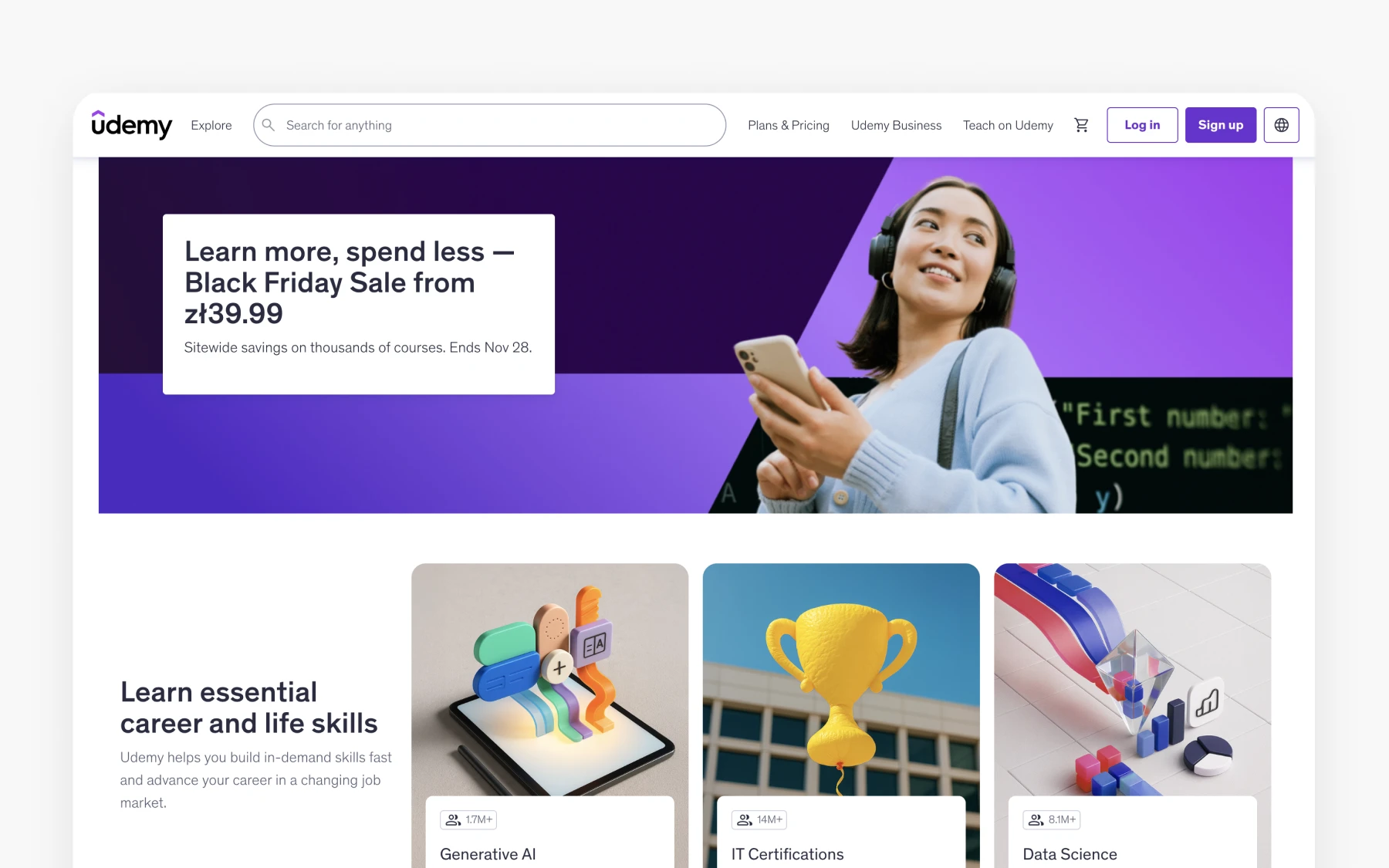
Udemy takes a different approach.
Rather than focusing primarily on university and institutional partnerships, Udemy operates as a broad course marketplace where instructors publish courses across a large range of subjects.
This makes the platform particularly useful for learners looking for specific practical skills.
Popular areas include:
• Programming
• Microsoft Excel
• Business
• Design
• Marketing
• Photography
• Personal development
• Data analysis
• Artificial intelligence
The marketplace model also means course quality and teaching style can vary.
Before enrolling, learners should examine the course description, curriculum, instructor information, ratings, reviews, and the date of the most recent update.
That simple research step can make a major difference when selecting between several courses covering the same subject.
LinkedIn Learning: Skills Connected to the Workplace
LinkedIn offers LinkedIn Learning as part of its professional education ecosystem.
The platform focuses heavily on workplace skills.
Courses cover areas such as business, technology, creative skills, leadership, communication, productivity, and software.
This can make it useful for professionals who want to develop skills that connect directly with their current responsibilities.
For example, someone working in marketing might study analytics, presentation skills, project management, content creation, or advertising tools.
Someone moving toward a management role could explore leadership, communication, delegation, and team management.
The connection between professional identity and learning can also make the platform useful for people who want to document completed learning on their professional profile.
edX: University Style Online Education
edX provides online courses and programs from universities and other educational institutions.
The platform can appeal to learners who prefer academically structured material.
Subjects span technology, business, data, science, engineering, and other disciplines.
For someone considering a career change, university associated learning can provide useful foundations before committing to a longer educational program.
The main consideration is time.
Some advanced programs require a more substantial commitment than a short skills course.
Learners should therefore distinguish between a quick introduction to a topic and a structured academic program designed to develop deeper expertise.
Pluralsight: Technology and Developer Skills

Pluralsight is focused heavily on technology and professional technical skills.
Its learning ecosystem covers areas such as software development, cloud computing, cybersecurity, data, IT operations, and related technologies.
This specialization can be useful for professionals who already know that their upskilling goal is technical.
A developer, for example, may want to learn a new programming language or cloud technology without working through a broad general education catalog.
Technology changes quickly, so learners should pay particular attention to course freshness.
A programming course based on an older software version may not provide the same practical value as current material.
Skillshare: Creative and Practical Learning
Skillshare is particularly associated with creative and practical subjects.
Courses cover areas such as design, illustration, photography, writing, freelancing, marketing, and creative entrepreneurship.
This type of platform can be useful for learners who prefer project oriented education.
For example, rather than simply studying graphic design principles, a learner might follow a class that involves creating an actual design project.
Project based learning can make it easier to connect theory with practical output.
That can be particularly valuable for freelancers and creative professionals building portfolios.
Google and Microsoft Learning Resources

Not all valuable Online learning resources follow the traditional course marketplace model.
Technology companies such as Google and Microsoft provide their own learning ecosystems.
Microsoft Learn offers training and documentation around Microsoft products, cloud technologies, development, data, security, and related areas.
Google provides learning resources and career focused programs covering areas such as data analytics, cybersecurity, digital marketing, IT support, and other professional skills.
These resources can be especially useful when the learner wants to understand a specific technology ecosystem.
For technical professionals, first party learning material can also help because it is closely connected to the products and services being taught.
AI Is Changing Online Learning in 2026
Artificial intelligence is becoming one of the most important developments in Online learning.
Traditionally, a learner might watch a lesson and then search elsewhere when something was unclear.
AI can potentially provide another layer of support.
Depending on the platform, AI may help learners:
• Summarize complicated concepts
• Generate practice questions
• Explain difficult terminology
• Provide examples
• Help identify learning gaps
• Assist with revision
• Suggest related topics
• Provide feedback on certain types of work
The important limitation is accuracy.
AI generated explanations should not automatically be treated as authoritative. Learners should verify important information against course material, documentation, textbooks, or other reliable sources.
The most useful role for AI may therefore be as a learning assistant rather than a replacement for high quality instruction.
Online Learning for Career Changes

Upskilling and career changing are related but not identical.
Upskilling usually strengthens capabilities within an existing professional direction.
Career changing can require a much broader learning plan.
For example, someone working in marketing who wants to move into data analytics may need more than one short course.
A sensible path could include:
Learning basic statistics
Building spreadsheet skills
Learning SQL
Studying data visualization
Practicing with real datasets
Building portfolio projects
Learning how to communicate analytical findings
The platform matters, but the learning sequence matters just as much.
A collection of certificates without practical ability may not demonstrate the same capability as a smaller number of courses combined with strong projects.
Certificates vs Practical Skills
Certificates can be useful, but learners should understand what they represent.
A certificate generally demonstrates that someone completed a particular learning experience. It does not automatically prove mastery of every skill covered by the course.
For employers, actual ability can matter considerably.
A person applying for a design position might benefit from a portfolio.
A developer may need working projects.
A data analyst may need examples of analysis and visualization.
A project manager may need evidence of managing real projects.
The strongest Online learning strategy often combines structured education with demonstrable work.
How to Choose the Right Online Learning Platform
Instead of choosing a platform simply because it is popular, start with the learning objective.
Define the skill
Be specific.
“Learn AI” is broad.
“Learn how to use generative AI for marketing research” is much more actionable.
Choose the appropriate level
Check whether the course expects previous knowledge.
Examine the curriculum
Look beyond the course title.
Review the actual lessons and projects.
Check instructor expertise
Consider professional background, teaching experience, reviews, and recent activity.
Look at course freshness
Technology and professional practices can change quickly.
Consider the learning format
Choose between video, reading, projects, quizzes, labs, live classes, or a combination.
Check the credential
Understand whether the certificate is simply a course completion record or part of a larger professional credential.
Calculate the complete cost
Consider subscription fees, individual course prices, certificates, assessments, and any additional resources required.
Building a Sustainable Learning Routine
The biggest obstacle to Online learning is often not access.
It is consistency.
A person can have access to thousands of courses and still make little progress without a practical routine.
A simple approach is to establish a realistic weekly schedule.
For example:
• Two weekday sessions for lessons
• One session for practice
• One weekend session for a project
• A short review session at the end of the week
The exact schedule is less important than consistency.
Learning also becomes easier when every course has a defined purpose.
Instead of enrolling in five unrelated classes, choose one skill and complete enough material to apply it.
Creating a Personal Upskilling Roadmap
A useful learning roadmap can follow four stages.
Stage One: Identify the Goal
Decide what capability you want to develop and why.
Stage Two: Build the Foundation
Start with beginner or intermediate material depending on your existing knowledge.
Stage Three: Practice
Use projects, exercises, simulations, or real work to apply what you have learned.
Stage Four: Demonstrate the Skill
Create something that shows what you can do.
This might be a portfolio, project, case study, presentation, technical demonstration, or work sample.
This final stage is particularly important because learning becomes more valuable when it can be translated into practical ability.
A Practical Comparison
Platform | Strong area | Learning style | Useful for |
|---|---|---|---|
Coursera | Professional and academic learning | Structured courses and programs | Career development |
Udemy | Broad practical skills | Individual courses | Specific skills |
LinkedIn Learning | Workplace skills | Short professional courses | Working professionals |
edX | University style education | Courses and programs | Academic and technical learning |
Pluralsight | Technology | Technical learning paths | Developers and IT professionals |
Skillshare | Creative skills | Project based classes | Designers and creative professionals |
Microsoft Learn | Microsoft technologies | Guided learning and documentation | Technical professionals |
Google learning resources | Technology and career skills | Courses and professional training | Career development |
This table is intended as a starting point rather than a universal ranking. The right platform depends on the subject, learning level, preferred format, budget, and desired outcome.
Common Online Learning Mistakes
Enrolling in Too Many Courses
More courses do not necessarily mean more learning.
Watching Without Practicing
Passive consumption can create the feeling of progress without developing usable skills.
Choosing Based Only on Certificates
A certificate can document completion, but practical ability still matters.
Ignoring Course Dates
Older material can be problematic in rapidly changing fields.
Skipping Projects
Practical work helps turn knowledge into capability.
Learning Without a Goal
A clearly defined objective makes it easier to choose relevant courses and decide when learning is complete.
The Future of Online Learning
Online learning is likely to become increasingly personalized.
Instead of every learner following exactly the same sequence, AI systems may increasingly recommend lessons based on existing knowledge, performance, goals, and areas of difficulty.
Interactive simulations may also become more common.
A learner studying cybersecurity could practice responding to simulated incidents. A business student could work through realistic decision scenarios. A developer could solve programming problems inside the learning environment.
This creates an important shift.
The future of Online learning is not simply about watching more videos.
It is about creating more useful interactions between learners, instructors, software, practical exercises, and intelligent learning assistants.
Human expertise will remain important, particularly for subjects requiring professional judgment, nuanced feedback, and real world experience.
Final Thoughts
The best Online learning platform is not necessarily the one with the largest course catalog.
It is the one that helps you move from a specific learning goal to practical capability.
Coursera can provide structured professional and academic learning. Udemy offers a broad marketplace of practical courses. LinkedIn Learning focuses heavily on workplace skills. edX provides university associated education. Pluralsight specializes in technology. Skillshare emphasizes creative learning, while technology companies such as Microsoft and Google provide specialized training ecosystems.
The right choice depends on what you want to learn and how you prefer to learn it.
In 2026, AI is making the experience even more flexible by providing additional assistance with explanations, practice, research, and personalization. But technology does not replace the fundamentals of effective learning.
Set a clear goal.
Choose appropriate material.
Practice what you learn.
Build something with the knowledge.
Then use that experience to identify the next skill worth developing.
That approach can turn Online learning from a collection of courses into a long term professional development strategy.
Frequently Asked Questions
What is the best platform for Online learning?
There is no single platform that is best for every learner. The right option depends on the subject, experience level, learning format, budget, and career objective.
Which Online learning platform is good for professional development?
Platforms such as Coursera, LinkedIn Learning, Udemy, and edX offer professional learning options. The most appropriate choice depends on the specific skill and the type of credential or practical experience you want to develop.
Are online certificates worth it in 2026?
Certificates can help document completed education, but their value varies by provider, subject, employer, and industry. Practical skills and demonstrable work can be equally or more important for many roles.
Can AI replace online instructors?
AI can provide explanations, practice exercises, summaries, and personalized assistance, but it does not completely replace the expertise, feedback, context, and mentorship that human instructors can provide.
How can I stay motivated while learning online?
Set a specific goal, create a realistic weekly schedule, study in manageable sessions, practice regularly, and work toward a tangible project or outcome.
Is Online learning suitable for beginners?
Yes. Many platforms offer beginner courses. The key is to check prerequisites and choose material that matches your current knowledge.
How many courses should I take at once?
For most learners, focusing on one primary skill at a time can make it easier to maintain momentum and complete practical work rather than collecting unfinished courses.