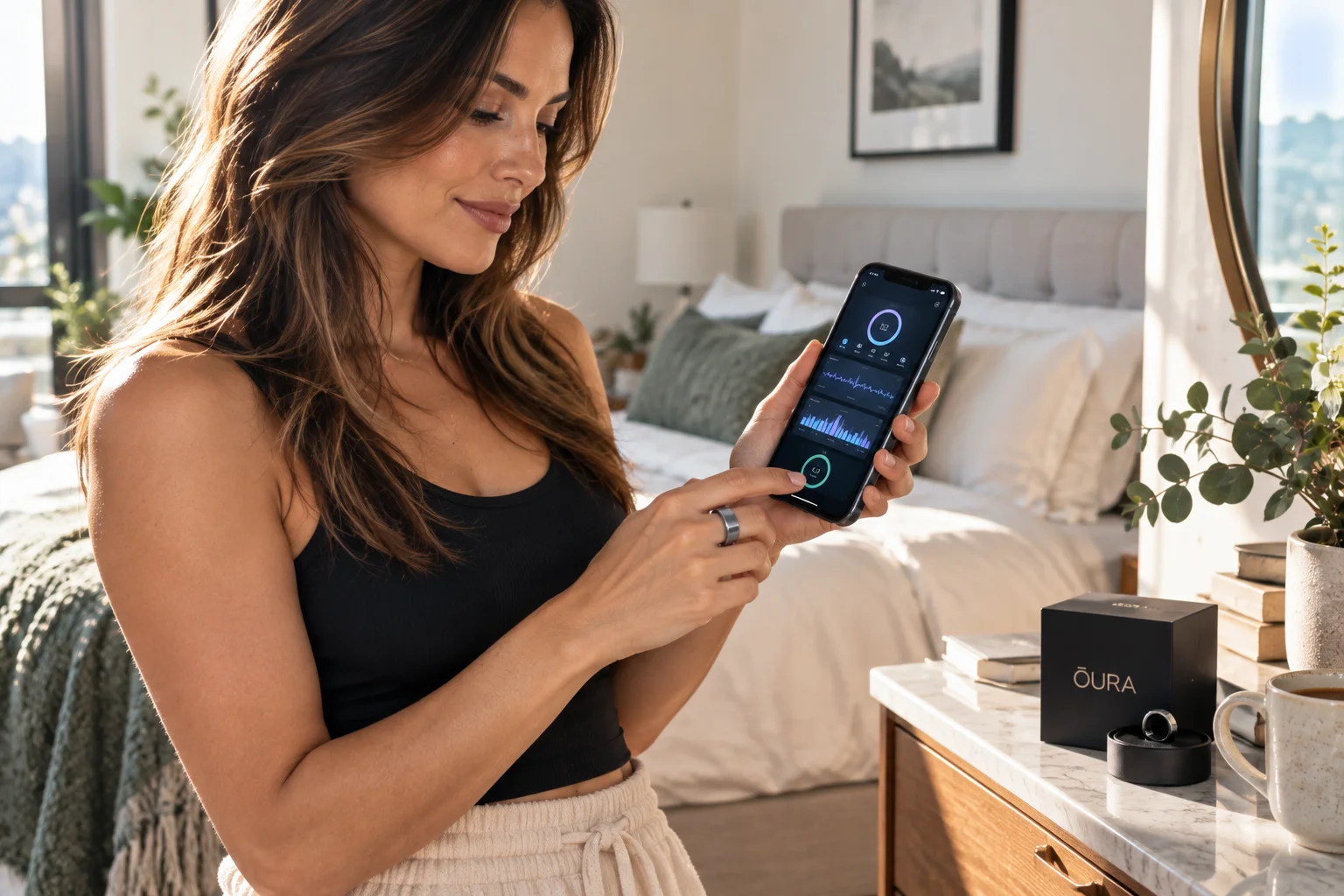
A smart ring looks almost too simple to be a serious fitness tracker. There’s no large display, no obvious buttons and barely enough space to notice the electronics inside.
Yet modern smart rings can collect a surprising amount of information.
Depending on the model, a smart ring can track heart rate, heart rate variability, blood oxygen, skin temperature, movement, sleep patterns, workouts and other wellness metrics. It does this through a combination of optical sensors, temperature sensors, accelerometers and software that turns raw signals into estimates about sleep, recovery and activity. (ouraring.com)
The important word here is estimates.
A smart ring doesn't directly measure "stress" or "sleep quality" as a single physical quantity. It collects signals from your body and movement, then algorithms interpret those signals.
That makes the technology fascinating, but it also means you should understand what is actually being measured before treating every number on the app as a precise measurement.

What a smart ring can track | How it generally works |
|---|---|
Heart rate | Optical sensors |
Heart rate variability | Optical heart-rate data |
Blood oxygen | Red/infrared optical sensing |
Skin temperature | Temperature sensor |
Movement | Accelerometer |
Sleep duration | Movement + physiological signals |
Sleep stages | Algorithmic estimates |
Activity | Movement + heart-rate data |
Recovery | Combination of physiological metrics |
Stress | Algorithmic interpretation of physiological signals |
Workouts | Movement + heart-rate data, depending on model |
What sensors are inside a smart ring?
The tiny size of a smart ring makes its sensor technology particularly interesting.
Different manufacturers use different hardware, but modern smart rings can contain several types of sensors working together.
The main sensor categories are optical sensors, temperature sensors and motion sensors.
Optical sensors use light to detect changes associated with blood flow. Motion sensors detect movement and position. Temperature sensors monitor changes at or around the skin.
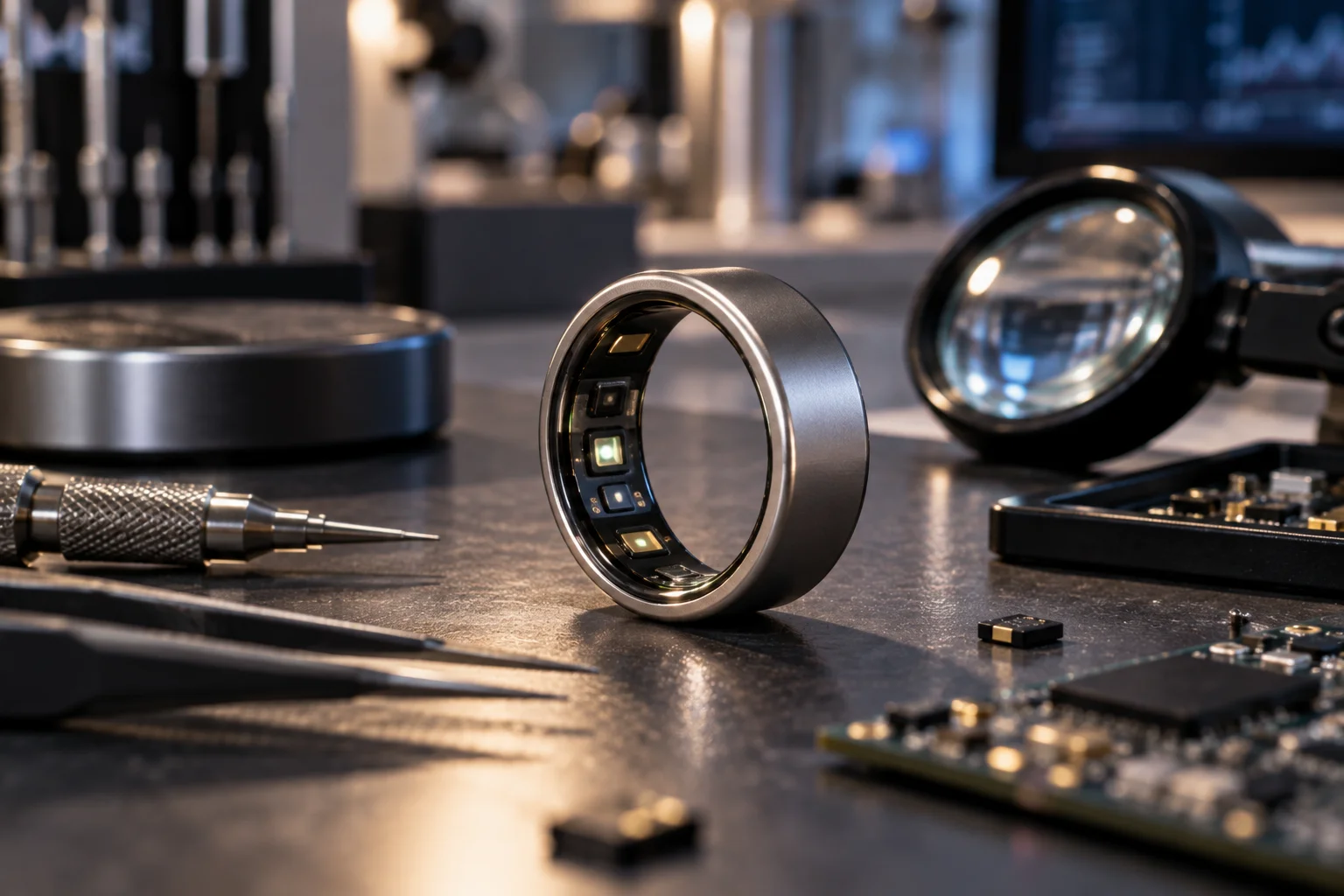
For example, Oura's current Ring 4 uses a redesigned sensing platform with infrared LED sensors for blood oxygen measurements, red and infrared LEDs for heart-rate signals, a digital temperature sensor and an accelerometer. (ouraring.com)
The individual components are useful, but the real value comes from combining them.
A heart-rate reading by itself tells you one thing.
Heart rate + movement + temperature + sleep timing can tell a much more interesting story about your day.
How does a smart ring measure heart rate?
Most smart rings use photoplethysmography, or PPG, to estimate heart rate.
The basic idea is surprisingly elegant.
Tiny LEDs shine light into the skin, while sensors measure how that light changes as blood volume changes with each heartbeat. The software then processes those fluctuations to estimate your pulse.
Smart rings can use this information throughout the day and during sleep, although measurement frequency and capabilities vary between products.
Oura, for example, says Ring 4 uses green and red/infrared LEDs for heart-rate sensing and can collect heart-rate data throughout the day and night. (ouraring.com)
That continuous background monitoring is one of the main reasons rings can be useful for long-term trends.
Can a smart ring measure heart rate variability?
Yes. Many advanced smart rings track heart rate variability, or HRV.
HRV isn't your heart rate. It refers to variations in the time interval between successive heartbeats.
Rather than simply saying your heart is beating at 60 beats per minute, HRV looks at how those individual beat-to-beat intervals vary.
Smart rings can use optical heart-rate signals to estimate HRV, particularly during periods when you're relatively still, such as sleep.
Oura says its readiness metrics incorporate overnight HRV alongside other measurements. (ouraring.com)
The useful part isn't necessarily comparing your HRV with someone else's.
Your own long-term baseline is generally more informative.
Can a smart ring measure blood oxygen?
Some smart rings can estimate blood oxygen saturation, commonly referred to as SpO2.
This is another optical measurement. Sensors use different wavelengths of light to estimate the proportion of oxygenated and deoxygenated haemoglobin in the blood.
For example, Oura Ring 4 uses red and infrared LEDs for blood oxygen sensing and reports blood oxygen-related metrics through its app. (ouraring.com)
However, consumer wearable readings shouldn't automatically be treated as equivalent to measurements from medical equipment.
Fit, movement, circulation and other factors can influence readings.
For everyday wellness tracking, trends can be interesting. For medical decisions, a wearable should not replace appropriate clinical equipment or professional advice.
What does a smart ring track during sleep?
Sleep is arguably where smart rings become most interesting.
Unlike a smartwatch, a ring is small, unobtrusive and doesn't have a bright screen constantly reminding you that you're wearing technology.
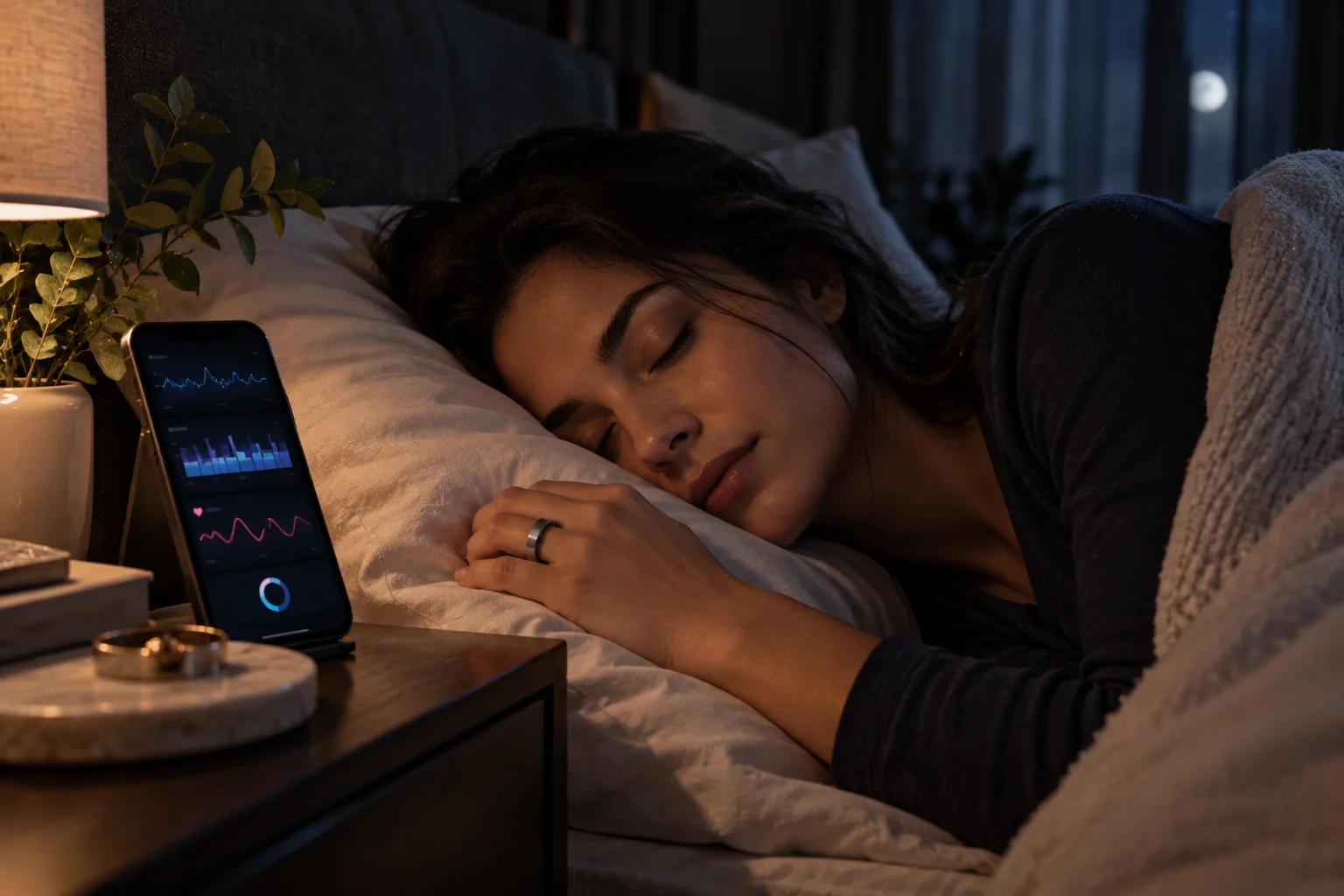
Depending on the model, a smart ring can estimate:
Total sleep duration
Time spent awake
Sleep timing
Sleep stages
Resting heart rate
HRV
Breathing-related metrics
Skin-temperature changes
Blood oxygen-related measurements
Sleep regularity
Oura, for example, combines movement, heart rate, temperature and other physiological signals to generate sleep-related insights. (ouraring.com)
But there's an important distinction:
A smart ring doesn't directly see your brain activity.
Clinical sleep studies can use measurements such as brain waves, eye movements and muscle activity to identify sleep stages. Consumer rings infer sleep stages using indirect signals.
So if your ring says you spent a certain amount of time in deep sleep, treat that number as an estimate rather than a laboratory measurement.
How does a smart ring know when you're asleep?
The ring doesn't have a tiny sleep detector waiting for you to close your eyes.
Instead, its algorithms look for patterns.
Reduced movement, changes in heart rate, heart-rate variability, temperature and other physiological signals can indicate that you're asleep. The software combines those signals with your normal sleep patterns to estimate when sleep begins and ends.
This is why a ring can sometimes get confused.
You might lie completely still while reading for 30 minutes and have the device interpret some of that period as rest or sleep.
That's not necessarily a malfunction.
It's a limitation of trying to infer a complex biological state from indirect signals.
Can a smart ring track workouts?
Yes, although fitness tracking is an area where smart rings vary significantly.
A ring can detect movement and, depending on the model, monitor heart rate during exercise. Some devices can automatically identify certain activities, while others allow you to start workouts manually through their companion app.

Oura's current Ring 4, for example, includes automatic activity detection and heart-rate monitoring, with workout capabilities handled through the Oura app. (ouraring.com)
But if your priority is serious workout tracking, a smartwatch may still be more convenient.
There's a simple reason.
A smartwatch can show your heart rate, pace, distance, workout duration and other information while you're exercising.
A ring usually doesn't have a screen.
So the ring can be excellent for passive tracking, but less useful when you need live workout feedback.
Can a smart ring track steps and daily activity?
Most fitness-oriented smart rings can track movement and activity, and many provide step counts or comparable activity measurements.
The accelerometer is central to this.
An accelerometer detects changes in movement across different axes. Algorithms then use those patterns to estimate activity, steps and periods of inactivity.
This can give you a useful picture of your day without requiring you to interact with the ring.
You might discover that your "quiet office day" wasn't quite as sedentary as it felt, or that a weekend spent walking around a city generated considerably more activity than a formal workout.
As with step counts from other wearables, the number is best treated as a useful estimate rather than an absolute measurement.
Can smart rings measure skin temperature?
Yes, and temperature tracking is one of the more interesting features of modern smart rings.
The sensor typically measures skin temperature, not your core body temperature.
That distinction matters.
Changes in skin temperature can be influenced by the environment, circulation, activity and other factors. But when measured consistently over time, deviations from your personal baseline can provide useful context.
Oura, for example, uses temperature sensing as part of its broader sleep, readiness and wellness insights. (ouraring.com)
This is another example of where trends can be more useful than individual readings.
A single unusual temperature reading doesn't necessarily mean anything.
A persistent change from your normal pattern may be more interesting.
Can a smart ring measure stress?
Not directly.
This is an important distinction that's often lost in wearable marketing.
There isn't a sensor that physically measures "stress."
Instead, smart rings can combine signals such as heart rate, HRV, temperature and movement to estimate periods of physiological stress or recovery.
Oura's stress features, for example, use multiple physiological signals and activity context to identify changes in stress and recovery. (ouraring.com)
So when your app reports stress, think of it as:
"These physiological patterns are consistent with increased stress."
Not:
"The ring has measured exactly how stressed I am."
That distinction makes the data much easier to interpret responsibly.
Can a smart ring track recovery?
Recovery is another calculated metric rather than a direct sensor reading.
A ring may combine:
Resting heart rate
HRV
Sleep duration
Sleep timing
Temperature trends
Recent activity
Other physiological signals
It can then produce a readiness or recovery score.
Oura's Readiness Score is built from multiple contributors rather than one measurement. (ouraring.com)
These scores can be useful as a convenient summary.
But you shouldn't let one number dictate how you feel.
If your ring says your recovery is poor but you feel completely normal, that's context worth considering rather than an instruction you must follow.
What can a smart ring actually tell you every day?
The most useful information often isn't a single metric.
It's the pattern across several metrics.
Imagine you notice that after several late nights, your sleep duration drops, your resting heart rate rises slightly and your HRV falls relative to your normal baseline.
The ring hasn't diagnosed anything.
But it has highlighted a pattern you may want to pay attention to.
That is where wearable technology can become genuinely useful.
Daily question | Metrics that may provide context |
|---|---|
Did I sleep enough? | Sleep duration, timing |
How active was I? | Steps, movement, activity |
How did my body respond overnight? | Resting heart rate, HRV |
Did something change from my baseline? | Temperature, HRV, resting heart rate |
Was yesterday demanding? | Activity + recovery metrics |
Am I maintaining a consistent routine? | Sleep and activity trends |
Are smart ring measurements accurate?
Accuracy depends on the specific metric, device, fit, activity and conditions.
Heart-rate measurements during periods of relatively stable movement can be quite useful, while intense exercise can create more challenges for optical sensors. Sleep-stage estimates are inherently different from clinical sleep measurements because consumer rings infer stages rather than directly measuring brain activity.
Fit matters too.
A ring that moves around your finger may produce less reliable sensor contact than one that fits appropriately.
The safest approach is to treat smart-ring data as wellness information and trend tracking, not as a substitute for medical testing.
The bottom line
A smart ring can track far more than steps.
Modern devices can collect physiological and movement signals that help estimate heart rate, HRV, blood oxygen, skin-temperature changes, sleep, activity, workouts, stress and recovery.
But the most useful distinction is between measurement and interpretation.
The sensors measure signals.
The software interprets those signals.
That's why a smart ring can tell you that your sleep pattern changed, your resting heart rate was different or your activity increased, but it shouldn't be treated as a tiny medical laboratory sitting on your finger.
And honestly, that's still pretty impressive for something that looks like an ordinary ring.