Smartwatches can measure much more than steps and heart rate. Many modern models can also estimate blood oxygen saturation, or SpO₂, using optical sensors built into the back of the watch.
The basic idea sounds simple: the watch shines light into your skin, measures how that light interacts with blood flowing through your wrist, and uses the returned signal to estimate how much oxygen your blood is carrying.
But there's an important distinction between measuring SpO₂ and measuring it clinically.
A smartwatch doesn't take a blood sample. It makes an optical estimate, and manufacturers such as Apple and Google explicitly describe their smartwatch blood-oxygen features as wellness tools rather than medical diagnostic devices.
That means the number on your wrist can be useful for observing patterns and changes, but it shouldn't automatically be treated as a definitive measurement of your health.
So how does the technology actually work, and how accurate is it?
What Is SpO₂ and What Does a Blood Oxygen Reading Mean?
SpO₂ is an estimate of the percentage of hemoglobin in your blood that is carrying oxygen.
Hemoglobin is the protein in red blood cells responsible for transporting oxygen from your lungs to the rest of your body.
A pulse oximeter estimates oxygen saturation without drawing blood. The FDA explains that SpO₂ is generally displayed as a percentage and that the measurement is an estimate of arterial oxygen saturation rather than a direct blood measurement.
For example, a smartwatch might report:
SpO₂: 97%
That means the device estimates that about 97% of the hemoglobin detected by the measurement is oxygenated.
For many healthy people at sea level, oxygen saturation is commonly around 95% to 100%, although normal values can vary with altitude and individual circumstances.
The important word is estimate.
A smartwatch isn't directly measuring the oxygen molecules in your blood.
It's measuring light.
How Does a Smartwatch Measure Blood Oxygen?
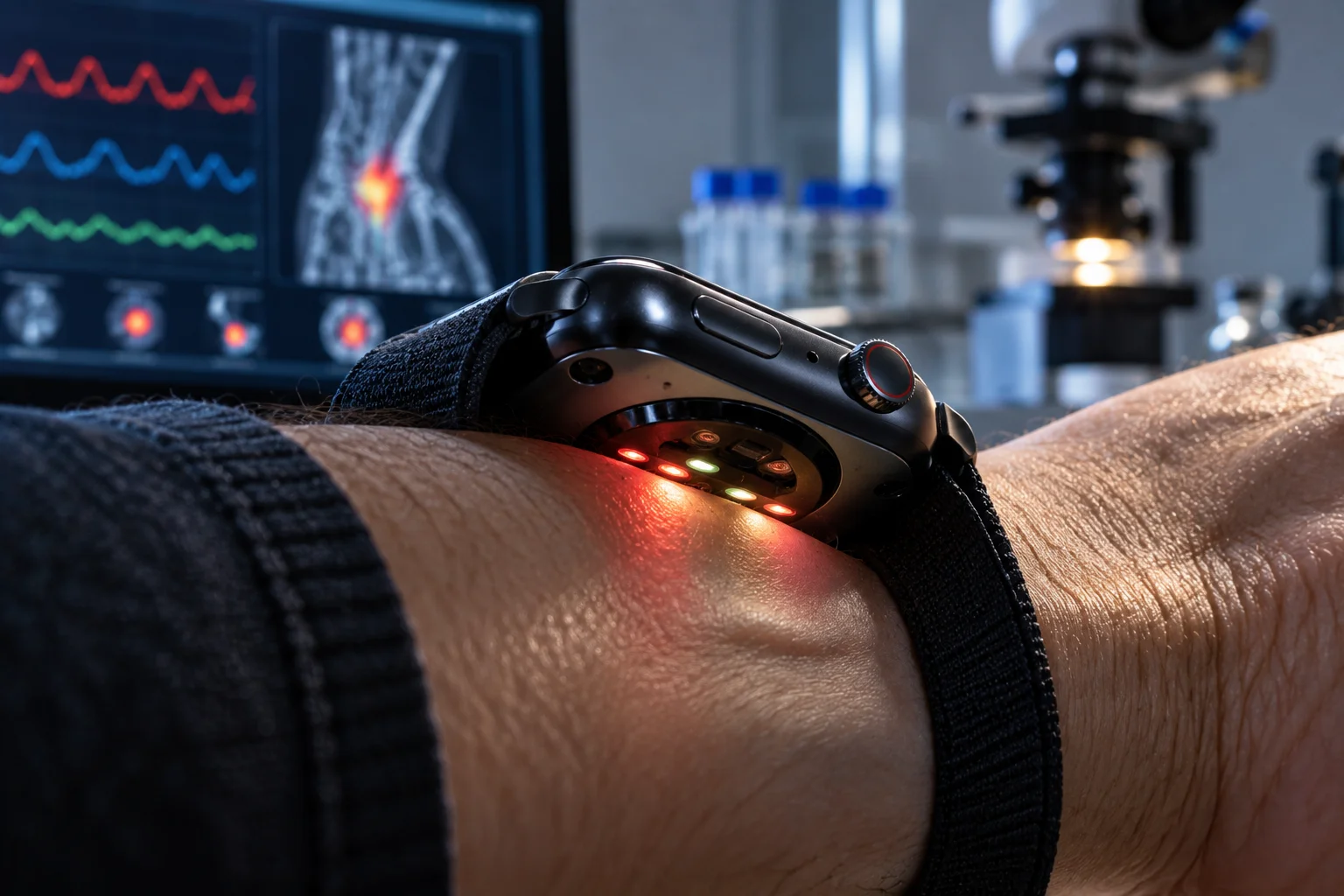
A smartwatch estimates SpO₂ by shining different wavelengths of light into the skin and analyzing how much light is absorbed or reflected by blood.
This is based on a technology called pulse oximetry.
The sensor generally contains:
Red or near-infrared LEDs
Photodetectors
Signal-processing hardware
Algorithms that analyze the changing optical signal
The LEDs send light into the tissue around your wrist.
Some of that light is absorbed by the tissue and blood.
Some is scattered back toward the sensor.
The photodetector measures the returned light.
The watch then analyzes the relationship between the signals at different wavelengths to estimate oxygen saturation.
A traditional fingertip pulse oximeter uses essentially the same underlying optical principle, although the physical placement and implementation are different. The FDA describes pulse oximeters as devices that use light beams to estimate blood oxygen saturation and pulse rate.
Why Does Oxygenated Blood Absorb Light Differently?
Oxygenated and deoxygenated hemoglobin absorb certain wavelengths of light differently, which gives the sensor information it can use to estimate oxygen saturation.
This is the scientific foundation of pulse oximetry.
The sensor doesn't need to see your blood directly.
Instead, it looks at changes in the optical signal caused by blood moving through the tissue.
Because arterial blood pulses with each heartbeat, the system can separate the changing blood signal from relatively constant background tissue signals.
That's one reason the watch needs a reasonably good contact with your skin.
The better the optical signal, the more useful the measurement can be.
Why Do Smartwatches Use Red and Infrared Light?
Different wavelengths interact differently with oxygenated and deoxygenated hemoglobin, allowing the sensor to estimate their relative proportions.
A typical pulse-oximetry system uses at least two wavelengths of light.
The exact hardware differs between manufacturers and devices.
The important concept is that:
Oxygenated hemoglobin absorbs light differently from deoxygenated hemoglobin.
The watch compares the signals and applies an algorithm to estimate the oxygen saturation.
It isn't simply measuring "how red" your blood is.
The calculation involves the changing optical signal produced by pulsating blood and the relative absorption characteristics at the wavelengths being used.
Why Is the Sensor on the Back of the Smartwatch?
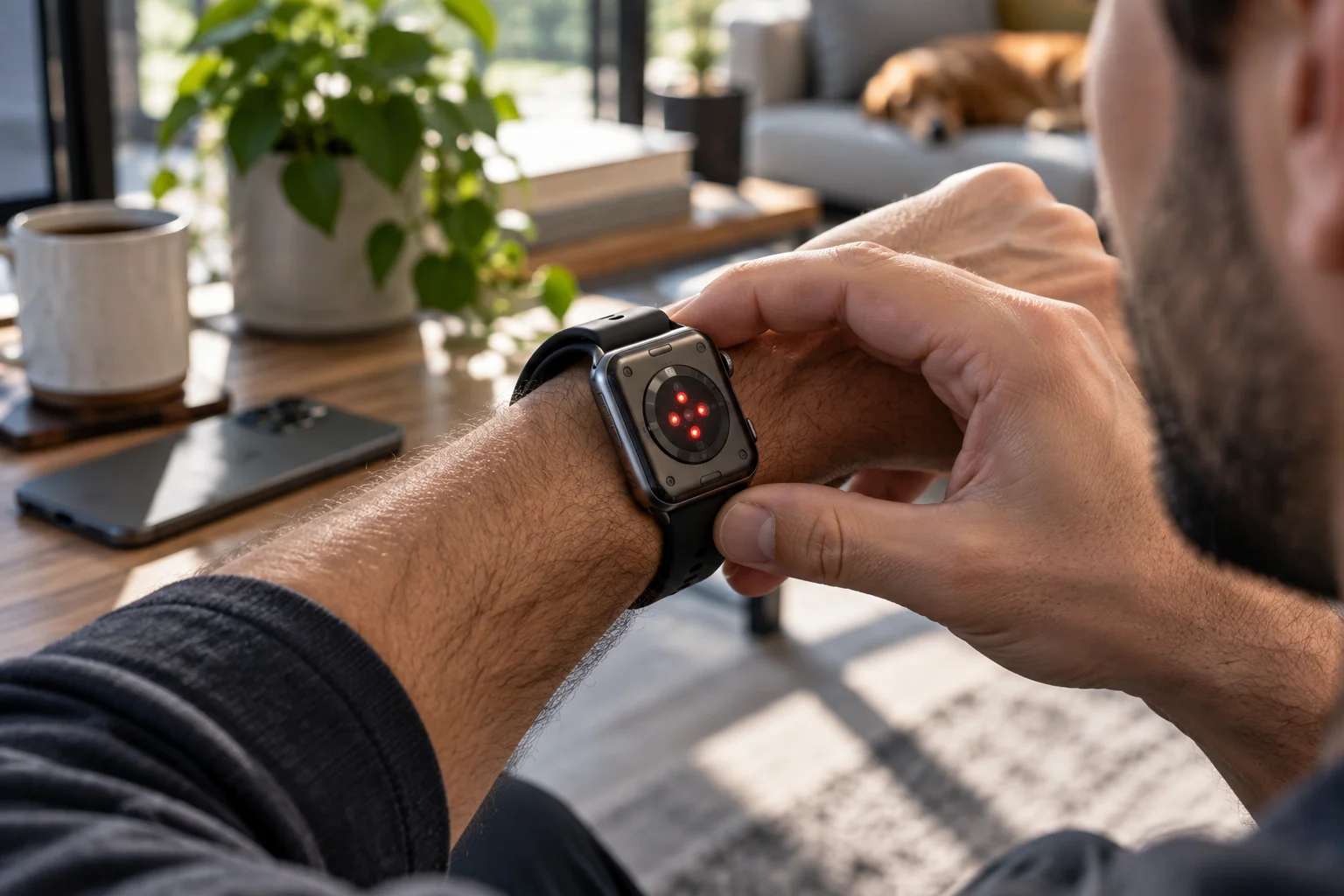
The underside of the watch provides direct contact with the skin while allowing the optical sensors to shine light into tissue and detect the returning signal.
Look at the back of a modern smartwatch and you'll usually see a collection of LEDs and optical sensors.
The watch needs:
Light source → skin/tissue → blood → returning light → photodetector
A loose watch can allow ambient light to enter the measurement path or reduce the consistency of the optical signal.
Apple specifically recommends wearing Apple Watch so the back remains in contact with the skin and the watch is neither too tight nor too loose for successful Blood Oxygen measurements.
That fit requirement isn't just about comfort.
It's part of the measurement itself.
Why Does a Smartwatch Need to Stay Still During an SpO₂ Measurement?
Movement can introduce optical noise that makes it harder for the algorithm to isolate the blood signal.
Imagine the watch trying to detect tiny changes in reflected light while your wrist is moving.
The sensor's position changes.
The amount of tissue being illuminated changes.
The angle between the LEDs and skin changes.
External light conditions can also change.
All of that can make the optical signal more difficult to interpret.
That's why Apple instructs users taking an on-demand Blood Oxygen measurement to keep their arm still during the measurement period.
The FDA similarly identifies excessive movement as one factor that can affect pulse-oximeter accuracy.
So if you're checking SpO₂ while walking around, exercising or constantly moving your wrist, don't expect the same measurement quality as when you're sitting still.
How Accurate Are Smartwatch SpO₂ Readings?
Smartwatch SpO₂ readings can be useful for wellness tracking and trends, but they should not be assumed to have the same accuracy or clinical status as a medical pulse oximeter.
This distinction is crucial.
Apple describes its Blood Oxygen feature as being designed for wellness purposes and not for medical use.
Google similarly states that Fitbit SpO₂ measurements are intended for general wellness and should not be relied upon for medical purposes.
There are several reasons.
A smartwatch measures from the wrist rather than the fingertip.
It has to contend with movement.
The sensor has to work across different wrist sizes, skin characteristics and temperatures.
And its algorithm has to estimate a physiological measurement from a relatively small optical signal.
The FDA also emphasizes that even pulse oximeters designed specifically for oxygen measurement aren't perfectly accurate and have a range of uncertainty around the displayed SpO₂ value.
What Can Make a Smartwatch SpO₂ Reading Inaccurate?
Poor circulation, movement, skin temperature, sensor fit, ambient light and other factors can affect optical oxygen measurements.
Some of the main variables include:
Factor | Why it can matter |
|---|---|
Movement | Adds noise to the optical signal |
Loose fit | Reduces consistent skin contact |
Very tight fit | Can be uncomfortable and affect circulation |
Cold skin | Can reduce blood flow near the measurement site |
Poor circulation | Produces a weaker pulsatile signal |
Ambient light | Can interfere with optical sensing |
Skin pigmentation | Can affect optical measurement performance |
Wrist position | Can change contact and blood flow |
Tattoos or other skin characteristics | May interfere with optical sensing in some circumstances |
The FDA specifically identifies poor circulation, skin pigmentation, skin thickness, skin temperature, movement and ambient light among factors that can affect pulse-oximeter accuracy.
This is why a single smartwatch reading should be treated differently from a consistent pattern recorded under similar conditions.
Does Skin Tone Affect SpO₂ Accuracy?
Skin pigmentation can affect the performance of optical oxygen measurements, and regulators have been working to improve how these devices are evaluated across different skin tones.
This is an important limitation that shouldn't be glossed over.
The FDA says current scientific evidence indicates some differences in pulse-oximeter performance between people with lighter and darker skin pigmentation. It has been developing updated recommendations for evaluating device performance across a broader range of skin pigmentation.
That doesn't mean every smartwatch will produce an inaccurate result for people with darker skin.
It means measurement performance can vary, and device validation matters.
It's also worth separating clinical pulse oximeters from consumer smartwatch sensors. The FDA's current discussions primarily concern pulse oximeters used for medical purposes, while many smartwatch SpO₂ functions are marketed specifically for general wellness.
For consumers, the practical takeaway is simple:
Don't assume an SpO₂ number is equally precise for every person and every situation.
Why Does Cold Weather Affect SpO₂ Measurements?
Cold hands and wrists can reduce peripheral blood flow, making the optical signal more difficult to measure.
Your smartwatch needs pulsatile blood flow near the sensor.
When your skin becomes cold, blood vessels in the extremities can constrict, reducing blood flow near the surface.
That can weaken the signal available to the optical sensor.
The FDA lists skin temperature and poor circulation among factors that can affect pulse-oximeter accuracy.
This is one reason a reading taken immediately after being outside in cold weather may not be as reliable as one taken after you've warmed up and are sitting still.
Why Does a Loose Smartwatch Give Worse Measurements?
The optical sensor needs consistent contact with your skin to produce a useful signal.
If the watch is loose:
Light can escape around the sensor.
The sensor can move relative to your skin.
The optical path can change.
External light may interfere.
The pulsatile signal can become harder to isolate.
Apple recommends that the back of the Apple Watch remain in contact with the skin and that the watch be worn neither too tight nor too loose.
The same basic principle applies to other wrist-based optical sensors.
You don't need to clamp the watch tightly against your wrist.
You need stable, consistent contact.
Why Do Smartwatches Often Measure SpO₂ During Sleep?
Sleep provides long periods when you're relatively still, making it easier for a wrist-worn optical sensor to collect repeated measurements.
Fitbit, for example, says its devices estimate SpO₂ while you sleep.
This approach can provide a series of measurements rather than relying on one manually triggered reading.
That can be useful for observing patterns.
For example, instead of asking:
"What was my SpO₂ at 2:15 PM?"
you can potentially ask:
"Does my overnight oxygen measurement tend to change from my normal pattern?"
That's a more appropriate use of consumer wearable data.
But again, the data is not automatically a clinical diagnosis.
Is a Smartwatch SpO₂ Reading the Same as a Finger Pulse Oximeter?
No. Both can use pulse-oximetry principles, but their sensors, placement, algorithms and intended uses can differ significantly.
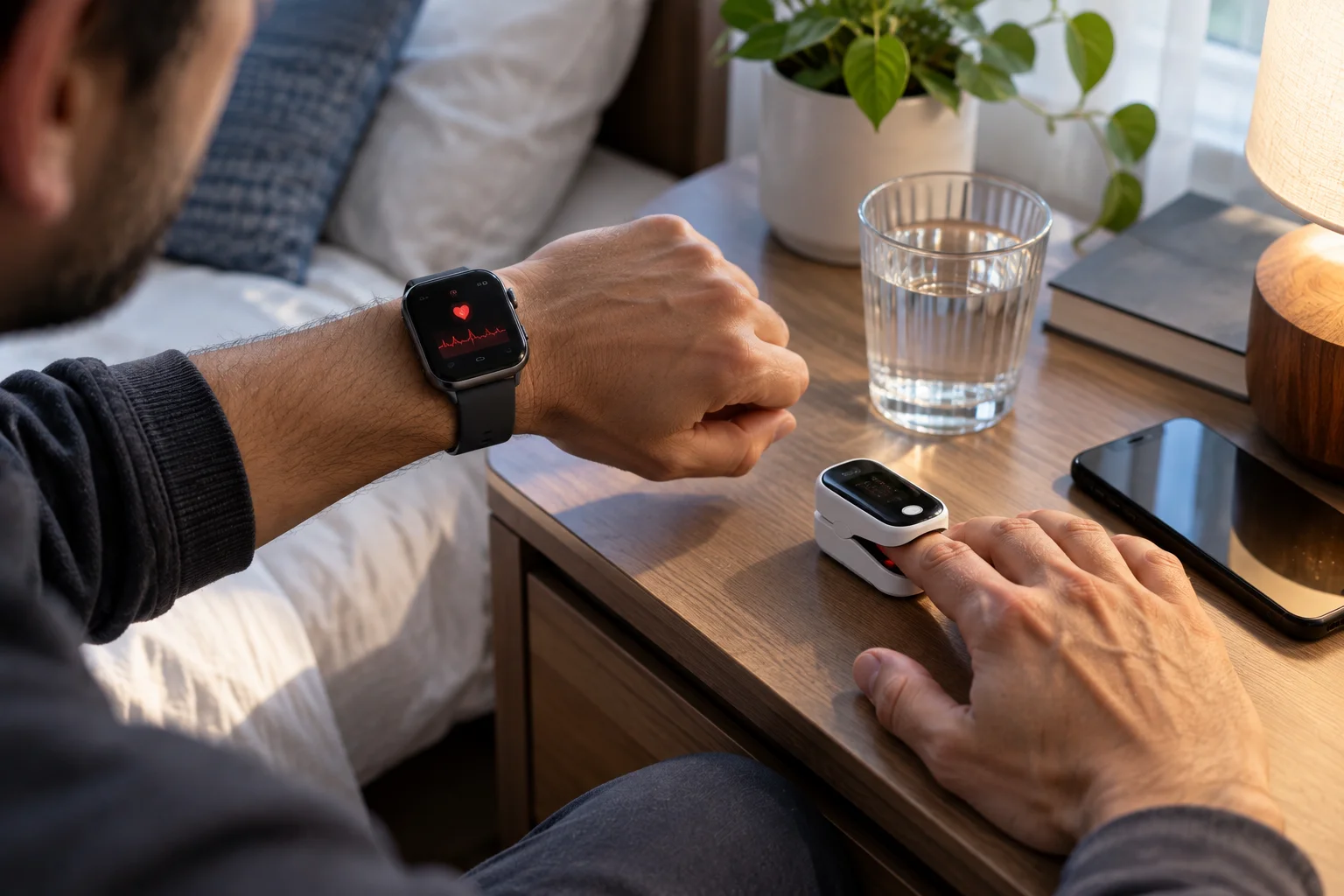
A fingertip pulse oximeter is designed around the fingertip, where the optical measurement can be made through a relatively well-defined tissue path.
A smartwatch measures from the wrist using reflected light.
That creates different measurement conditions.
A smartwatch also has to balance:
Comfort
Battery life
Sensor size
Continuous monitoring
Motion
Industrial design
A dedicated medical device can be designed around the measurement itself.
This is one reason you shouldn't assume that a smartwatch reading and a medical pulse oximeter reading are interchangeable.
Can Smartwatch SpO₂ Detect Health Problems?
A smartwatch SpO₂ trend may provide useful wellness information, but a consumer reading should not be used by itself to diagnose a medical condition.
This distinction is emphasized by manufacturers.
Apple says its Blood Oxygen feature isn't intended for medical use.
Google similarly says Fitbit SpO₂ should not be used or relied upon for medical purposes.
The FDA also warns consumers not to rely solely on pulse-oximeter readings and recommends considering symptoms and other information when interpreting oxygen measurements.
That means a smartwatch can be useful for tracking changes, but a concerning reading shouldn't automatically lead to a diagnosis.
If you're experiencing symptoms such as significant breathing difficulty, chest pain or bluish discoloration, don't wait for a smartwatch to tell you whether something is wrong. The FDA lists these among symptoms associated with potentially low oxygen levels that warrant attention.
How Should You Get a Better Smartwatch SpO₂ Reading?
Take measurements while sitting still, wear the watch correctly and give the sensor consistent skin contact.
For a cleaner measurement:
Wear the watch correctly.
Keep the sensor flush against your skin.
Don't wear it excessively loose.
Sit still during an on-demand measurement.
Keep your wrist relaxed.
Allow cold skin to warm up.
Avoid taking measurements immediately after vigorous movement.
Follow the manufacturer's instructions.
Look at repeated readings rather than obsessing over one number.
Apple's instructions for its Blood Oxygen app specifically call for a flat wrist, stable arm position and approximately 15 seconds of stillness during an on-demand measurement.
The FDA similarly recommends keeping still, having a warm hand and waiting for the reading to stabilize when using a pulse oximeter.
Why Are SpO₂ Trends Often More Useful Than One Reading?
A consistent change from your personal baseline can be more informative than a single isolated smartwatch measurement.
Imagine your watch normally records values around a similar range, then you suddenly see substantially different readings over multiple measurements.
That's more interesting than one unusual number that appears once and disappears.
The FDA's draft guidance explicitly notes that changes or trends in measurements may be more meaningful than a single measurement.
That doesn't mean a smartwatch trend is automatically diagnostic.
It simply reflects the reality that wearable sensors have measurement uncertainty.
A pattern can tell you:
"Something appears different from my usual measurements."
It can't necessarily tell you:
"This specific medical condition is causing the change."
Do All Smartwatches Have Blood Oxygen Sensors?
No. SpO₂ is a model-specific feature, and availability can also vary by country or region.

Manufacturers don't necessarily enable the same health features everywhere.
Google notes that Fitbit SpO₂ availability varies by region.
Samsung similarly notes that blood oxygen availability can vary by country or region on some devices.
Apple's Blood Oxygen feature also has model, region and regulatory availability considerations.
So when buying a smartwatch specifically for SpO₂, check the exact model and region, not just the product family.
What Is the Difference Between SpO₂ and Blood Oxygen Measurement in a Medical Device?
The underlying measurement principle can be similar, but intended use, validation, accuracy requirements and regulatory status can be very different.
This is perhaps the most important distinction in the entire topic.
A consumer smartwatch may say:
"Track your blood oxygen for wellness."
A medically cleared pulse oximeter has a very different role.
The FDA distinguishes medical-purpose pulse oximeters from general-wellness products. It notes that general-wellness products aren't evaluated by the agency before being marketed for medical decision-making.
So don't interpret a smartwatch's SpO₂ feature as proof that the device is a medical pulse oximeter.
The Bottom Line: How Do Smartwatches Measure Blood Oxygen?
Smartwatches estimate SpO₂ by using optical sensors to measure how different wavelengths of light interact with blood and tissue at the wrist.
The process is roughly:
LEDs emit light → light enters the skin → blood absorbs some wavelengths → photodetectors measure the returning signal → algorithms analyze the pulsatile component → the watch estimates SpO₂.
It's an impressive piece of miniaturized sensing technology.
But it isn't perfect.
Movement, poor circulation, cold skin, sensor fit, ambient light and skin pigmentation can all influence optical oxygen measurements. The FDA continues to highlight these limitations in its guidance and research around pulse oximetry.
The best way to think about smartwatch SpO₂ is therefore:
Useful for wellness tracking and observing patterns, but not a substitute for clinical evaluation.
If your watch produces an unusual result once, don't automatically assume something is wrong.
If readings repeatedly differ from your normal pattern, especially alongside concerning symptoms, that's a reason to pay attention and seek appropriate medical advice rather than relying on the watch alone.
FAQs
How does a smartwatch measure SpO₂?
It uses optical sensors, typically LEDs and photodetectors, to analyze how light is absorbed and reflected by blood and tissue. Algorithms then estimate the percentage of oxygenated hemoglobin.
Is smartwatch SpO₂ accurate?
It can provide useful estimates and trends, but accuracy varies with the device and measurement conditions. Consumer smartwatch SpO₂ features are generally intended for wellness rather than medical diagnosis.
What does SpO₂ mean on a smartwatch?
SpO₂ refers to estimated blood oxygen saturation, expressed as a percentage. It represents an estimate of how much hemoglobin is carrying oxygen.
What is a normal SpO₂ level?
The FDA says oxygen saturation is 95% to 100% for most healthy people, although values can be lower at higher altitudes and in some people with heart or lung conditions.
Can a smartwatch diagnose low oxygen?
A consumer smartwatch should not be used by itself to diagnose hypoxemia or another medical condition. Manufacturers such as Apple and Google explicitly position their SpO₂ features as wellness tools.
Why does my smartwatch give different SpO₂ readings?
Movement, watch fit, skin temperature, circulation and other factors can affect the optical signal.
Does skin tone affect SpO₂ readings?
Skin pigmentation can affect the performance of pulse-oximetry technology, and the FDA has identified differences in performance across skin pigmentation as an area requiring further evaluation and improved testing.
Why does my smartwatch measure SpO₂ while I sleep?
Sleep provides long periods when you're relatively still, allowing the watch to collect repeated optical measurements. Fitbit, for example, uses sleep-based SpO₂ tracking on supported devices.
Is smartwatch SpO₂ the same as a fingertip pulse oximeter?
No. Both can use optical pulse-oximetry principles, but their sensor placement, hardware, algorithms and intended uses can differ. A smartwatch should not automatically be treated as equivalent to a medical-purpose pulse oximeter.
How can I get a better SpO₂ reading from my smartwatch?
Wear the watch with consistent skin contact, keep your wrist still and relaxed, avoid measuring immediately after strenuous activity, and follow the manufacturer's measurement instructions.