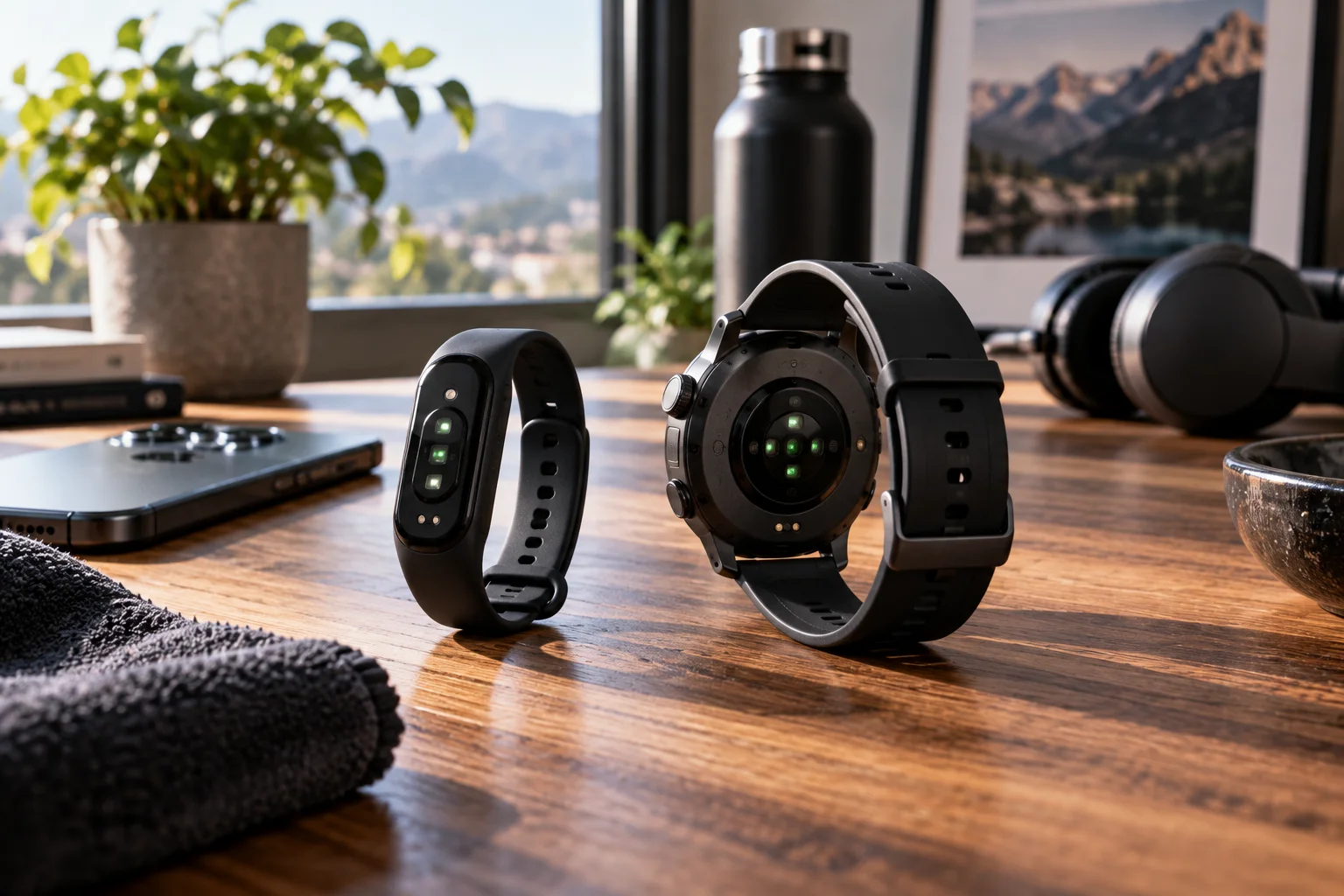
A fitness band looks like a smartwatch that has been stripped down. It is smaller, lighter, usually lasts longer between charges and focuses on health and activity tracking rather than apps, calls and notifications.
But there's an important misconception here: smaller doesn't automatically mean fewer sensors.
A compact tracker can still measure heart rate, blood oxygen, sleep, movement, stress and other health metrics. Fitbit Charge 6, for example, has an optical heart-rate sensor, electrical sensors for ECG and EDA, red and infrared sensors for SpO₂, an accelerometer and built-in GPS.
The differences become more obvious when you compare a fitness band with a full smartwatch such as the Apple Watch Series 12 or current Samsung Galaxy Watch models. Smartwatches can add ECG, temperature, compass, altimeter, more sophisticated GPS, cellular connectivity, larger displays, microphones, speakers and additional body-composition or environmental sensors, depending on the model.
So the better question isn't “Which has more sensors?”
It's “Which measurements, tracking capabilities and everyday functions actually matter to me?”
Do Fitness Bands Have Fewer Health Sensors Than Smartwatches?
Not necessarily. Fitness bands can have many of the same core health sensors as smartwatches, but individual models vary considerably.
The most common sensors in both categories include:
Optical heart-rate sensors
Accelerometers
Gyroscopes
SpO₂ sensors
Temperature sensors
Ambient-light sensors
Some bands go considerably further.
Fitbit Charge 6, for example, includes electrical sensors compatible with its ECG and EDA features, alongside optical heart-rate, SpO₂, accelerometer, ambient-light and built-in GPS hardware.
A larger smartwatch can simply provide more physical space and power budget for additional sensors and radios.
Apple Watch Series 12, for example, includes an electrical heart sensor, optical heart sensor, blood oxygen sensor, temperature sensor, compass, altimeter, accelerometer, gyroscope, ambient-light sensor, depth gauge and water-temperature sensor.
That doesn't mean you'll use every one.
What Sensors Do Both Fitness Bands and Smartwatches Usually Have?
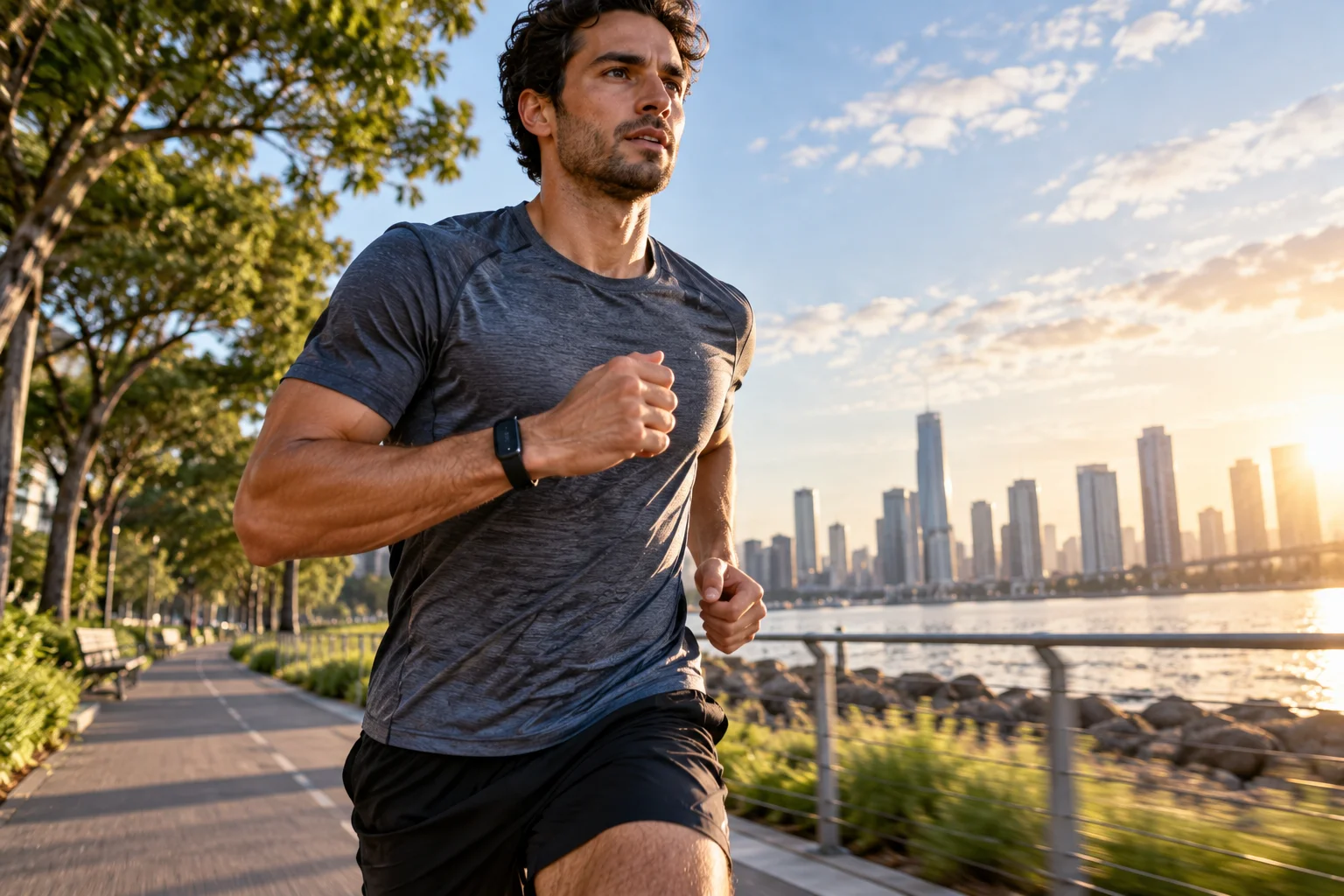
Heart-rate and motion sensing are the foundation of most modern fitness wearables.
Optical heart-rate sensor
Green LEDs and photodetectors measure changes in blood volume beneath the skin.
This supports:
Heart-rate tracking
Resting heart rate
Workout heart rate
Heart-rate zones
Recovery metrics
Some stress calculations
Accelerometer
The accelerometer detects movement and acceleration.
It's fundamental for:
Step counting
Activity detection
Movement during sleep
Workout recognition
Calories and activity estimates
Gyroscope
A gyroscope measures rotational movement.
It can help distinguish how the wrist is moving and can improve activity or orientation tracking.
SpO₂ sensor
Red and infrared light can be used to estimate blood oxygen saturation.
But availability varies by product, market and software.
Garmin's vívosmart 5, for example, includes a wrist-based Pulse Ox sensor, although its GPS is supplied through a connected smartphone rather than a receiver in the band itself.
What Do You Actually Lose by Choosing a Fitness Band?
The biggest losses are often not basic health measurements but standalone connectivity, navigation, interaction and specialized sensors.
A typical fitness band may give you excellent:
Steps
Heart rate
Sleep
Activity
Calories
Stress
SpO₂
Basic workout tracking
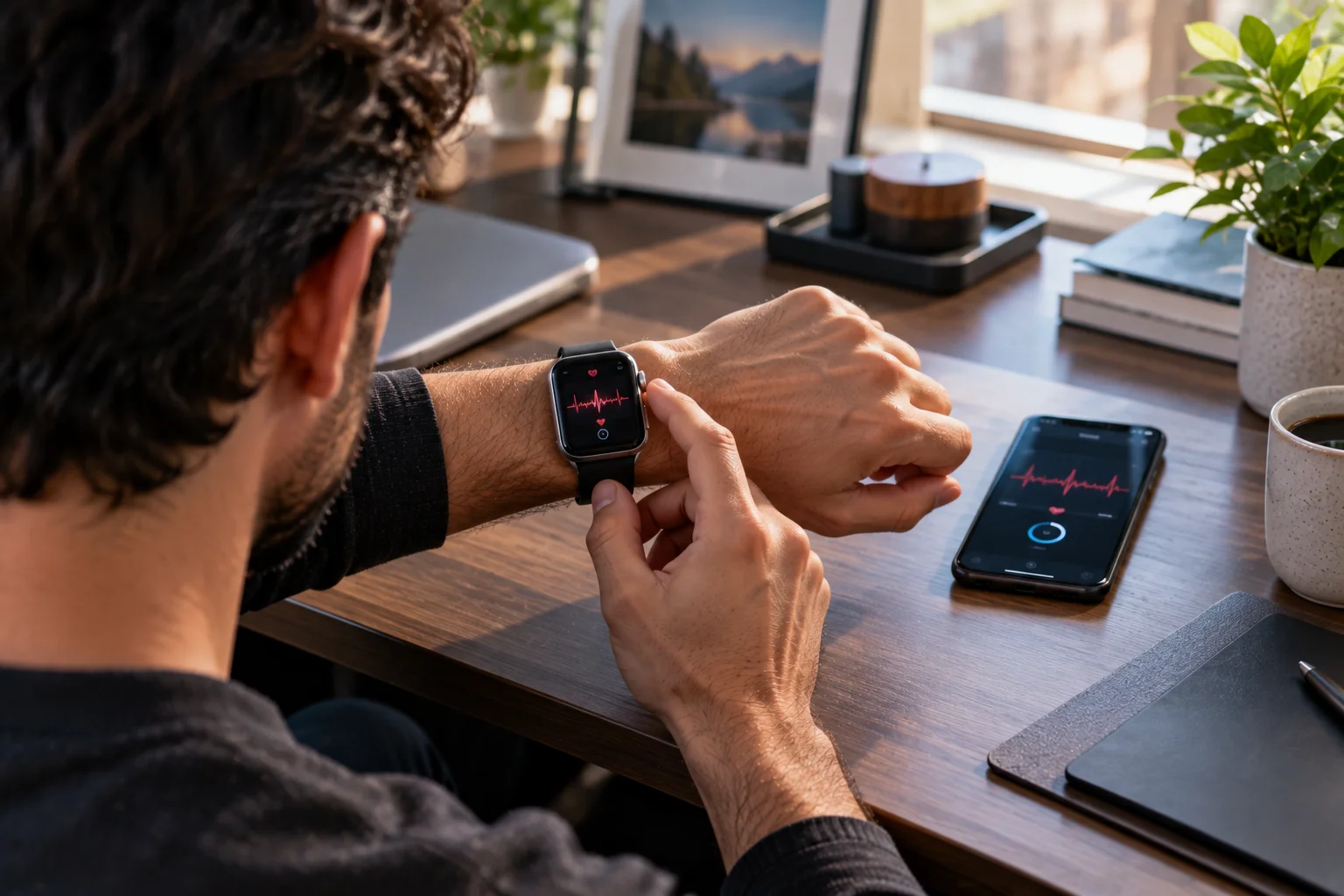
A full smartwatch may add:
Standalone GPS
Cellular connectivity
ECG
Compass
Altimeter
More advanced temperature sensing
BIA/body-composition measurement
Maps
Voice calls
Music storage
Larger apps
More advanced workout interfaces
But these aren't universal differences.
Some bands have GPS and ECG, while some inexpensive smartwatches don't.
The model matters more than the category name.
Is Built-In GPS the Biggest Difference?
For runners, cyclists and outdoor athletes, GPS is one of the most important differences to check before buying a fitness band.
There are two fundamentally different approaches.
Built-in GPS
The wearable contains its own GNSS/GPS receiver.
You can leave your phone behind and record your route, distance and pace.
Fitbit Charge 6 is an example of a relatively compact tracker with built-in GPS, supporting GPS, GLONASS and Galileo.
Connected GPS
The band uses your phone's GPS.
Garmin vívosmart 5 uses connected GPS for outdoor walking, running and cycling, meaning the phone needs to be nearby to record GPS data.
This can be perfectly adequate for casual exercise.
But if you regularly run without your phone, built-in GPS becomes much more useful.
Do Fitness Bands Lose ECG?
Some do, but ECG is not exclusive to full-sized smartwatches.
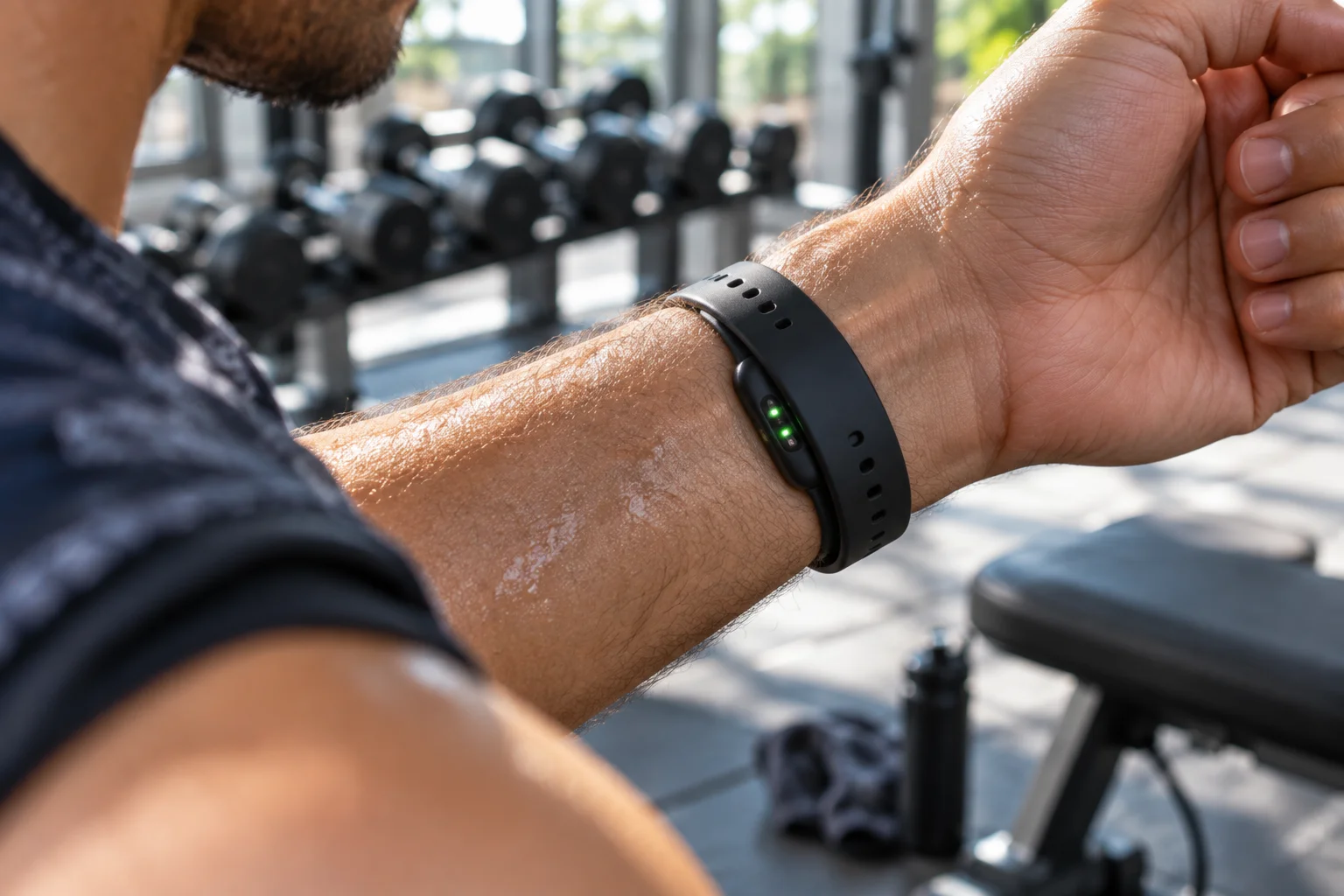
This is an important example of why you shouldn't assume that “band” means “basic.”
Fitbit Charge 6 contains electrical sensors compatible with its ECG feature.
At the other end, Apple Watch Series 12 includes an electrical heart sensor and ECG app.
However, ECG availability can depend on the specific device, software and country.
So if ECG matters to you, check the manufacturer's specifications for the exact model rather than choosing based on form factor.
What About Blood Oxygen Tracking?
SpO₂ tracking is available on some fitness bands and many smartwatches, so choosing a smaller wearable doesn't automatically mean losing it.
Garmin vívosmart 5, for example, includes Pulse Ox measurement and can record readings during part of sleep.
Apple Watch Series 12 also lists a blood oxygen sensor and Blood Oxygen app, subject to regional availability.
The important limitation is that SpO₂ readings from wrist wearables are estimates and aren't equivalent to clinical blood testing.
For general fitness and wellness trends, the feature can be useful. For medical decisions, wearable readings should not automatically be treated as diagnostic measurements.
Do Smartwatches Have Better Heart-Rate Tracking?
A smartwatch isn't automatically more accurate simply because it is larger, but some premium watches have more advanced sensing systems and sampling capabilities.
Apple says its Series 12 uses a redesigned Health Sensing System with optical and electrical heart sensors and takes background heart-rate readings every five seconds.
Garmin's vívosmart 5 also uses continuous wrist-based heart-rate monitoring and says its heart-rate system samples multiple times per second.
This illustrates an important point:
Sensor count doesn't tell you how good the resulting measurement will be.
Sensor placement, algorithms, sampling strategy, skin contact, movement and software processing all matter.
A smaller band with excellent algorithms can outperform a larger watch with less sophisticated sensing.
Which Sensors Are More Common on Full Smartwatches?
Larger smartwatches have more room for sensors that support navigation, environmental awareness and specialized health features.
Compass
Useful for:
Direction
Navigation
Outdoor activities
Map orientation
Altimeter
Measures elevation changes.
That's useful for:
Hiking
Stair climbing
Elevation profiles
Outdoor training
Temperature sensor
Wrist temperature can support sleep and wellness features and, depending on the platform, cycle-related estimates.
Apple Watch Series 12 includes a temperature sensor and uses wrist-temperature data in its health and cycle-tracking features.
Depth and water-temperature sensors
These are specialized features found in certain watches rather than typical fitness bands.
Apple Watch Series 12 includes a depth gauge to 6 metres and water-temperature sensing.
These features make a smartwatch substantially more capable for certain water activities.
What Is BIA and Why Do Some Smartwatches Have It?
Bioelectrical impedance analysis, or BIA, uses electrical measurements to estimate body-composition-related metrics.
Samsung's current Galaxy Watch comparison page lists BIA alongside heart rate, ECG, SpO₂, temperature, accelerometer, gyroscope, altimeter, ambient-light and compass sensors on applicable models.
Depending on the device and software, BIA may be used to estimate metrics such as body composition.
This is a capability you won't find on every fitness band.
However, these readings are estimates and can vary with hydration, skin contact and measurement conditions.
Do Fitness Bands Have Shorter Battery Life?
Usually the opposite: removing a large display, powerful processor and some radios can make a fitness band much more power-efficient.
Garmin says its vívosmart 5 can last up to seven days.
Apple Watch Series 12, by comparison, is rated for up to 24 hours of normal use and up to 38 hours in Low Power Mode.
Longer battery life matters more than it initially appears.
A tracker that can remain on your wrist continuously makes it easier to collect:
Overnight sleep data
Resting heart rate
Recovery trends
Daily activity
Long-term patterns
Charging frequency can therefore affect the usefulness of the data, not just convenience.
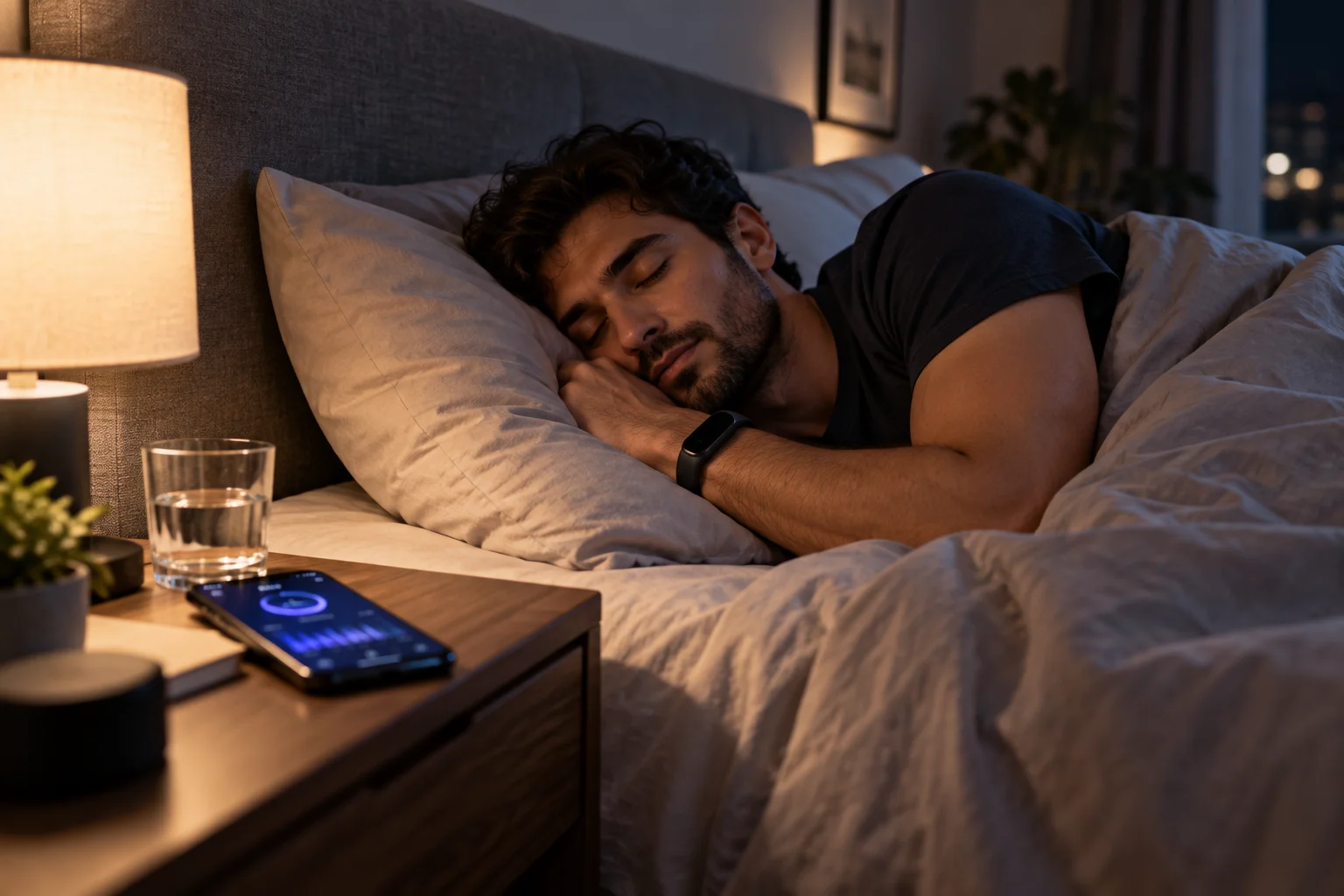
Does a Fitness Band Track Sleep as Well as a Smartwatch?
A fitness band can provide substantial sleep tracking, and its smaller size can actually make overnight wear more comfortable.
Garmin vívosmart 5 tracks sleep stages, sleep score, heart rate, stress, Pulse Ox and respiration.
WHOOP 5.0 takes an even more extreme approach: it has no traditional watch face and is designed around continuous health and fitness monitoring rather than smartwatch functions.
The advantage of a band is simple.
If you forget you're wearing it, you're more likely to wear it every night.
That consistency can be more valuable than having a larger screen.
What Do You Lose Beyond Sensors?
The biggest sacrifice when moving from a smartwatch to a band is often the entire smartwatch experience rather than health tracking.

You may lose:
Feature | Fitness band | Smartwatch |
|---|---|---|
Step tracking | Usually | Yes |
Heart rate | Usually | Yes |
Sleep tracking | Usually | Yes |
SpO₂ | Model dependent | Common on advanced models |
ECG | Some models | Some models |
Built-in GPS | Some models | Common on advanced models |
Compass | Less common | More common |
Altimeter | Less common | More common |
BIA | Rare | Available on some |
Large maps | Usually no | Often |
App ecosystem | Limited | Much broader |
Cellular | Rare | Available on some |
Calls | Usually limited | Common on capable models |
Music storage | Limited | Available on some |
Voice assistant | Limited | Common |
Large touchscreen | Limited | Yes |
Battery life | Often longer | Often shorter |
The table also shows why “fitness band vs smartwatch” isn't really a sensor-only decision.
Is a Fitness Band Better for Fitness Than a Smartwatch?
Not necessarily. A band can be the better fitness wearable when its smaller design makes you more likely to wear it continuously.
Consider someone whose main goals are:
Steps
Sleep
Heart rate
Basic workouts
Stress tracking
Long battery life
That person may gain little from a large smartwatch.
Now consider someone who wants to:
Run without a phone
Follow maps
Navigate trails
Answer calls
Use cellular data
Track advanced training metrics
Use ECG or specialized sensors
Control music
View detailed workout data
A full smartwatch becomes much more relevant.
Can a Smaller Wearable Be More Accurate?
Yes, in some situations, because accuracy depends on sensor quality, algorithms and fit rather than physical size alone.
A smaller band can sit securely against the wrist and remain comfortable during sleep.
A poorly fitted smartwatch can produce worse readings.
Movement is another major factor.
During intense exercise, rapid wrist movement can make optical heart-rate measurement harder regardless of whether the device is a band or watch.
That's why specifications such as “more sensors” shouldn't be treated as a simple accuracy ranking.
What About WHOOP-Style Fitness Bands Without Screens?
A screenless wearable demonstrates that you can remove most smartwatch hardware without removing sophisticated health tracking.
WHOOP 5.0, for example, is deliberately designed without a traditional watch face and focuses on continuous health and fitness measurements. WHOOP says its 5.0 sensors capture data points every second, while the device itself doesn't contain built-in GPS.
That trade-off is intentional.
Instead of putting a mini smartphone on your wrist, the device concentrates on sensing and then sends the information to the companion app.
It's a useful reminder that display size and sensor capability aren't directly connected.
Which Features Should You Check Before Buying?
Choose the wearable according to the sensors and tracking functions you actually need rather than assuming that a smartwatch is automatically more capable in every area.
Before buying, check these specifications:
For everyday health
Look for:
Continuous heart rate
Sleep tracking
HRV
SpO₂
Temperature
For running and cycling
Look for:
Built-in GPS
GPS accuracy
Heart-rate broadcasting
Workout profiles
Training metrics
For advanced health features
Check for:
ECG
Temperature sensing
Irregular rhythm detection
BIA
Specialized health features
For outdoor activities
Consider:
Compass
Altimeter
Dual-band or multi-band GPS
Maps
Water resistance
Offline navigation
For everyday smartwatch use
Check:
Display
Notifications
Calls
Apps
Music
NFC payments
Cellular connectivity
Frequently Asked Questions About Fitness Bands vs Smartwatches
Do fitness bands have the same sensors as smartwatches?
Some do. Advanced fitness bands can include optical heart-rate, SpO₂, ECG and even built-in GPS sensors. Fitbit Charge 6 is one example.
What is the biggest thing you lose with a fitness band?
Usually it's not basic health tracking. The biggest losses tend to be the large display, apps, standalone connectivity, navigation, cellular features and specialized sensors such as a compass, altimeter or BIA, depending on the model.
Do fitness bands have GPS?
Some have built-in GPS, while others use connected GPS through a smartphone. Fitbit Charge 6 has built-in GPS, while Garmin vívosmart 5 uses connected GPS.
Can a fitness band measure blood oxygen?
Some can. Garmin vívosmart 5 and Fitbit Charge 6 are examples of fitness-focused wearables with SpO₂/Pulse Ox capabilities.
Is ECG only available on smartwatches?
No. Some fitness bands include electrical sensors capable of ECG. Fitbit Charge 6 is an example.
Do smartwatches track more health data?
Often, especially at the premium end, but not automatically. A specialized fitness band can sometimes track particular health metrics that a cheaper smartwatch doesn't.
Are fitness bands better for sleep tracking?
They can be. Their smaller, lighter design and longer battery life can make overnight wear easier, which can improve consistency of long-term tracking.
The Bottom Line
Choosing a fitness band doesn't necessarily mean giving up serious health tracking.
The core measurements most people care about, including heart rate, steps, sleep, activity and sometimes SpO₂, ECG and GPS, can all exist in a relatively small wearable.
The bigger difference is what surrounds those sensors.
A smartwatch can add standalone GPS, maps, compass, altimeter, cellular connectivity, calls, apps, larger displays and specialized sensors such as BIA or depth measurement. Current premium watches can pack a surprisingly broad sensor array into a device that is still relatively small.
A fitness band makes a different trade-off.
You get a lighter device, longer battery life and a more discreet form factor, often while retaining the health metrics that matter most for everyday tracking.
So before buying, don't ask:
“Which one has more sensors?”
Ask:
“Which sensors will I actually use, and which features would I miss if they weren't on my wrist?”
For basic health and fitness tracking, a band may give you nearly everything you need.
For navigation, advanced training, communication and a broader smartwatch experience, the larger device earns its extra size.