For more than a decade, the smartphone app has been the center of consumer technology. You opened an app to search, shop, communicate, watch videos, book travel or manage your files.
That model is beginning to change.
In 2026, companies including Meta, Google, Apple and OpenAI are increasingly building AI systems that can sit above individual apps and services. At the same time, they are developing new hardware that gives those AI systems access to cameras, microphones, sensors, displays and information about the user's surroundings.
Meta's latest AI glasses and Muse agent are a clear example. Google is combining Gemini with Android XR glasses and headsets. Apple is integrating Siri AI with personal context and systemwide app actions. OpenAI is developing a new device with former Apple design chief Jony Ive.
The underlying idea is simple: instead of opening an app to do something, you increasingly tell an AI what you want done.
Why is Big Tech moving beyond traditional apps?
AI agents can potentially become a new interface for services that users previously accessed through individual applications.

Consider ordering a product.
The traditional process involves opening a shopping app, searching, comparing products, entering information and checking out.
An AI agent could eventually handle much of that workflow after receiving a natural-language request.
That doesn't mean apps disappear. The shopping service, payment system and delivery platform still exist. What's changing is who controls the interaction.
AI becomes the layer through which the user reaches those services.
This is one reason companies are investing heavily in agents. Amazon, Meta and OpenAI are among the companies exploring AI platforms that could allow agents to take actions on users' behalf rather than simply answer questions.
Why are AI-powered devices important if smartphones already have AI?
New hardware can give AI access to information that a phone doesn't continuously capture or present naturally.
A pair of glasses can see what you're looking at and hear conversations around you. Earbuds can provide hands-free interaction. A wearable can remain accessible without requiring you to pull a phone from your pocket.
Meta says its AI glasses can understand visual context, provide translations and summarize conversations, while the company's AI architecture is designed to make the assistant more personal and stateful over time.
This creates a different interaction model.
Instead of:
Phone → unlock → app → prompt → answer
the experience can become:
See something → ask AI → receive help.
That reduction in friction is one of the strongest reasons Big Tech is experimenting with new form factors.
Why are AI glasses getting so much attention?
Glasses are one of the few devices that can add AI capabilities without requiring users to stare at another screen.
Meta has been particularly aggressive in this category. At Connect 2026, the company announced new AI glasses, Ray-Ban Meta Audio glasses, updated Ray-Ban Meta models and Meta VR Glasses. Meta says its portfolio will exceed 100 AI-glasses styles across Ray-Ban, Oakley and Meta brands by the end of 2026.
Google is taking a similar route with Android XR.
Google and Samsung have been developing AI-powered eyewear around Gemini, while Android XR is designed to combine AI with augmented and extended reality experiences.
The attraction is partly practical. People already understand glasses, unlike an entirely new category such as an AI pin.
What is Google doing with AI devices?
Google is trying to combine Gemini's existing access to personal information with new wearable and spatial-computing hardware.
Android XR is Google's operating system for next-generation headsets and glasses. Google says Gemini can understand a user's surroundings and provide real-time assistance in XR environments.
That could eventually allow someone to look at an object and ask a question, receive translation while traveling or create a virtual workspace without sitting in front of a conventional monitor.
Google also has an important advantage in this strategy: Gemini can already connect to information across Google's broader ecosystem.
IDC notes that Google's AI assistant can draw on services such as email, photos, calendar and search history, giving its hardware strategy a potentially deep personal-context layer.
How is Apple approaching the shift?
Apple is trying to make AI a system-level interface rather than treating it as a separate application.
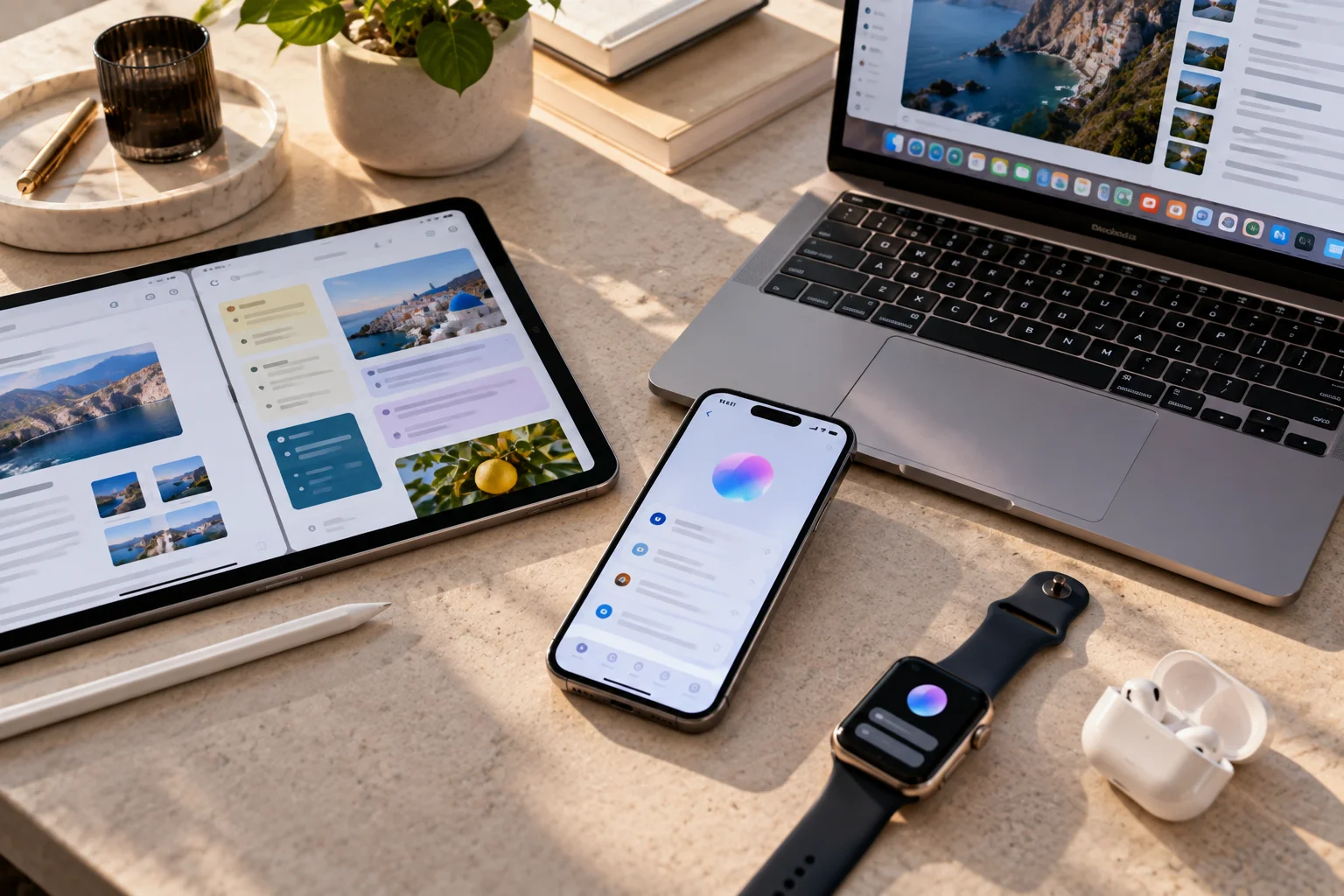
Its new Siri AI can use personal context from messages, emails and photos, understand what is displayed on screen and perform actions across supported apps. Apple says the system combines on-device processing with Private Cloud Compute for more demanding AI workloads.
That approach matters for hardware because Apple's advantage isn't only the AI model.
The company controls the iPhone, iPad, Mac, Apple Watch and other devices, allowing Siri to move between different hardware environments.
Apple's strategy therefore suggests that the future may not require one revolutionary AI gadget. Instead, AI could become the common interface connecting the devices people already own.
What is OpenAI trying to build?
OpenAI is developing dedicated hardware intended to make interaction with AI less dependent on conventional screens and applications.

OpenAI has been working with former Apple design chief Jony Ive and said in January that its first device was on track for the second half of 2026, although the company did not disclose its final design or launch details at that point. Reports have described prototypes as small and potentially screenless.
The strategy is significant because OpenAI does not have a mature consumer hardware ecosystem like Apple or Google's Android platform.
A successful device would give ChatGPT a direct physical interface rather than requiring users to open a website or app.
But it also has to avoid the problems that hurt the first generation of dedicated AI gadgets.
Why did the first AI gadgets struggle?
Early AI hardware demonstrated that putting an AI assistant into a new device isn't automatically enough to create a useful product.
The Humane AI Pin struggled to establish a compelling everyday use case, while the Rabbit R1 faced criticism over its early capabilities.
That history has influenced the second wave.
The newer strategy is less about creating a standalone gadget that replaces everything and more about combining AI with hardware people already understand.
Glasses are still glasses. Earbuds are still earbuds. Smartphones remain available as computing hubs.
The AI becomes the new layer on top.
Are apps becoming less important?
Apps are unlikely to disappear, but users may interact with them less directly.
An AI assistant could eventually search a service, fill out information, compare options and complete a transaction without the user manually navigating every screen.
That could fundamentally change the role of apps.
Today, apps compete for attention through interfaces, notifications, advertising and recommendations.
In an AI-first environment, the user may simply state an objective and let the assistant decide which service to use.
That creates a major strategic question for developers: how does an app remain valuable when an AI agent becomes the customer's primary interface?
What does this shift mean for consumers?
The biggest benefit could be convenience, but privacy and control become more important as AI gains access to more personal information.
An AI device with cameras, microphones and access to your accounts can understand far more about your environment than a traditional app.
Meta has introduced private-processing technologies for its AI glasses, while Apple emphasizes on-device processing and Private Cloud Compute.
Consumers will increasingly need to consider:
What can the device see and hear?
Which accounts can the AI access?
Can it take actions without confirmation?
Where is personal data processed?
How long is information retained?
Can the device be disabled or disconnected easily?
The convenience of personal AI depends heavily on users trusting the hardware.
Are AI devices replacing smartphones?
Not yet. The more likely near-term outcome is that AI devices work alongside smartphones rather than replacing them outright.
Phones still provide processing power, connectivity, applications, payments and a mature display.
AI glasses and wearables can handle specific interactions more naturally, while the phone remains the underlying computer.
Over time, however, that balance could change.
If AI becomes capable enough to handle most everyday digital tasks, users may care less about which app or operating system performs the task and more about which assistant can do it reliably.
That is the strategic opportunity Big Tech is pursuing.
Why is Big Tech betting on hardware now?
Hardware gives AI companies a direct relationship with the user and creates new ways for AI to understand the physical world.

The smartphone revolution made apps central to computing. The AI era could make the assistant central instead.
Meta wants Muse available through glasses and other devices. Google is putting Gemini into Android XR. Apple is embedding Siri AI throughout its device ecosystem. OpenAI is attempting to create dedicated hardware around its AI platform.
The companies are therefore not abandoning software.
They're trying to make software intelligence so central that the hardware becomes the place where the AI is always available.
The next major technology platform may not be another app store.
It could be the personal AI assistant sitting between the user and almost everything else.
AI-Powered Devices FAQs
Why is Big Tech building AI devices?
AI devices can provide new ways to interact with assistants and give them access to cameras, microphones, sensors and contextual information that conventional apps cannot access as naturally.
Are AI glasses the future of smartphones?
They could become an important companion to smartphones, but current AI glasses generally do not replace the full functionality of a phone.
What is the difference between an AI app and an AI device?
An AI app primarily runs within an existing computing platform. An AI device can be designed around AI from the beginning, potentially giving the assistant dedicated sensors, microphones, cameras and interfaces.
Why are companies interested in AI agents?
Agents can potentially perform tasks instead of simply answering questions. They can interact with services, use tools and complete multi-step workflows, which could change how people interact with traditional applications.
Will apps disappear because of AI agents?
Probably not in the near term. Apps and online services will still provide the underlying functionality, but users may increasingly access them through AI interfaces rather than navigating them manually.
What is the biggest risk with AI-powered devices?
Privacy and control are major concerns. Devices that continuously capture audio, images or contextual information can provide powerful AI experiences, but they also create new questions about data collection, permissions, storage and consent.
What should consumers look for in an AI device?
Look beyond the AI branding. Check battery life, privacy controls, connectivity, compatibility, data processing, permissions and the specific tasks the device can actually perform. The useful question is not simply whether a device has AI, but what it enables that your existing devices cannot.