
Smart home appliances used to be relatively simple. You could connect a washing machine to an app, turn an air conditioner on remotely, check a camera feed or ask a smart speaker to switch off the lights.
In 2026, that model is changing.
The biggest shift isn't that refrigerators, washing machines and air conditioners suddenly became intelligent on their own. It's that AI is becoming the conversational and decision-making layer connecting them.
Samsung's 2026 Bespoke AI ecosystem is one of the clearest examples. Through SmartThings, Samsung is connecting appliances, phones, TVs, wearables and home services so devices can share information, respond to commands and automate parts of a household routine. Its latest appliances use combinations of AI Vision, Bixby, cameras, sensors and SmartThings connectivity to understand situations and adapt settings.
Google is moving in a similar direction with Gemini for Home. Instead of requiring users to remember specific commands or build complicated routines manually, Gemini can understand natural-language requests, control compatible devices and even create automations from a description.
That makes 2026 an important year for smart homes.
The question is no longer simply "Is this appliance connected to Wi-Fi?"
It's becoming:
"Can my home understand what I want and coordinate the devices needed to do it?"
What Makes a Smart Appliance an AI Assistant in 2026?
A connected appliance becomes more assistant-like when it can interpret information, understand intent, make limited decisions and coordinate actions instead of simply responding to a basic command.
A traditional smart appliance might let you start a washing cycle from your phone.
An AI-enabled appliance can potentially detect the load, identify fabric characteristics, adjust the cycle and communicate its status through the broader home ecosystem.
Samsung's 2026 Bespoke AI lineup illustrates this progression. The company describes its ecosystem around four ideas: AI understands you, AI adapts to you, AI connects your home and AI cares for you.
The distinction can be simplified like this:
Traditional smart appliance | AI-enabled smart appliance |
|---|---|
Remote control | Context-aware control |
Fixed commands | Natural-language requests |
User selects settings | System can recommend or adjust settings |
Works mainly by itself | Can coordinate with other devices |
App notifications | More contextual information |
Manual routines | AI-assisted automation |
Basic sensors | Sensors + cameras + AI interpretation |
The important word is coordination.
The real potential of AI in the home isn't making one refrigerator cleverer. It's allowing the refrigerator, air conditioner, washing machine, TV, phone and other connected devices to participate in the same system.
How Samsung's Bespoke AI Ecosystem Is Connecting the Home
Samsung is using SmartThings as the connective layer between Bespoke AI appliances, Galaxy devices, TVs and other compatible products.
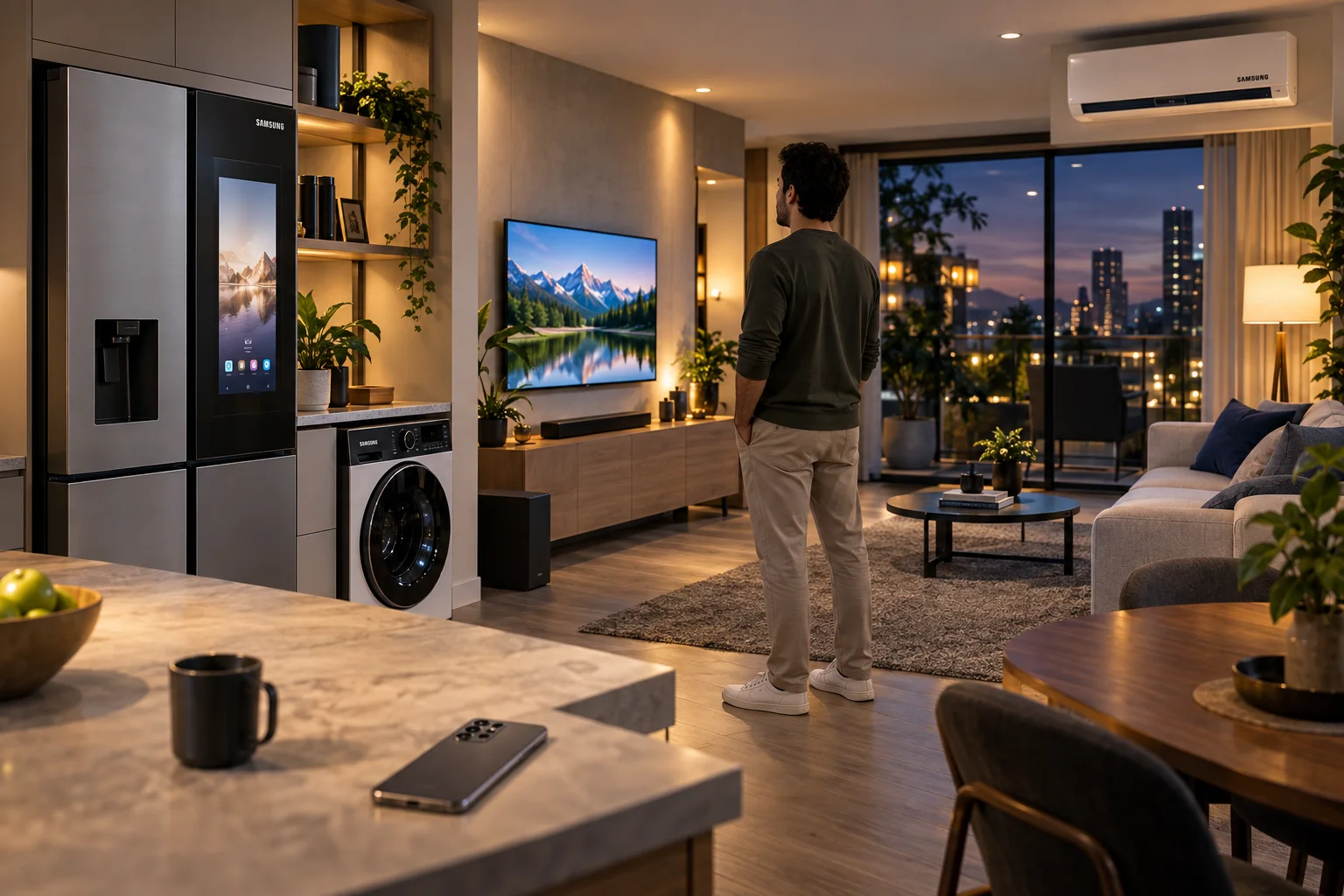
Samsung's 2026 strategy is explicitly broader than individual appliances.
The company says its Bespoke AI appliances are designed to connect through SmartThings, while its wider ecosystem also includes mobile devices and TVs. Cameras, screens and Bixby voice recognition can allow appliances to see, hear and respond to users.
That creates several layers of intelligence.
The appliance layer
This includes refrigerators, washing machines, dryers, ovens, air conditioners and robot vacuums.
The sensing layer
Cameras and sensors provide information about food, loads, temperature, activity and the surrounding environment.
The AI layer
AI can interpret that information and make recommendations or adjustments.
The ecosystem layer
SmartThings connects compatible devices so actions can happen across the home.
The interface layer
Users can interact through phones, appliance displays, voice commands and Samsung's broader device ecosystem.
This is why Samsung's 2026 approach is better described as an AI home ecosystem than a collection of AI appliances.
What Can Samsung's AI Refrigerator Actually Do?
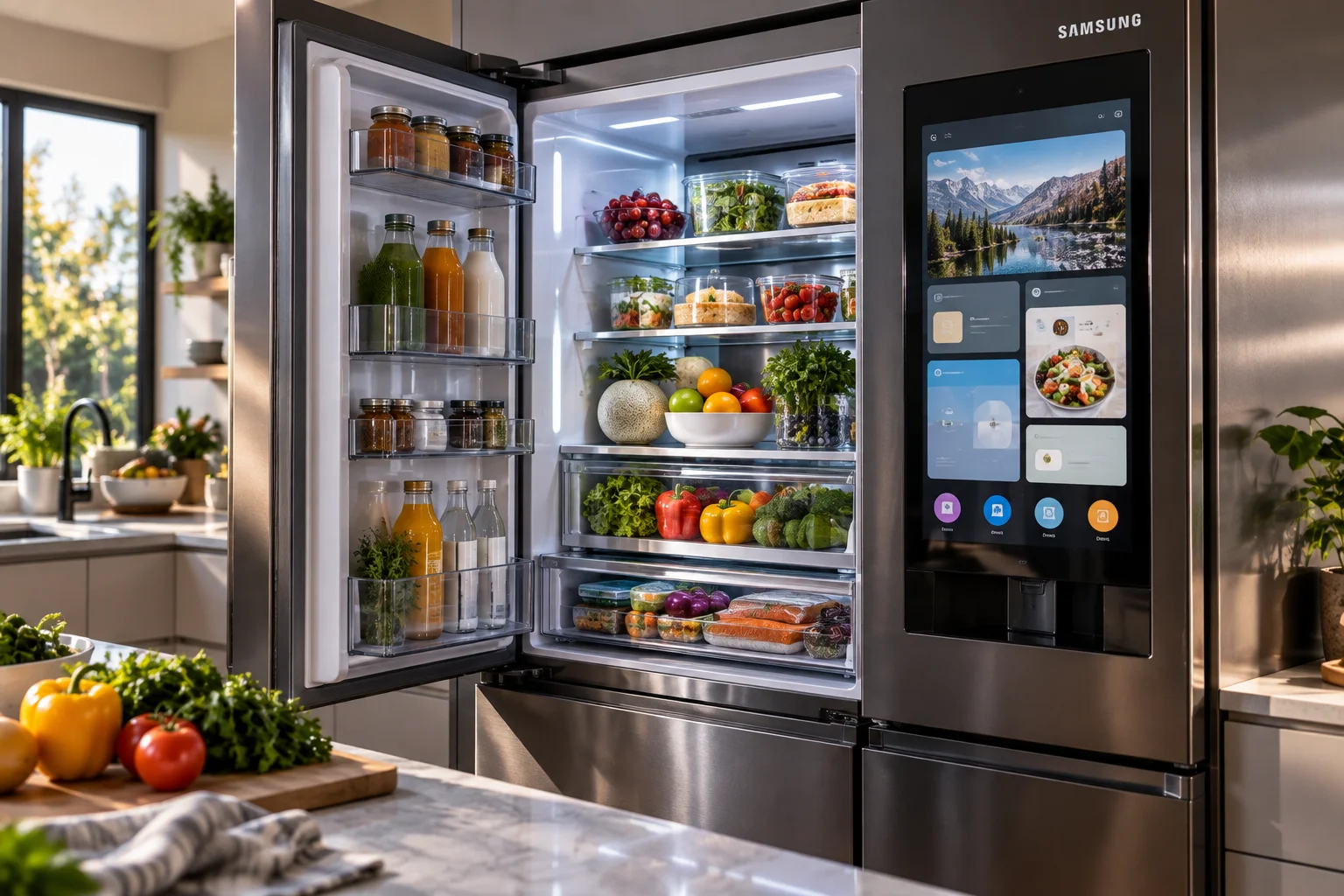
Samsung's latest Family Hub refrigerators use AI Vision, Gemini integration, Bixby and SmartThings features to make the refrigerator more than a food-storage appliance.
Samsung's 2026 Family Hub refrigerator lineup includes a 32-inch Family Hub experience with AI Vision built with Google Gemini. The system can recognize selected foods, provide recipe-related experiences and offer personalized information through features such as Now Brief.
That creates several potential use cases.
You could use the refrigerator as:
A food inventory interface
A recipe assistant
A household information screen
A SmartThings control centre
A family communication display
A source of reminders and personalized information
Samsung has also expanded AI Vision and Bixby capabilities through software updates for existing compatible Family Hub refrigerators, showing another important development: AI functionality can increasingly improve after an appliance has already been purchased.
That changes the traditional appliance upgrade cycle.
A refrigerator no longer necessarily has a completely fixed feature set on the day it leaves the factory.
How AI Is Changing Washing Machines and Dryers
AI-enabled laundry systems are moving from simple cycle selection toward automatic sensing, optimization and remote monitoring.
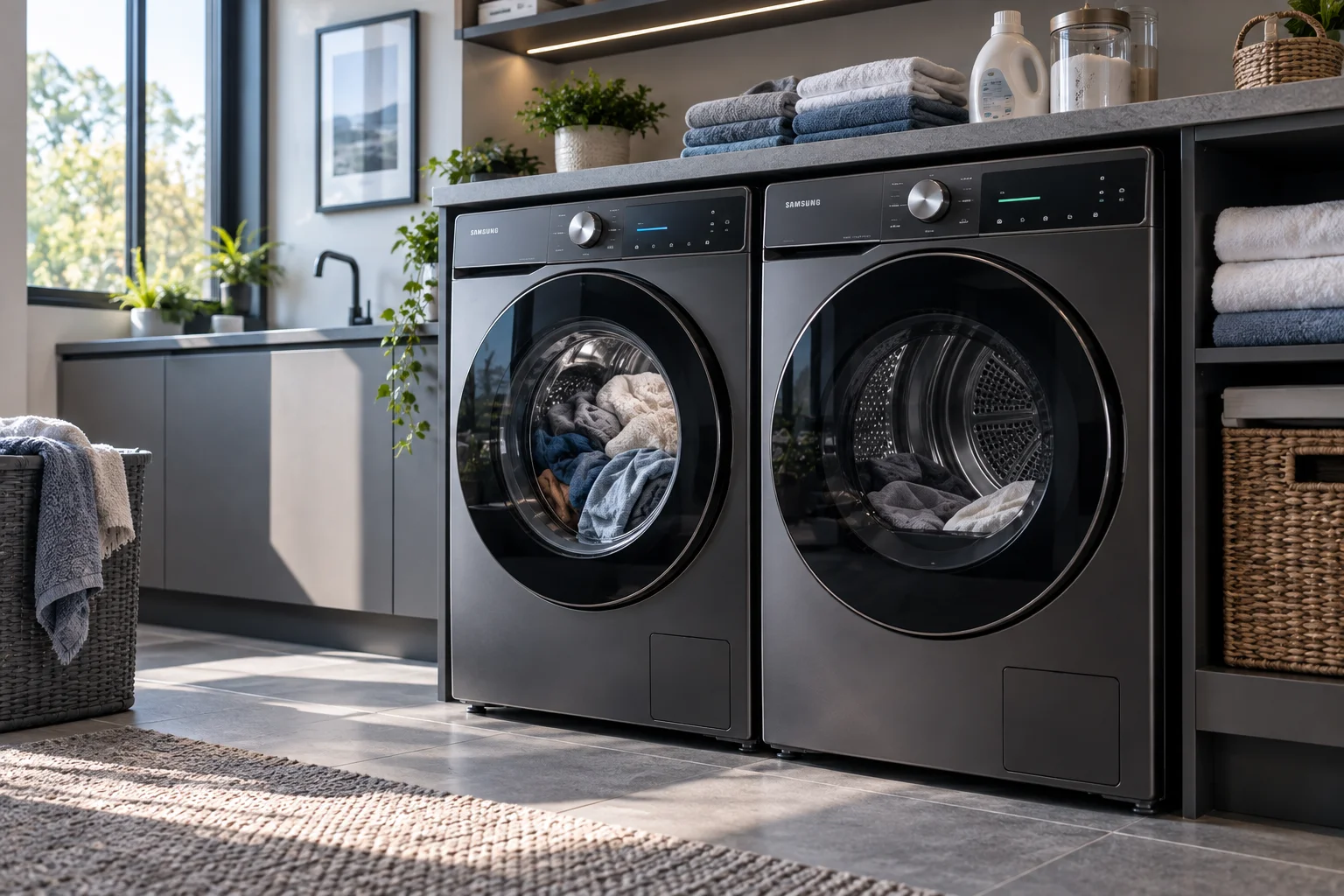
Samsung's Bespoke AI Laundry Combo uses AI Wash & Dry to detect characteristics such as load weight and adjust aspects of the washing and drying process. Samsung also connects laundry appliances to SmartThings for monitoring, energy management and remote functions.
The practical benefit isn't that the washing machine is having a conversation with you.
It's that the user has fewer decisions to make.
Instead of asking:
Which cycle should I use?
the system can increasingly answer:
Based on this load, what cycle and settings make sense?
Samsung is also using SmartThings Energy and AI Energy Mode to optimize energy consumption on compatible appliances. Samsung says its 2026 lineup can use AI-based energy management to reduce consumption under certain conditions, although actual savings depend on the appliance, settings and usage pattern.
That's a more useful definition of AI in appliances than simply adding a chatbot to the washing machine.
AI Air Conditioners Are Starting to Learn Personal Comfort
AI-enabled air conditioners can use usage patterns, environmental information and connected-device data to adjust comfort more automatically.
Samsung's 2026 Bespoke AI air-conditioning lineup includes AI Comfort Mode and AI Energy Mode, while some experiences can integrate with Galaxy wearables to adjust cooling based on sleep-related information.
That points toward a different model of climate control.
Instead of:
"Set the AC to 23°C."
the longer-term goal is closer to:
"Make the bedroom comfortable for sleeping."
The system can potentially consider:
Temperature
Time
User preferences
Sleep patterns
Room conditions
Energy-saving settings
The AI doesn't necessarily need to make a complicated decision every time. Sometimes the intelligence is simply choosing the appropriate setting automatically.
Automated Home Routines Are Becoming Easier to Create
The biggest AI improvement may be that users no longer need to manually program every smart-home routine.
Traditional smart-home automation can be powerful, but it often requires users to understand conditions, triggers, actions and device names.
For example:
IF: it is 7:00 AM
AND: Monday to Friday
THEN: turn on bedroom lights
THEN: adjust thermostat
THEN: start coffee machine
That's useful, but it still feels like programming.
Google's Gemini for Home takes a different approach.
Google says users can describe an automation conversationally, such as asking the system to turn on porch lights and lock the front door at sunset. Gemini can interpret the request and create the automation.
That's a significant change in usability.
The automation engine hasn't necessarily become fundamentally different.
The interface for creating it has.
Instead of learning how the smart-home platform works, you can describe the outcome you want.
What Does Gemini for Home Add to Smart Appliances?
Gemini for Home turns natural-language conversation into a control layer for compatible smart-home devices, routines and household tasks.
Google's Gemini for Home can understand more natural requests, maintain conversational context and handle more complicated smart-home commands. Google gives examples such as turning off all lights except those in a particular room or combining several actions in one request.
It can also help create automations.
That means you could theoretically move from:
"Turn on the kitchen lights."
to:
"I'm starting dinner. Make the kitchen comfortable and turn on the lights I normally use for cooking."
The second request requires understanding intent and context.
The exact actions Gemini can take still depend on the devices connected to the home, permissions, supported integrations and Google's available features.
So AI doesn't magically make every appliance compatible.
It makes the control layer more flexible where compatible devices already exist.
The Home Is Becoming One System Instead of Separate Appliances
The most important change is that AI can coordinate different appliances instead of treating every product as an isolated device.
Consider a simple evening routine.
You arrive home.
A connected system could potentially:
Detect your arrival through supported devices.
Adjust lighting.
Set the preferred room temperature.
Start or resume an appliance routine.
Send relevant notifications to your phone.
Prepare a TV or entertainment environment.
Switch devices into an energy-saving state later.
Not every ecosystem can perform every action today.
But this is the direction being demonstrated by Samsung's SmartThings ecosystem and Google's Gemini for Home.
Samsung describes its AI Home vision around appliances and devices working together, while SmartThings provides the underlying connectivity for compatible Samsung and partner devices.
The appliance is becoming a node in a larger system.
AI Can Also Make Smart Homes More Proactive
The next step beyond responding to commands is detecting situations and surfacing useful information without waiting for the user to ask.

Samsung's 2026 Bespoke AI ecosystem includes services such as Family Care and Pet Care, which can use connected-device information to provide alerts and reminders around household activity.
Samsung also uses Home Appliance Remote Management for monitoring and predictive diagnostics on supported appliances. Its US Bespoke AI appliance platform describes continuous monitoring and fault detection that can support remote troubleshooting.
That creates a different relationship between the homeowner and the appliance.
Instead of:
"Something is wrong with my washing machine."
the system can potentially move toward:
"There may be a problem. Here's what I detected."
That doesn't eliminate the need for servicing or human judgment, but it can reduce the amount of time users spend diagnosing routine problems.
Does AI Actually Make Smart Appliances More Energy Efficient?
AI can help reduce energy use by optimizing appliance operation, but AI branding alone doesn't guarantee lower energy consumption.
Samsung's AI Energy Mode, for example, can adjust operation on compatible appliances with the goal of reducing energy consumption. Samsung currently states that AI Energy Mode can reduce refrigerator energy use by up to 10% under its specified conditions, while its 2026 laundry examples cite reductions that vary by appliance and cycle.
The distinction matters.
An appliance doesn't become energy efficient simply because it has an AI processor.
Actual energy performance depends on:
Hardware efficiency
Compressor or motor design
Heating elements
Insulation
Operating temperature
Load size
User settings
Usage patterns
AI optimization
AI is another tool for controlling those variables.
What Are the Downsides of AI-Powered Smart Homes?
The biggest trade-offs are complexity, privacy, compatibility, software dependence and the possibility that some AI features will require subscriptions or specific ecosystems.
A connected home needs more than intelligent appliances.
It also needs:
Reliable connectivity
If devices depend on cloud services, internet outages can affect certain features.
Strong privacy controls
Cameras, microphones, household activity information and personal routines create sensitive data.
Long-term software support
An expensive appliance is increasingly dependent on software updates.
Samsung says flagship Bespoke AI appliances receive seven years of continuous software updates, which is significant because connected appliances can now gain functionality after purchase.
Ecosystem compatibility
A Samsung appliance may work particularly well inside SmartThings, while a Google Home environment may make more sense for someone heavily invested in Google's ecosystem.
Subscription boundaries
Google's Gemini for Home includes basic assistant functionality, while some advanced capabilities, such as Gemini Live and certain AI-powered home features, are associated with Google Home Premium.
That's an important consideration when calculating the real cost of an AI home.
Will You Need to Replace All Your Appliances to Get an AI Home?
No. The more important question is which existing devices can connect to the ecosystem you already use.
Samsung is explicitly pushing software updates to some existing Bespoke AI appliances, demonstrating that not every improvement requires new hardware.
Google has also positioned Gemini for Home as an upgrade that can reach existing speakers, displays, cameras and doorbells rather than requiring users to replace everything immediately.
This suggests a more gradual transition.
You might start with:
Smart speaker → smart lights → thermostat → security camera → appliances → automated routines
rather than replacing the entire home at once.
That is probably how AI homes will actually develop for most households.
What Will an AI Home Look Like by the End of 2026?
The emerging model is a home where AI sits above individual devices and coordinates them according to natural-language requests, routines and household context.
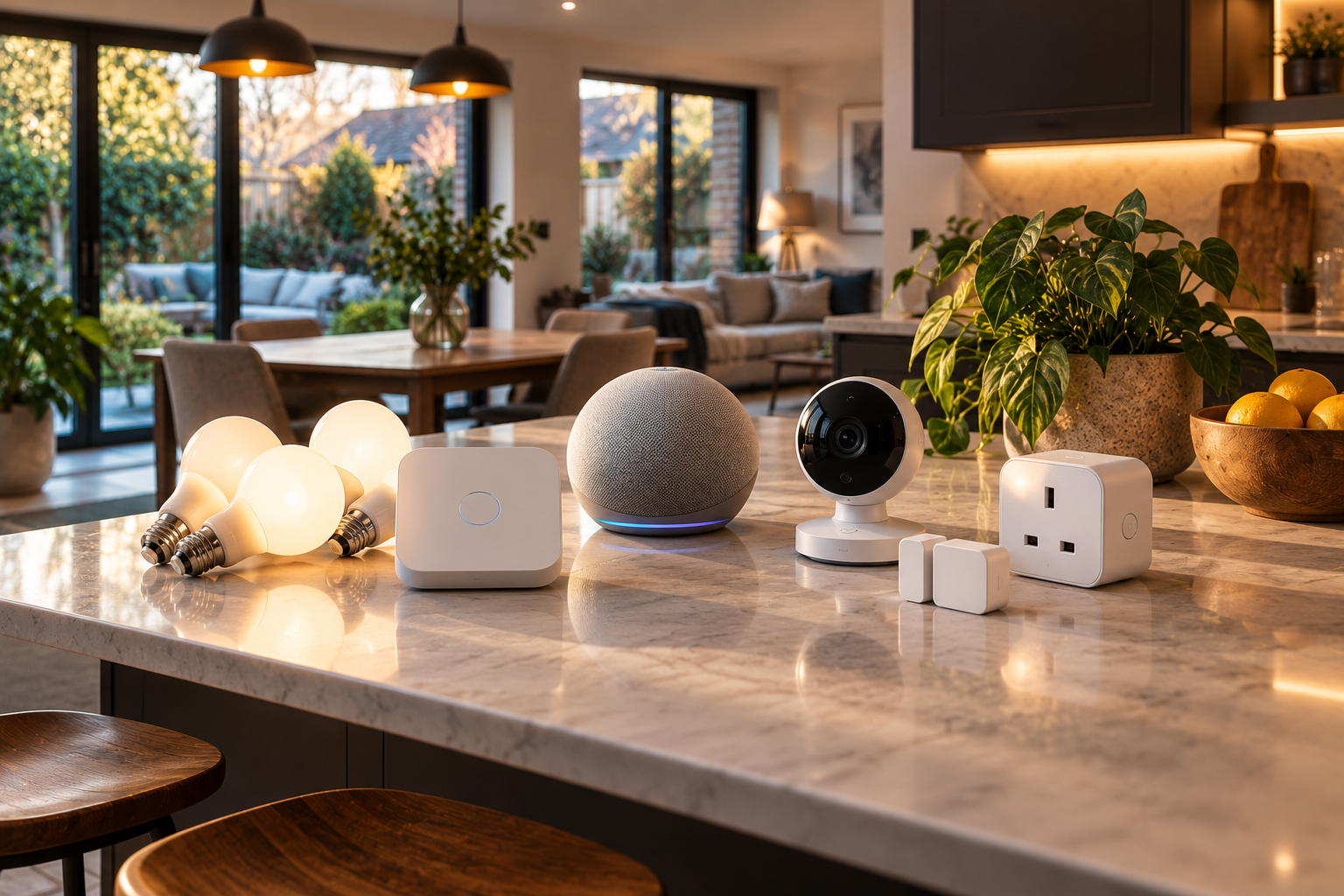
The appliance itself still matters.
A refrigerator needs good cooling hardware. An air conditioner still needs an efficient compressor. A washing machine still needs a capable motor and effective wash system.
But the software layer is becoming increasingly important.
The progression looks roughly like this:
Connected appliance
→ control it remotely
Smart home
→ connect multiple devices
Automated home
→ create routines between devices
AI home
→ describe what you want and let the system determine the appropriate actions
Samsung's Bespoke AI strategy and Google's Gemini for Home show two versions of this transition. Samsung is building intelligence deeply into its appliance portfolio and SmartThings ecosystem, while Google is putting Gemini increasingly at the conversational and automation layer of the home.
The interesting part isn't that your refrigerator can talk.
It's that your home may increasingly be able to understand what you're trying to accomplish.
FAQ: AI Smart Home Appliances in 2026
What is Samsung Bespoke AI?
Samsung Bespoke AI is the company's connected appliance strategy that combines AI-enabled appliances with SmartThings, Bixby, AI Vision, sensors and other Samsung devices to create a more coordinated home ecosystem.
Can Samsung appliances communicate with each other?
Compatible Samsung appliances can connect through SmartThings, allowing users to monitor devices, control them and create routines across supported products. The exact capabilities depend on the devices and services involved.
What is AI Vision in Samsung appliances?
AI Vision uses cameras and AI-based recognition on supported appliances to interpret visual information. Samsung uses it in products such as Family Hub refrigerators for food recognition and related experiences.
Can Gemini control smart home appliances?
Gemini for Home can control compatible smart-home devices using natural-language requests. Google also allows supported users to create automations by describing what they want the home to do.
Will AI appliances work without the internet?
Some basic appliance functions can continue to work without an internet connection, but cloud-dependent AI, remote control, updates and ecosystem features may require connectivity. The exact offline functionality varies by appliance.
Are AI appliances more expensive?
AI hardware and connected features can contribute to higher prices, particularly in premium appliance ranges. However, the practical value depends on whether you will actually use the automation, energy-management, monitoring and AI features.
Is an AI refrigerator really useful?
It can be useful if you regularly use food recognition, inventory information, recipe assistance, reminders and SmartThings controls. If you simply want a refrigerator that keeps food cold, many of the AI features may not justify paying a premium.
Is Samsung the only company making AI smart appliances?
No. Samsung is one of the most visible examples, but Google, Amazon and other companies are also developing AI-powered smart-home ecosystems and conversational control systems. Google's Gemini for Home, for example, is designed to control compatible devices and create automations using natural language.
What is the biggest change in smart homes in 2026?
The biggest change is the move from device control to intent-based automation. Instead of manually controlling each appliance or programming complicated routines, AI increasingly allows users to describe what they want the home to accomplish.