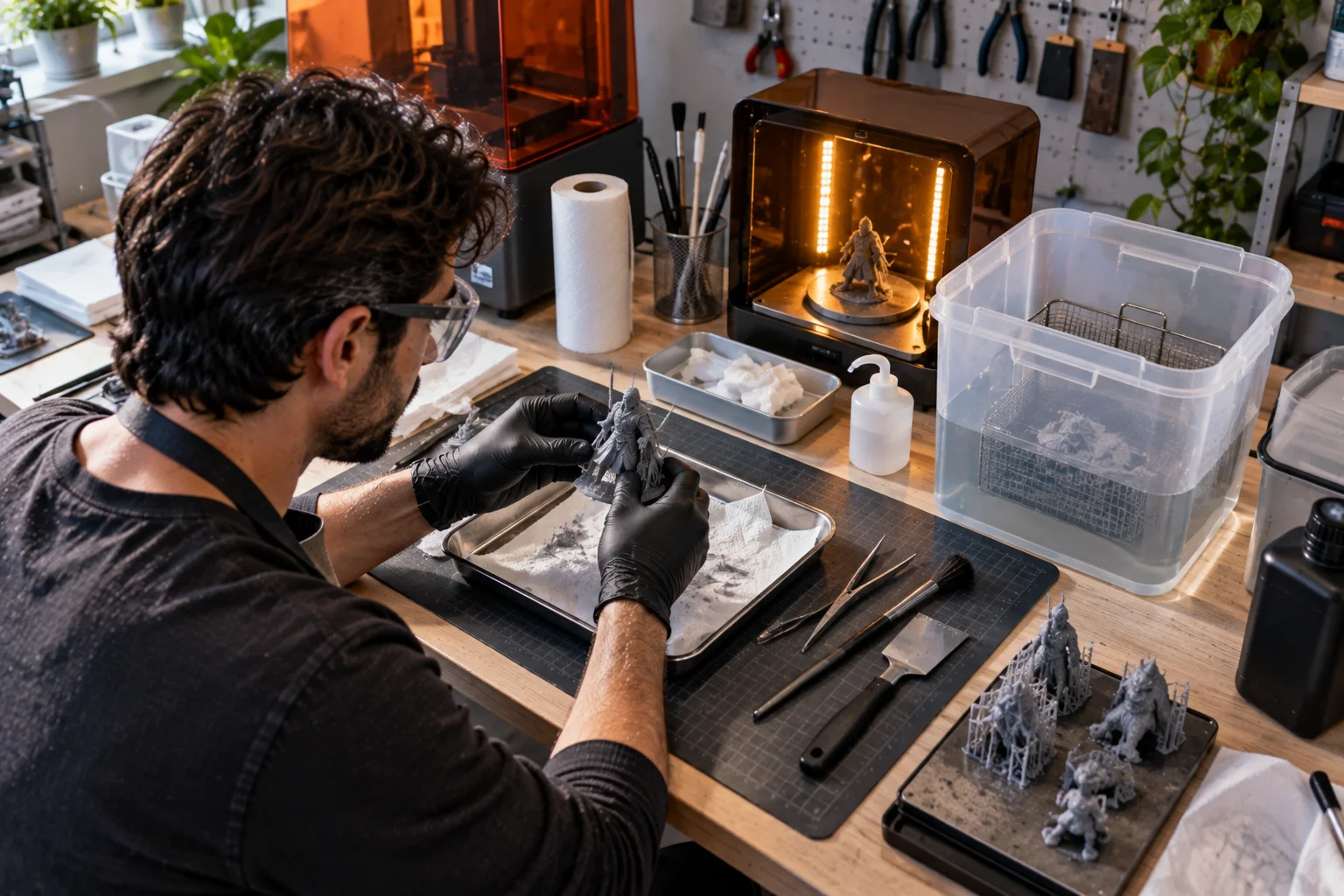
Choosing between resin vs FDM 3D printers comes down to what you actually want to make. FDM, or Fused Deposition Modeling, melts plastic filament and deposits it layer by layer. Resin printers use liquid photopolymer that is selectively cured with light.
For most home users, FDM is the easier starting point. It works with widely available materials such as PLA, PETG and ABS/ASA, handles larger functional parts well and generally requires less messy post-processing.
Resin printing has a different advantage: fine detail. MSLA, SLA and DLP printers can produce highly detailed models with very smooth surfaces, making them particularly useful for miniatures, jewelry prototypes, intricate models and certain visual prototypes.
The trade-off is workflow. Resin printing involves liquid chemicals, washing and UV curing, while FDM is usually more straightforward from digital file to finished part.
Resin vs FDM: What Is the Actual Difference?
FDM builds objects by melting filament through a heated nozzle, while resin printing hardens liquid photopolymer layer by layer using light.
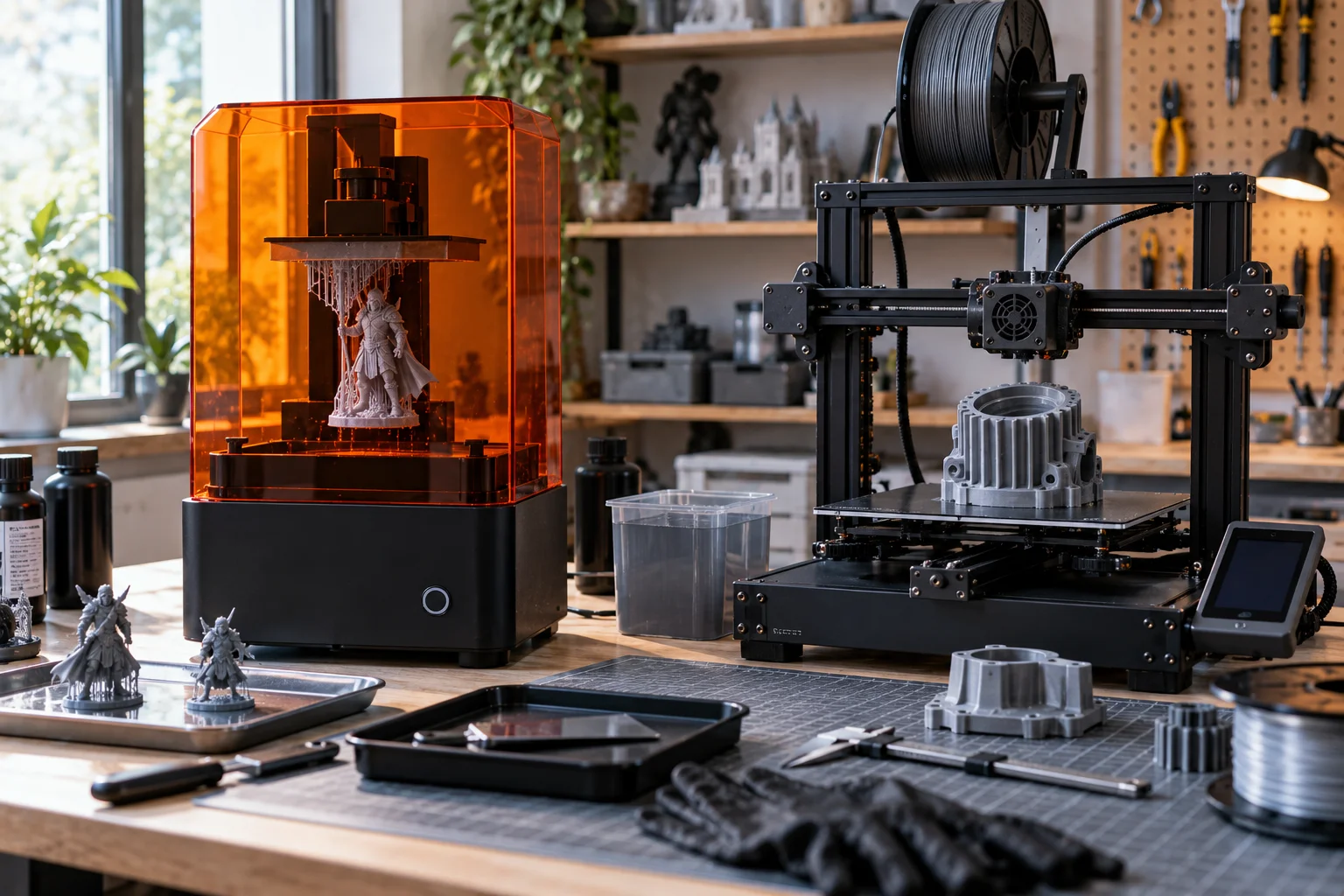
With FDM, a spool feeds plastic filament into an extruder. The filament melts and is deposited onto the build surface. The printer repeats this process layer after layer until the object is complete.
Resin printers instead have a vat of photosensitive liquid. Depending on the technology, a UV light source and LCD mask, projector or laser selectively cures each layer.
That fundamental difference affects almost everything else: materials, surface finish, supports, ventilation, post-processing and the types of parts each printer handles well.
Factor | FDM | Resin |
|---|---|---|
Printing material | Plastic filament | Liquid photopolymer |
Main advantage | Functional, versatile parts | Fine detail and smooth surfaces |
Typical materials | PLA, PETG, ABS/ASA, TPU and composites | Standard, tough, flexible, specialty resins |
Surface finish | Visible layer lines | Very smooth |
Fine detail | Good | Excellent |
Large parts | Generally easier | More limited by vat/build area |
Post-processing | Usually minimal | Washing and UV curing required |
Mess | Relatively low | Higher |
Material handling | Relatively simple | Requires more precautions |
Best starting point | Most beginners | Detail-focused users |
Which Produces Better Print Quality: Resin or FDM?
Resin generally wins for tiny details and smooth surfaces, while FDM can produce excellent quality when dimensional accuracy, material choice and print settings are more important.
Resin printing can produce layer heights in the tens of microns, with very fine surface detail and comparatively subtle layer lines.
That's why resin is popular for:
Tabletop miniatures
Figurines
Jewelry prototypes
Small mechanical models
Detailed sculptures
Dental and visual models
Small product prototypes
FDM can still produce impressive results, particularly with modern printers and carefully tuned profiles. Its strength is less about microscopic detail and more about producing useful physical objects from practical materials.
For example, a functional bracket doesn't necessarily benefit from resin's ultra-fine surface resolution if the part needs toughness, heat resistance or repeated mechanical use.
Which Is Better for Functional Prototypes?
FDM is usually the more versatile choice for functional prototyping because it offers a broad selection of engineering-oriented filament materials.
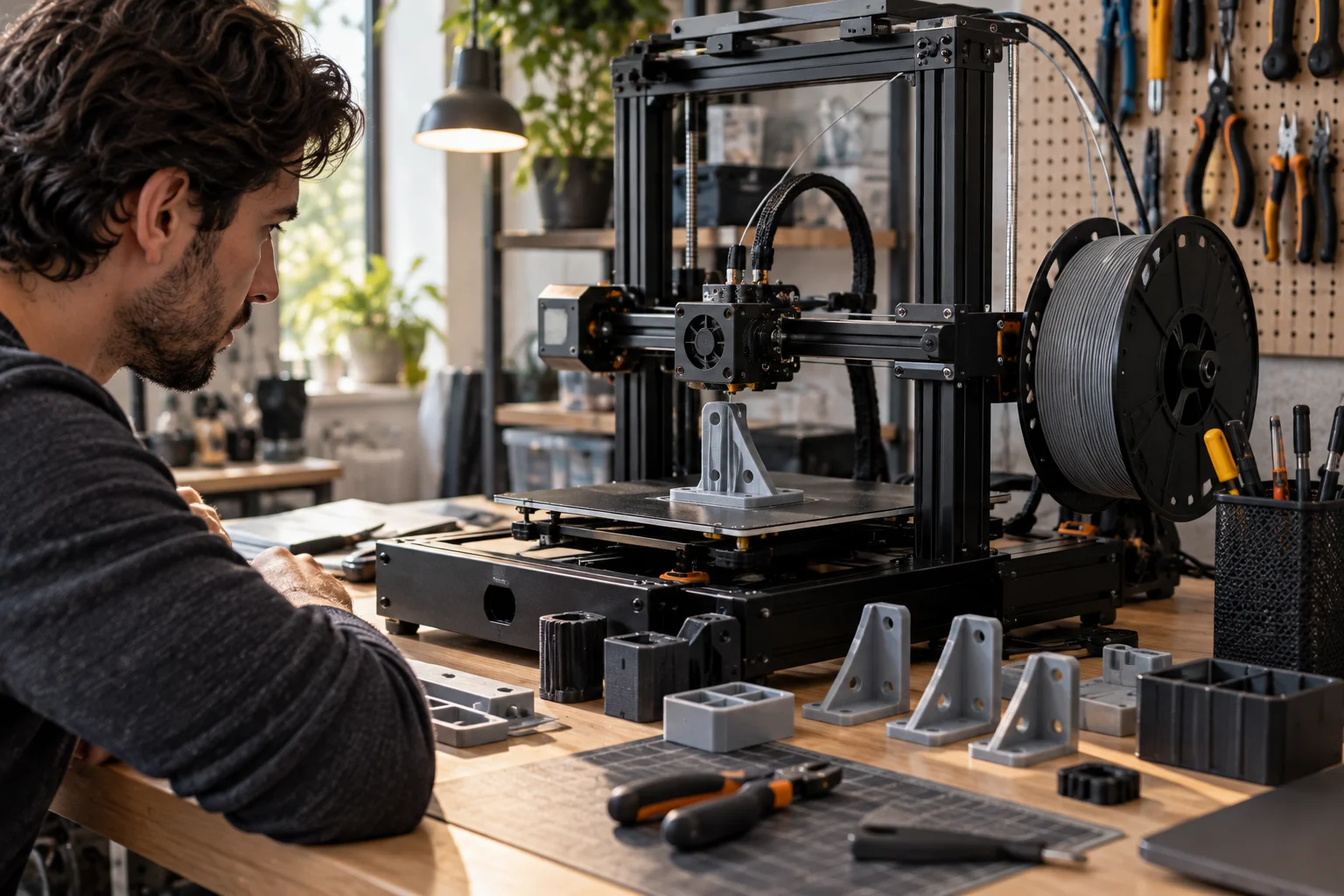
You can choose different filaments according to the job. PLA is easy to print, PETG is useful for durable general-purpose parts, ABS/ASA can suit more demanding applications, and flexible TPU can be used for grips, seals and protective components.
That makes FDM particularly useful for:
Brackets
Enclosures
Mounting hardware
Jigs and fixtures
Replacement parts
Product fit checks
Mechanical prototypes
Tooling
Household organizers
Professional 3D-printing workflows also use FDM/FFF for rapid prototyping, custom fixtures and low-volume production parts.
Resin can absolutely be used for prototypes, especially when appearance and detail matter. Specialized engineering resins can provide improved mechanical properties, but the material has to be selected for the intended application.
When Does Resin Make More Sense for Prototyping?
Resin becomes especially useful when the prototype needs to closely reproduce small details, textures, curves or intricate geometry.
Imagine you're creating a small consumer product enclosure with tiny buttons, fine lettering and detailed surface features.
An FDM printer can make it, but you may spend more time dealing with layer lines, nozzle limitations and support structures.
A resin printer can reproduce small features much more cleanly.
This is particularly useful for:
Industrial design models
Small product mockups
Miniature components
Jewelry prototypes
Detailed visual models
Casting patterns
Highly detailed presentation prototypes
Modern model resins are also available for rapid prototyping, combining high resolution with improved mechanical properties.
Which Printer Is Easier to Use at Home?
FDM is generally easier to live with because the material is supplied as a solid filament and finished parts often need little post-processing.
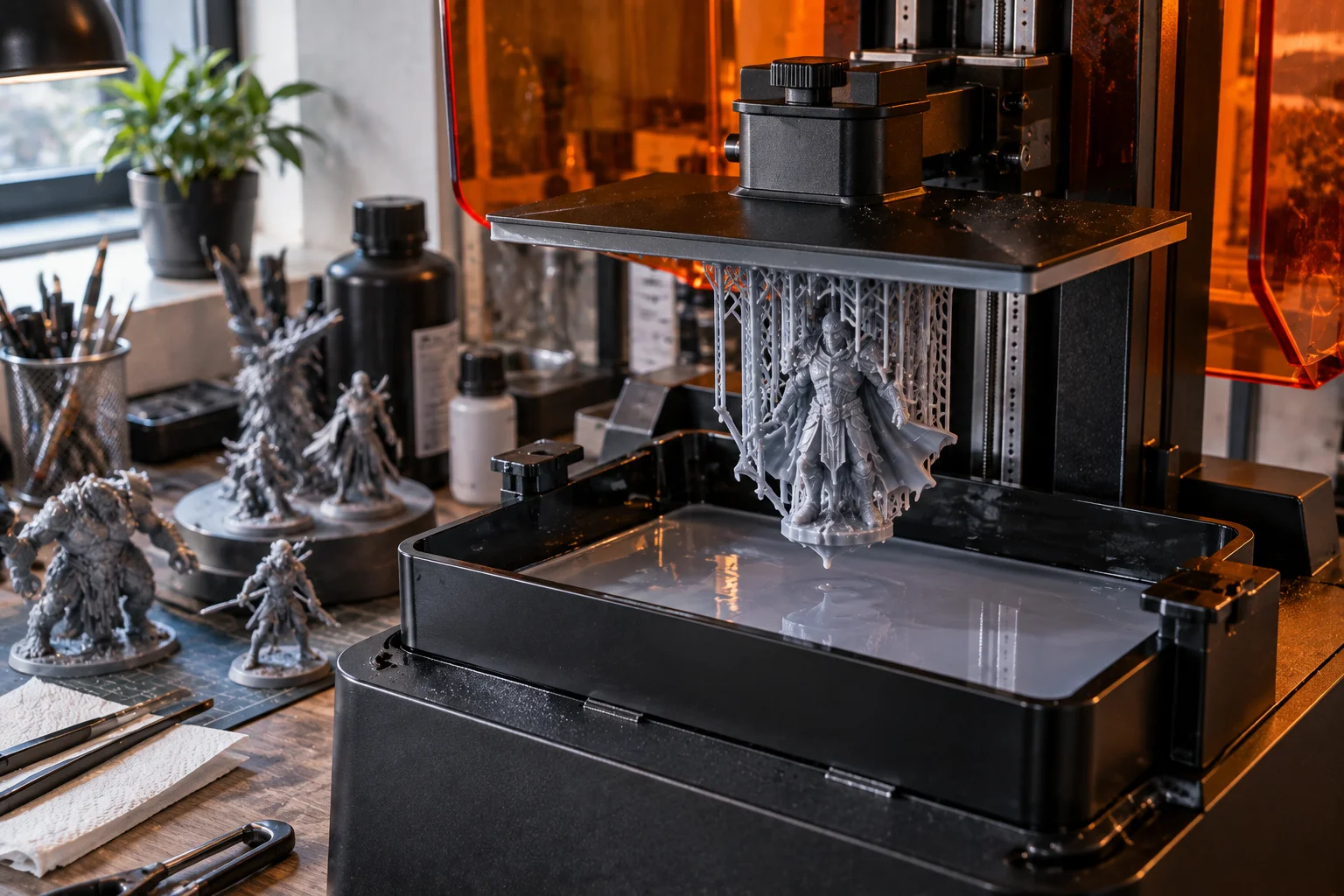
With FDM, you typically remove the print from the build plate, remove supports if necessary and clean up the edges.
Resin involves a longer workflow:
Print the model.
Remove it from the build plate.
Remove supports.
Wash away uncured resin.
Dry the part.
UV-cure it according to the resin and workflow.
Dispose of contaminated waste appropriately.
Prusa specifically recommends washing resin prints and further curing them because freshly printed resin parts can retain uncured material.
That doesn't make resin impractical. It simply means you need a dedicated workflow and workspace rather than treating the printer like a conventional desktop appliance.
Is Resin 3D Printing Safe for Home Use?
Resin printing requires more careful chemical handling than ordinary FDM printing, particularly while the resin is liquid or incompletely cured.
Uncured photopolymer resin should not be treated like harmless plastic. Prusa's safety guidance recommends limiting exposure to liquid resin and residues and using appropriate protective equipment such as gloves and goggles according to the material's safety information.
Ventilation is another consideration.
This is why a resin printer is better suited to a dedicated, well-managed workspace than an improvised setup beside your bed or on a shared dining table.
Different resin formulations also have different properties, so always follow the manufacturer's safety data and handling instructions.
Which Is More Affordable to Run?
FDM generally offers a simpler and often more economical material workflow, especially for everyday functional printing.
The actual cost depends on the printer, material, print failure rate, model size and post-processing requirements.
FDM filament is relatively straightforward to store and load. Resin printing adds consumables and workflow requirements such as cleaning liquid, gloves, paper towels or other disposable materials, and UV curing equipment depending on the setup.
There's also the question of failed prints.
A failed FDM print can mean wasted filament. A failed resin print can leave liquid resin that must be cleaned and handled properly.
For someone printing brackets, organizers, replacement parts and prototypes regularly, these differences can add up.
Which Is Better for Large 3D Prints?
FDM is generally the more practical choice for large home prints.

FDM printers are available with substantially larger build volumes, and large objects can be split into multiple sections when necessary.
Resin printers are excellent at producing detailed smaller objects, but increasing the size of resin prints also increases material use, support requirements and post-processing.
If you're thinking about printing:
Helmet components
Cosplay parts
Large organizers
Tool holders
Enclosures
Furniture accessories
Large prototypes
FDM usually makes more sense.
For a 5-inch miniature covered in tiny details, the equation changes.
Resin vs FDM for Different Home Projects
The best technology depends more on the object than on the printer itself.
Project | Better fit | Why |
|---|---|---|
Miniatures | Resin | Fine detail |
Figurines | Resin | Smooth surfaces |
Jewelry prototypes | Resin | Tiny features |
Phone stand | FDM | Simple functional geometry |
Tool organizer | FDM | Larger practical parts |
Replacement bracket | FDM | Material versatility |
Mechanical prototype | FDM | Functional materials |
Detailed product model | Resin | Surface quality |
Cosplay armor | FDM | Large build volume |
Flexible grip | FDM | TPU and similar filaments |
Small display model | Resin | Fine details |
Large enclosure | FDM | Size and material efficiency |
What About Speed: Is Resin Actually Faster?
Resin can be faster for producing multiple small detailed objects because MSLA systems expose an entire layer at once rather than tracing every object individually.
With MSLA, the LCD mask exposes the complete layer simultaneously. As a result, printing several objects on the same build plate can take roughly the same layer exposure time as printing one object, although the total workflow still depends on the printer, layer count and post-processing.
FDM behaves differently because the nozzle physically travels around each object and deposits filament.
So don't simply compare advertised “print speeds.” The geometry and number of parts matter.
Resin vs FDM: Which One Should You Buy?
For a first 3D printer, FDM is the more broadly useful option for most home users; choose resin when fine detail is the primary requirement and you can provide an appropriate workspace.
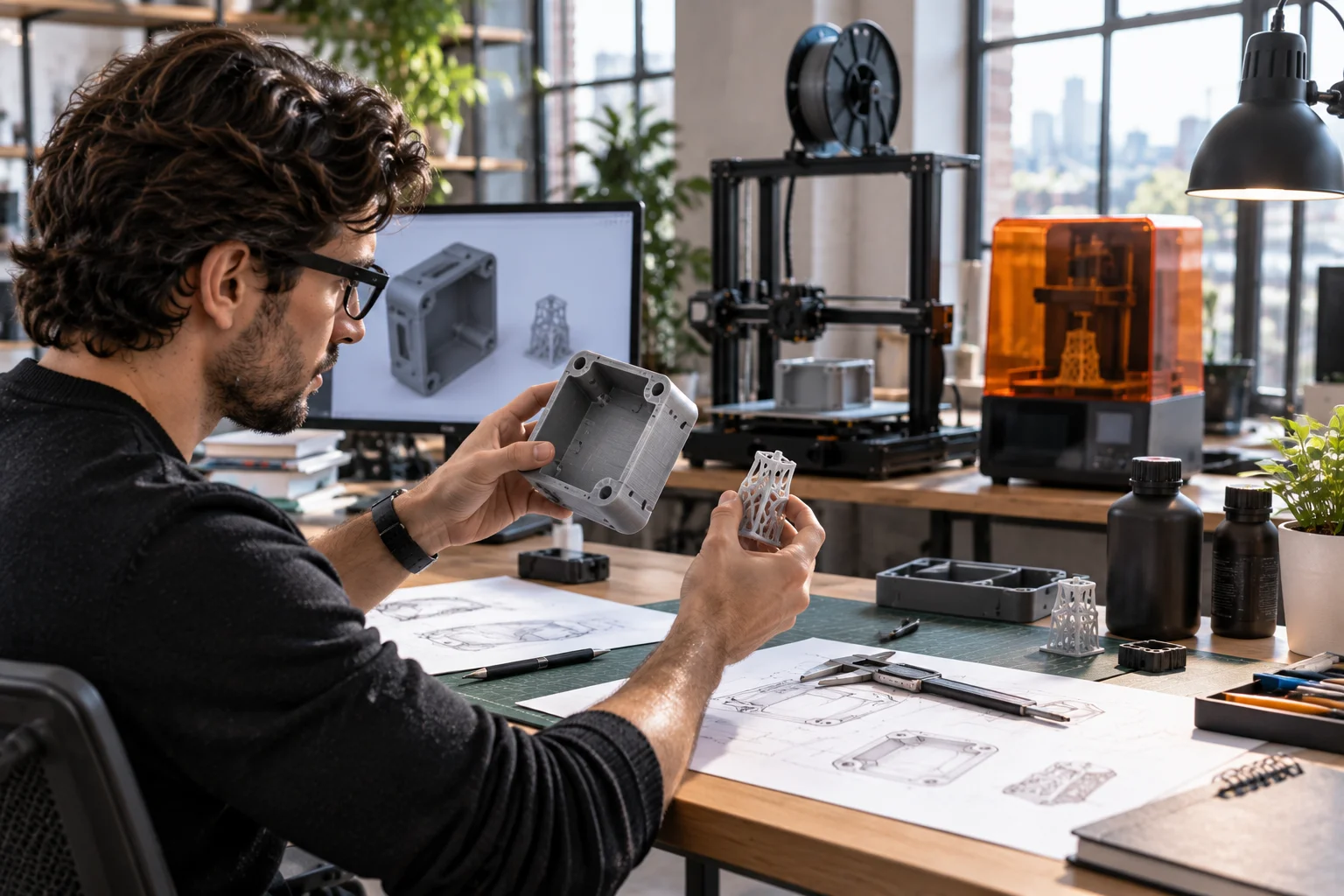
Choose FDM if you want:
A general-purpose home printer
Functional prototypes
Replacement parts
Larger objects
Affordable everyday printing
Multiple filament materials
Less complicated post-processing
Choose resin if you mainly want:
Miniatures
Highly detailed models
Jewelry prototypes
Smooth presentation models
Tiny intricate components
High-resolution visual prototypes
If you're unsure, think about the last ten things you would actually print. If most are functional objects, FDM is probably the natural starting point. If most are miniatures, sculptures or tiny detailed models, resin's strengths become much more valuable.
Frequently Asked Questions About Resin vs FDM 3D Printers
Is resin better than FDM?
Neither technology is universally better. Resin generally produces finer details and smoother surfaces, while FDM offers broader material choices and is often more practical for functional and larger parts.
Is FDM safer than resin?
FDM avoids handling liquid photopolymer resin, so its material-handling workflow is generally simpler. However, different filaments can have different emissions and safety considerations, particularly at high printing temperatures. Follow the manufacturer's guidance for both technologies.
Can resin printers make functional parts?
Yes. Engineering and tough resins can produce functional prototypes and mechanical components. However, standard resin can be relatively brittle, so material selection matters.
Can FDM produce detailed miniatures?
Yes, but resin usually has an advantage for very small details and smooth surfaces. FDM can still work well for larger miniatures and models.
Which is better for beginners?
FDM is generally the easier starting point because the material is solid, the workflow is simpler and there is less post-processing.
Which is better for prototyping?
It depends on the prototype. FDM is usually better for functional and larger prototypes, while resin is particularly useful for small, highly detailed visual prototypes.
The Bottom Line
FDM is the better all-rounder; resin is the specialist for detail.
For home projects, repairs, organizers, brackets, tools and functional prototypes, FDM offers a practical combination of material variety, part size and relatively straightforward operation.
Resin becomes compelling when appearance and microscopic detail are more important than simplicity. Miniatures, jewelry, intricate models and highly detailed prototypes are where its strengths become obvious.
The smartest choice isn't the printer with the highest resolution or fastest advertised speed. It's the technology that matches the parts you actually plan to make.