Buying a new TV used to be relatively simple.
You looked at the screen size, resolution and price, then picked the one that looked best in the store.
Now you have OLED, QLED, Mini-LED, Neo QLED, QNED, HDR, Dolby Vision, 120Hz and a collection of other terms that can make choosing a television feel more complicated than it needs to be.
The good news is that OLED, QLED and Mini-LED have distinctly different strengths once you understand how they produce an image.
OLED uses self-lit pixels, allowing individual pixels to switch off completely. That's why OLED is known for deep blacks and exceptionally precise contrast. QLED is an LCD-based technology that uses Quantum Dots to enhance color and brightness. Mini-LED is a more advanced type of LCD backlighting that uses much smaller LEDs and more precise local dimming to improve brightness and contrast.
So which is best?
There isn't one answer for everyone.
The right choice depends on your room, viewing habits, screen size, content and budget.
What is the difference between OLED, QLED and Mini-LED?
The simplest way to understand the three technologies is to look at how they create light.
Technology | How it works | Biggest strength | Best suited to |
|---|---|---|---|
OLED | Every pixel produces its own light | Perfect blacks and pixel-level contrast | Movies, premium viewing |
QLED | LCD panel + LED backlight + Quantum Dots | Brightness and vivid color | Everyday entertainment |
Mini-LED | LCD + much smaller LED backlight + local dimming | Brightness, HDR and improved contrast | Bright rooms, sports, gaming |
Neo QLED | Samsung's Mini-LED-based QLED approach | Brightness + Quantum Dot color + precise dimming | Premium all-round viewing |
The important distinction is that OLED is a self-emissive display technology, while QLED and Mini-LED generally build on LCD technology.
Mini-LED isn't really a replacement for QLED in the same way OLED is. A Mini-LED TV can also use Quantum Dot technology, which is why you will see products described as both QLED and Mini-LED. Samsung's Neo QLED range is a good example.
How does an OLED TV actually work?
OLED creates light at the pixel level, so individual pixels can turn completely off when displaying black.
That's the defining characteristic.
Imagine a movie scene showing a person standing beneath a night sky.
On an OLED TV, the pixels representing the black sky can switch off while the pixels representing the person remain illuminated.
There isn't a traditional backlight sitting behind the entire panel trying to dim that section.
The result is exceptionally deep black and precise contrast.
OLED's strengths include:
Extremely deep blacks
Excellent contrast
Precise light control
Strong viewing angles
Very fast pixel response
Slim panel designs
Excellent cinematic performance
That's why OLED has become particularly popular among movie and premium home-theater enthusiasts.
What is QLED and how is it different from OLED?
QLED is essentially an advanced LCD TV design that uses Quantum Dots to improve color and brightness.
The Quantum Dot layer helps produce a wider and more vivid range of colors.
Unlike OLED, QLED still relies on a backlight.
That means the pixels don't individually switch off in the same way OLED pixels do.
The result can be extremely bright and colorful, particularly in well-lit rooms.
QLED can therefore make a lot of sense if your television is used for:
Sports
Daytime TV
News
Streaming
General family entertainment
Large-screen viewing
Samsung describes Quantum Dots as nanoscale semiconductor materials that help produce precise colored light and improve brightness and color expression.
The important thing to remember is that not all QLED TVs are equivalent.
A basic QLED and a premium Mini-LED QLED can have dramatically different contrast and backlight performance.
What is Mini-LED and why is it different from QLED?
Mini-LED uses much smaller LEDs in the TV's backlight, allowing manufacturers to fit more LEDs and control the lighting more precisely.
That's the key.
A conventional LCD TV might divide its backlight into a relatively limited number of dimming zones.
Mini-LED allows manufacturers to create much finer control over those areas.
Imagine a black night sky with a bright moon.
A conventional LCD may struggle to keep the area around the moon completely dark because the backlight zone is illuminating a larger section.
With Mini-LED, the backlight can be controlled more precisely.
The result can be:
Higher brightness
Better HDR performance
Improved contrast
Deeper-looking blacks
Better control of bright and dark areas
Samsung's Neo QLED TVs combine Quantum Dot color technology with Quantum Mini LEDs and local backlight control.
So you can actually have a TV that is both QLED and Mini-LED.
That's why comparing "QLED vs Mini-LED" can be misleading.
Which TV technology has the deepest blacks?
OLED has the fundamental advantage because each pixel can switch itself off completely.
Mini-LED can produce very impressive blacks through local dimming, but it still uses an LCD panel with a backlight.
That distinction becomes particularly noticeable in dark rooms.
A movie scene with stars against a black sky is a classic example.
OLED can turn off the pixels surrounding each star.
Mini-LED has to dim the relevant backlight zones.
Modern Mini-LED TVs can control those zones extremely precisely, but they aren't controlling light at exactly the same pixel level as OLED.
If black level and contrast are your highest priorities, OLED's architecture gives it a natural advantage.
Which is brighter: OLED, QLED or Mini-LED?
High-end Mini-LED and QLED TVs can have a significant brightness advantage, particularly in bright rooms and HDR content.
This is where Mini-LED becomes particularly interesting.
Because it uses a powerful LED backlight, a premium Mini-LED TV can produce very bright highlights while controlling the backlight more precisely than a conventional LCD TV.
Samsung specifically positions its Neo QLED Mini-LED televisions around high brightness and HDR performance.
Modern OLED televisions have also become considerably brighter than earlier generations, so the old idea that "OLED is always dim" is too simplistic.
Still, if your living room gets lots of daylight, high-end Mini-LED deserves serious consideration.
Which is best for a bright living room?
Mini-LED or a strong QLED is often a practical choice for a bright room because high brightness can help overcome ambient light.
Consider a television positioned opposite a large window.
During the afternoon, sunlight may wash out darker scenes and make the screen harder to see.
A bright Mini-LED TV can maintain strong image impact in those conditions.
OLED can still work very well, particularly with newer high-brightness models and good reflection handling.
But don't buy based on the panel type alone.
Look at:
Peak brightness
Sustained brightness
Anti-reflection treatment
Screen finish
Window placement
Your typical viewing time
The specific TV can matter just as much as the technology category.
Which is best for movies and Netflix?
OLED is particularly compelling for movies because of its deep blacks, precise contrast and pixel-level light control.
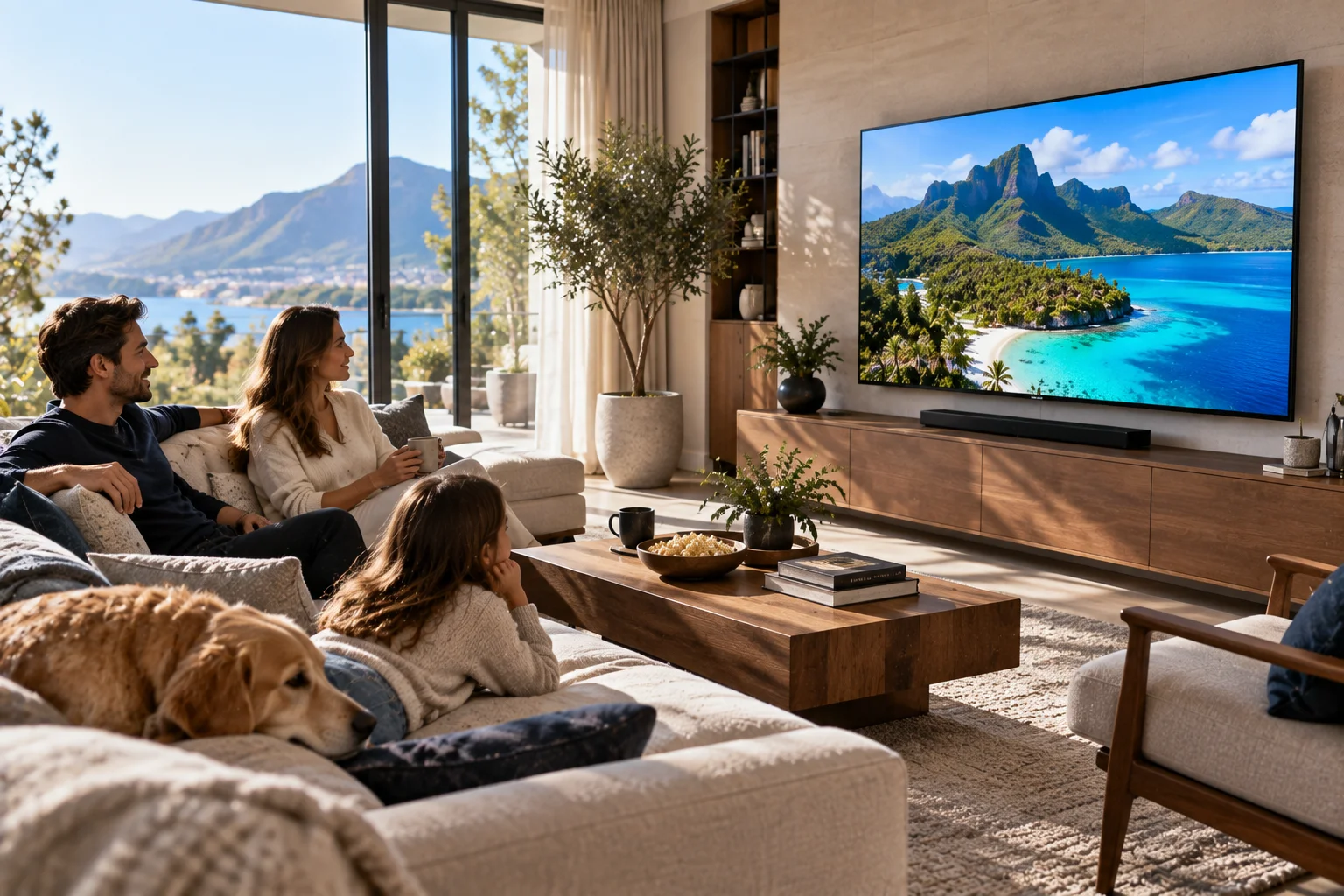
If you mostly watch films in the evening with the lights dimmed, OLED's strengths become easier to appreciate.
Dark scenes can look exceptionally clean.
Black bars around widescreen movies can also blend into the darkness of the room.
Mini-LED can still deliver an excellent movie experience, especially if you want a brighter picture or a very large screen.
Samsung's own comparison describes OLED as particularly suited to deep blacks and immersive dark-room viewing, while Mini-LED emphasizes brightness and HDR performance.
Which TV is better for sports?
Mini-LED and QLED can be excellent choices for sports because of their brightness and strong color performance.
Sports are often watched during the day.
You may also have bright stadium lights, fast movement and large areas of uniform color.
Brightness helps keep the picture punchy.
But don't stop at the display technology.
For sports, also look for:
120Hz or higher refresh rate
Strong motion processing
Low motion blur
Good upscaling
Wide viewing angles
OLED's extremely fast pixel response can also make it excellent for fast-moving content.
So for sports, the specific model's motion handling matters enormously.
Which is best for gaming?
Both OLED and premium Mini-LED TVs can be excellent for gaming, but they have different strengths.
OLED's fast pixel response is particularly useful for fast-moving games.
Mini-LED can offer high brightness and strong HDR impact, which can make bright explosions, sunlight and other highlights look impressive.
When choosing a gaming TV, look beyond OLED versus Mini-LED.
Check for:
120Hz or higher refresh rate
HDMI 2.1
Variable Refresh Rate
Auto Low Latency Mode
Low input lag
FreeSync or G-Sync compatibility where relevant
HDR performance
Samsung notes that both its Neo QLED Mini-LED and OLED models support gaming-oriented features such as VRR and ALLM on applicable models.
For serious gaming, those specifications can matter more than the marketing name on the panel.
Which has better viewing angles?
OLED generally has an advantage when people are watching the TV from different positions around the room.
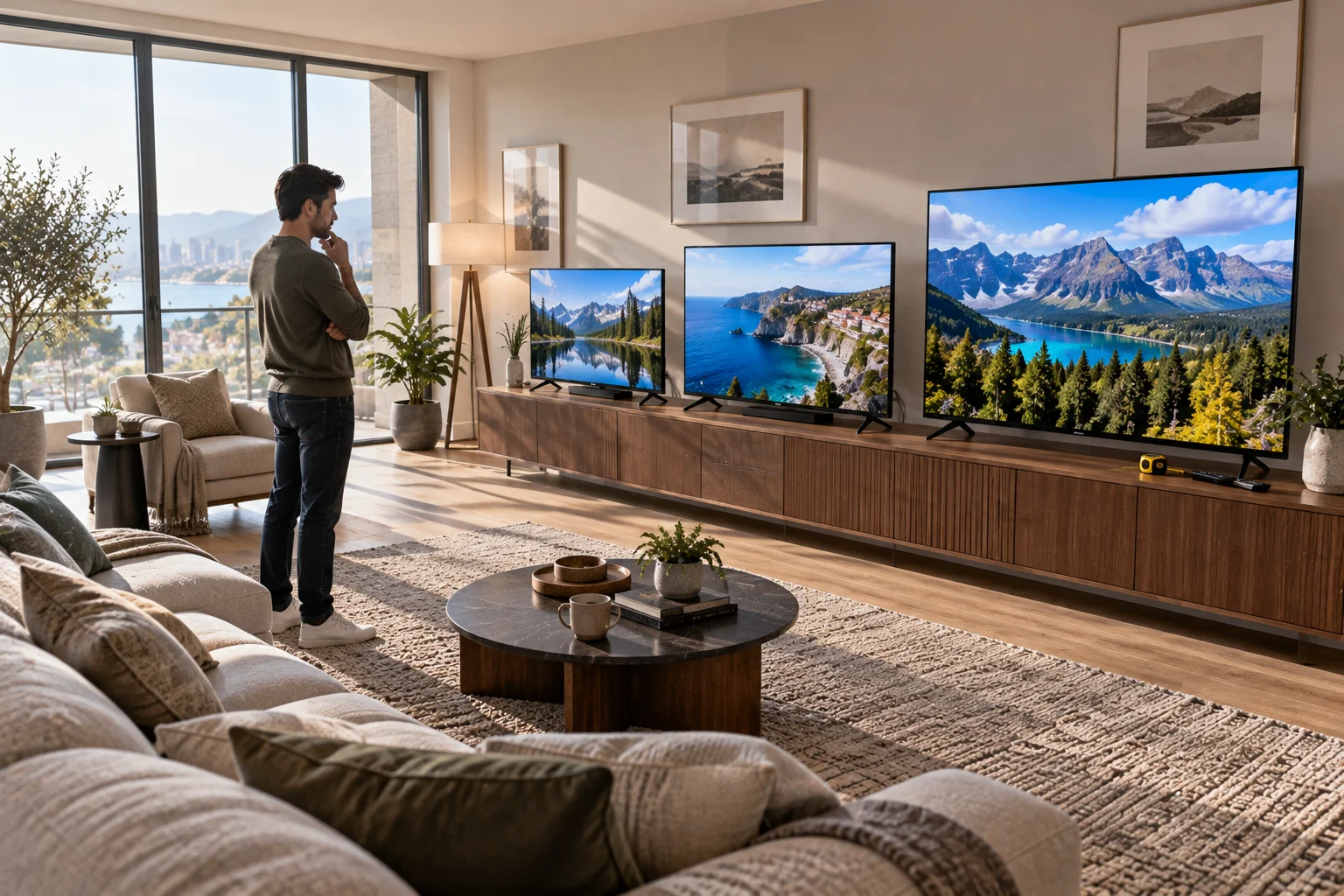
This matters in larger living rooms.
If you're sitting directly in front of the television, it may not matter much.
But if someone is sitting several feet to the side, LCD-based TVs can show changes in brightness or color depending on the panel technology.
OLED's self-emissive structure generally maintains its image characteristics more consistently at wide viewing angles.
If you regularly have a family watching from sofas positioned across a large room, viewing-angle performance deserves attention.
Is Mini-LED better than QLED?
Mini-LED can be considered an advanced backlighting approach rather than a completely separate alternative to QLED.
This is where TV terminology gets confusing.
QLED refers to the Quantum Dot color layer.
Mini-LED refers to the backlight.
A premium TV can use both.
Samsung's Neo QLED is essentially a combination of Quantum Dot technology and Mini-LED backlighting.
So when you see:
QLED
you're mainly talking about the Quantum Dot-enhanced LCD display.
When you see:
Mini-LED QLED
you're generally getting the Quantum Dot color technology plus more precise Mini-LED backlighting.
That's usually a more advanced implementation.
Does OLED have burn-in?
OLED can experience permanent image retention under certain prolonged usage conditions, although modern OLED TVs use technologies designed to reduce the risk.
This matters most if you watch content with static elements for very long periods.
For example:
News channels with permanent logos
Financial tickers
Static game interfaces
Desktop computer interfaces
Digital signage
For normal mixed television use, this may not be a major concern.
But if you're buying a TV specifically to use as a computer monitor or display static content for many hours every day, an LCD-based Mini-LED display may deserve closer consideration.
This is one area where your usage pattern matters more than picture-quality rankings.
Which TV technology uses the most power?
Power consumption depends heavily on screen size, brightness, settings and usage, so the panel type alone doesn't tell the whole story.
A huge 85-inch TV running at high brightness will naturally consume more electricity than a smaller television.
Mini-LED's powerful backlight can consume significant energy when producing high brightness.
OLED doesn't require a conventional full-screen backlight, and its power consumption can vary with the brightness and content being displayed.
If energy use matters to you, check the actual energy label and manufacturer specifications for the model you're considering.
Don't assume that "OLED" or "Mini-LED" automatically means lower electricity consumption.
Which technology is best for a large TV?
Mini-LED and QLED can be particularly attractive when you're looking for a very large screen with strong brightness.
As screen sizes increase, room lighting and viewing distance become increasingly important.
A huge television in a bright living room may benefit from the brightness of Mini-LED.
OLED is also available in large sizes and can deliver an exceptionally cinematic experience.
The question becomes:
Do you prioritize maximum contrast and cinematic black levels, or brightness and large-screen versatility?
Your room should answer that.
OLED vs QLED vs Mini-LED: Which is best for you?
Here's the simplest way to match the technology to your viewing habits.
Your priority | Technology to consider |
|---|---|
Deepest blacks | OLED |
Dark-room movies | OLED |
Bright living room | Mini-LED / QLED |
Strong HDR brightness | Mini-LED |
Vivid colors | QLED / Mini-LED QLED |
Premium cinematic viewing | OLED |
Large-screen family viewing | Mini-LED / QLED |
Fast gaming response | OLED |
Bright HDR gaming | Mini-LED |
Wide seating arrangement | OLED |
Static PC use | Mini-LED / QLED |
Best value | Depends heavily on the specific model |
This isn't a universal ranking.
A premium QLED can outperform a cheap Mini-LED TV.
A high-end Mini-LED can be a better choice than an entry-level OLED for a bright room.
And a premium OLED can be a better movie display than either.
The TV model matters.
What should you check before buying an OLED, QLED or Mini-LED TV?
Don't buy based on the panel name alone.
Check these specifications:
1. Brightness
Particularly important for HDR and bright rooms.
2. Local dimming
Critical for LCD and Mini-LED TVs because it affects contrast and black levels.
3. Refresh rate
Important for sports and gaming.
4. HDMI 2.1
Worth checking if you own a current-generation game console or gaming PC.
5. HDR formats
Check which HDR standards the TV supports and whether your streaming devices and content use them.
6. Viewing angles
Especially important for large family rooms.
7. Reflection handling
A major consideration for rooms with windows.
8. Screen size
Don't underestimate how much this changes the viewing experience.
9. Smart TV platform
The interface you'll use every day matters more than many buyers realize.
10. Warranty and service
A great picture isn't much consolation if support is poor in your region.
So, should you buy OLED, QLED or Mini-LED?
The answer depends on what you want your television to be good at.
Choose OLED if you care most about deep blacks, precise contrast, cinematic viewing and excellent response for gaming.
Choose QLED if you want a bright, colorful LCD television and are looking for a broad range of models and prices.
Choose Mini-LED if you want the brightness and color strengths of LCD/QLED technology combined with more precise backlight control and stronger HDR performance.
And remember that these categories overlap.
A TV can be QLED and Mini-LED at the same time.
That's why the most useful comparison isn't simply OLED vs QLED vs Mini-LED.
It's:
OLED vs conventional QLED vs premium Mini-LED QLED, in the specific model and size you are considering.
For a dark home theater, OLED's pixel-level control can be extraordinary.
For a bright family room, Mini-LED's combination of brightness and local dimming can be extremely compelling.
For everyday viewing at a more accessible price, QLED can offer a strong balance of color, brightness and features.
The best TV technology isn't the one with the most impressive acronym. It's the one that suits your room, your content and the way you actually watch television.
FAQs
Is OLED better than QLED?
OLED has an architectural advantage for black levels and pixel-level contrast because each pixel can switch itself off. QLED can offer higher brightness and vivid color, particularly in bright environments. The better choice depends on your viewing conditions and priorities.
Is Mini-LED better than OLED?
Neither is universally better. Mini-LED can offer very high brightness and strong HDR performance, while OLED offers self-lit pixels, deep blacks and precise contrast. Your room and viewing habits should determine the choice.
Is Mini-LED the same as QLED?
No. Mini-LED refers to the backlighting system, while QLED refers to an LCD display using Quantum Dot technology. A television can use both technologies, as with Samsung's Neo QLED range.
Which is best for watching movies?
OLED is particularly well suited to movies because of its deep blacks and precise contrast. Mini-LED can also be excellent, especially if you watch in a bright room or want a very large screen.
Which is best for a bright room?
A high-brightness Mini-LED or QLED TV can be a strong choice because of its ability to produce bright images. Modern OLED models can also perform well in bright rooms, so compare the actual brightness and reflection handling of the models you're considering.
Which is best for gaming?
Both OLED and Mini-LED can be excellent gaming displays. OLED offers extremely fast pixel response, while Mini-LED can provide strong brightness and HDR. Look for 120Hz or higher refresh rates, low input lag, VRR and HDMI 2.1 support where required.
Is QLED worth buying?
Yes, if you want a bright, colorful LCD television without necessarily moving to a premium OLED or Mini-LED model. The value depends heavily on the specific TV, its backlight, brightness, processing and price.
Which TV technology should you choose?
Start with your room and viewing habits. For dark-room movies and maximum contrast, consider OLED. For bright rooms and HDR-heavy viewing, consider Mini-LED. For a versatile LCD TV with strong color and brightness, QLED remains a useful option.
The panel technology is only the beginning. The specific TV model, screen size and how you use it ultimately matter more than the acronym on the box.