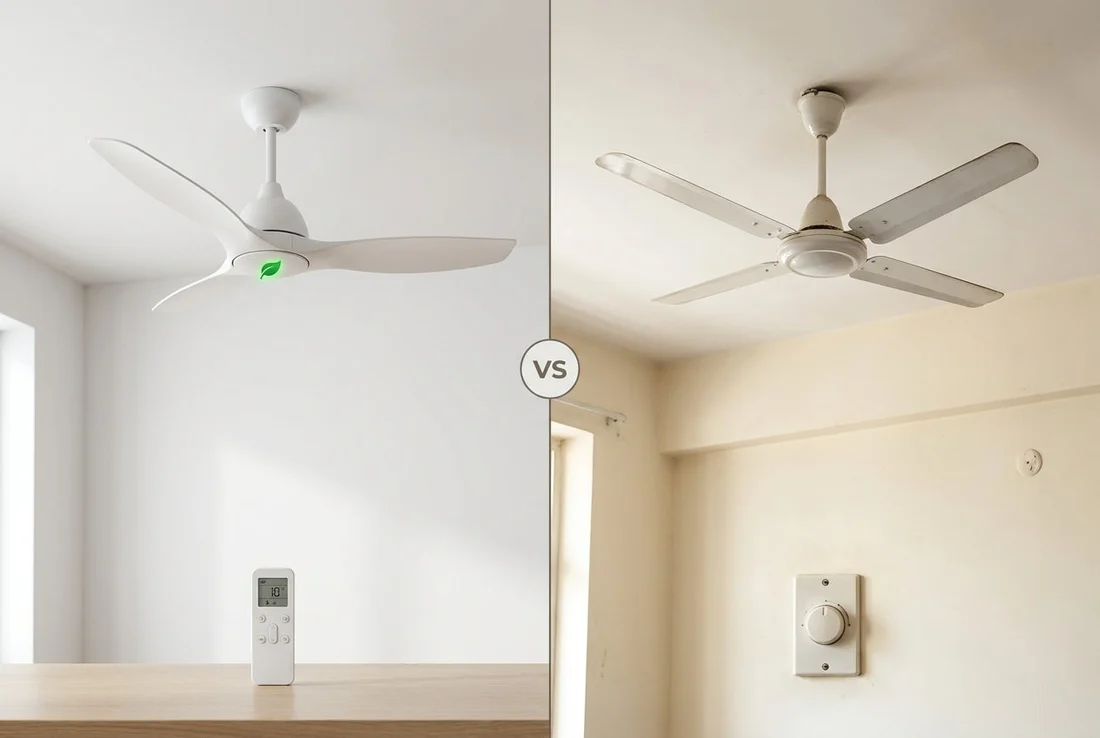
A ceiling fan can be one of the most frequently used appliances in a home, particularly in warmer climates. That makes its energy consumption worth paying attention to. While traditional fans have remained a familiar household choice for decades, Smart Fans powered by BLDC motors are changing the way people think about everyday cooling.
At first glance, the difference may seem simple. A regular fan moves air, while a smart fan adds features such as remote controls, app connectivity, scheduling, or voice commands. But there is another important distinction: the motor.
BLDC, or Brushless Direct Current, motor technology can provide efficient operation compared with many conventional fan motors. When combined with smart controls, it can create a fan that is not only easier to operate but potentially less expensive to run.
So, are BLDC Smart Fans really worth the extra investment? How much can you potentially save on electricity? And when does a regular fan still make sense?
Let's compare the two across efficiency, features, running costs, maintenance, and everyday usability.
BLDC vs Regular Fans: What's the Difference?
Before comparing smart features, it helps to understand the basic technology.
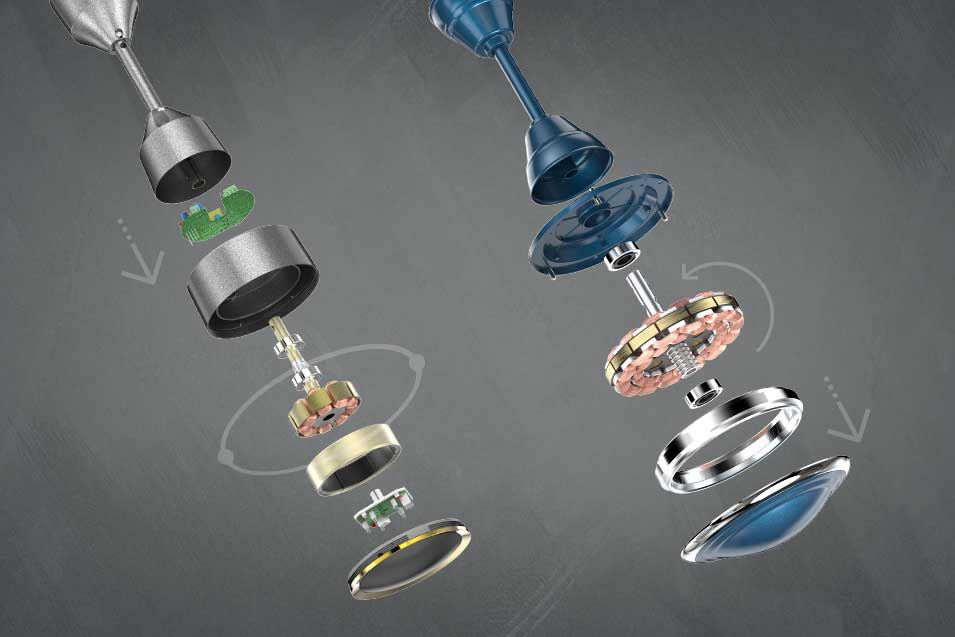
A conventional ceiling fan generally uses an AC induction motor. These motors have been widely used because they are relatively straightforward, dependable, and familiar to consumers.
A BLDC fan uses a brushless direct-current motor. Instead of relying on mechanical brushes, electronic components control the motor's operation.
That design can offer several advantages, including efficient operation and better speed control.
When smart technology is added, the fan can also become part of a connected home ecosystem.
At a glance
Feature | Regular Fan | BLDC Smart Fan |
|---|---|---|
Conventional motor | Usually | No |
BLDC motor | No | Yes |
Energy efficiency | Varies | Generally designed for lower power consumption |
Remote control | Some models | Common |
App control | Rare | Available on compatible models |
Voice control | Usually unavailable | Available on compatible models |
Scheduling | Limited | Often available |
Smart-home integration | Limited | Available on compatible models |
Upfront cost | Usually lower | Usually higher |
Potential running-cost savings | Lower potential | Higher potential |
The exact performance depends on the individual model, motor design, operating speed, and usage pattern. "BLDC" should therefore be treated as an important specification rather than a guarantee of a particular electricity bill.
What Is a BLDC Motor?
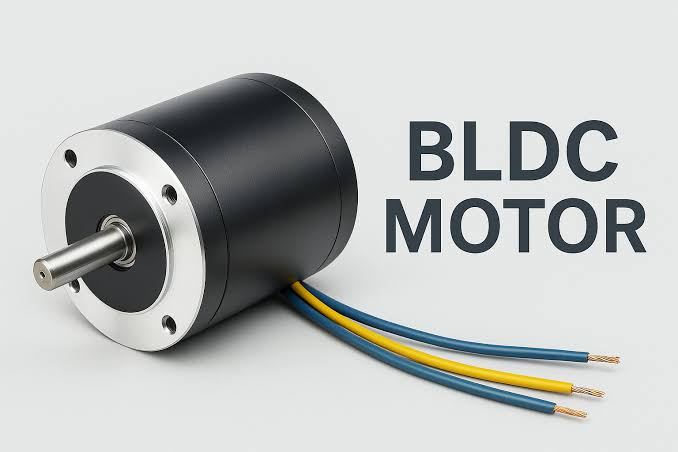
BLDC stands for Brushless Direct Current.
The name comes from the fact that these motors operate without the traditional brushes found in some other motor designs. Electronic controls manage the motor's operation, allowing the fan to run at different speeds efficiently.
One of the biggest reasons BLDC fans attract attention is their lower power consumption compared with many conventional ceiling fans.
A conventional fan might consume substantially more power at its normal operating speed, while a comparable BLDC model can often provide similar airflow using considerably less electricity.
The actual difference varies by model, so always compare the rated wattage of the specific fans you're considering.
Why does this matter?
Fans often run for several hours a day.
A difference of only a few dozen watts may seem insignificant when viewed over one hour. But multiply that difference by:
Several hours every day
Multiple fans in a home
Several months of use
Multiple years of ownership
The potential difference becomes much more meaningful.
How Much Electricity Can BLDC Smart Fans Save?
Let's use a simple example.
Suppose a regular fan uses around 70 watts, while a BLDC model uses around 35 watts under comparable operating conditions.
If both operate for 10 hours a day:
Regular fan
70W × 10 hours = 700 Wh
= 0.70 kWh per day
BLDC fan
35W × 10 hours = 350 Wh
= 0.35 kWh per day
Over 30 days:
Fan | Example daily consumption | Example monthly consumption |
|---|---|---|
Regular fan | 0.70 kWh | 21 kWh |
BLDC fan | 0.35 kWh | 10.5 kWh |
Difference | 0.35 kWh | 10.5 kWh |
That's an illustrative example rather than a guarantee. Actual consumption depends on the fan's rated power, selected speed, operating conditions, and household usage.
If your electricity tariff were ₹8 per kWh, the illustrative monthly difference would be:
10.5 kWh × ₹8 = ₹84 per month per fan
Across a year:
₹84 × 12 = ₹1,008
If a household operates three similar fans for comparable periods, the theoretical difference could become approximately ₹3,024 per year.
Again, these are examples designed to explain the calculation. Actual savings should be calculated using the wattage and electricity rate applicable to your specific situation.
Running Cost Formula
You can estimate the electricity cost of any fan using a simple formula:
Power consumption (kW) × Hours used × Electricity rate = Running cost
For example:
0.035 kW × 10 hours × ₹8 = ₹2.80 per day
The easiest way to compare fans is therefore to find their rated wattage and use your own electricity tariff.
This is more reliable than assuming that every BLDC fan will provide the same savings.
Why Smart Features Matter

Energy efficiency is only one part of the comparison.
Smart Fans add another layer: control.
Instead of relying only on a wall regulator, users may be able to manage the fan through a remote, smartphone app, voice assistant, or automated schedule.
Common smart features include:
Remote control
Smartphone control
Voice commands
Speed adjustment
Sleep modes
Timer functions
Scheduling
Smart-home integration
Status monitoring
Not every model offers all these features.
For example, one Smart fan might have only a remote control, while another may connect to Wi-Fi and work with a voice assistant.
That's why it's important to check the exact specification rather than assuming every smart fan offers the same experience.
BLDC Smart Fans and Voice Control
Voice control can be particularly convenient for ceiling fans.
Imagine you're already comfortable in bed and want to reduce the speed.
Instead of reaching for the remote or getting up, a compatible fan may allow you to use a voice command through a supported smart-home platform.
Similarly, you might turn a fan on while preparing dinner or change its speed while working at your desk.
The biggest advantage isn't improved airflow. It's convenience.
For households that already use voice assistants, Smart Fans can fit naturally into existing routines.
Scheduling Can Help Reduce Unnecessary Usage
One of the most practical smart features is scheduling.
A fan doesn't need to run continuously if nobody is using the room.
With compatible scheduling tools, you may be able to set the fan to operate at specific times.
For example:
7:00 PM — Fan starts when the family returns home
11:00 PM — Fan changes to a lower setting
6:30 AM — Fan switches off
The exact functions depend on the model and its connected platform.
The important idea is that automation can help align fan usage with your routine.
That can potentially reduce unnecessary runtime, which may contribute to lower electricity consumption.
Smart Features vs Real Energy Savings
It's worth making an important distinction.
A fan being "smart" does not automatically make it energy efficient.
A connected fan with a conventional motor may still consume more electricity than a highly efficient BLDC model.
Likewise, a BLDC fan operated continuously at high speed can use more electricity than a conventional fan that is only used for a few hours.
The biggest factors are:
Motor efficiency
Rated power consumption
Operating speed
Hours of use
Number of fans
Electricity tariff
User behavior
Think of smart technology as a way to improve control, while BLDC technology primarily addresses motor efficiency.
When the two are combined, you get both advantages.
BLDC Smart Fan vs Regular Fan: Cost Comparison
The upfront purchase price is another important factor.
Regular fans are usually less expensive to purchase because their technology is simpler.
BLDC Smart Fans can cost more because they combine more efficient motor technology with electronics, remote controls, connectivity, and additional features.
This creates an important question:
Does the higher purchase price eventually pay for itself?
The answer depends on:
Purchase-price difference
Electricity tariff
Hours of operation
Number of fans
Expected lifespan
Actual power consumption
Simple payback example
Suppose:
Regular fan: ₹3,000
BLDC Smart Fan: ₹5,000
Price difference: ₹2,000
If the BLDC fan saves approximately ₹1,000 per year in electricity under your usage conditions, the simple energy-cost payback would be around two years.
But this is only an illustration. Your actual payback period could be shorter or considerably longer.
What About Maintenance?
Both conventional and BLDC fans can provide long service when properly manufactured and maintained.
BLDC motors don't use brushes in the traditional sense, which eliminates brush replacement as a maintenance concern.
However, smart fans contain electronic components that conventional fans may not have.
These can include:
Control boards
Wireless connectivity components
Sensors
Remote receivers
Display systems
This doesn't mean Smart Fans are unreliable. It simply means buyers should consider warranty coverage and after-sales support.
For a connected appliance, good manufacturer support can be particularly valuable.
Which Fan Is Better for Bedrooms?
Bedrooms are one of the strongest use cases for BLDC Smart Fans.
A fan may operate for several hours every night, making energy consumption important.
Smart controls can also be convenient when you're already in bed.
Look for:
Quiet operation
Multiple speed settings
Timer functionality
Sleep mode
Remote control
App or voice support
Low power consumption
If you're replacing a bedroom fan that runs eight to ten hours every night, the electricity difference can potentially be more meaningful than it would be in a room where the fan is used for only an hour or two each day.
Which Fan Is Better for Large Homes?
For a larger home with several frequently used fans, energy efficiency can become more significant.
Imagine a household with four fans operating regularly.
Even a modest reduction in power consumption per fan can add up across the household.
This is where BLDC technology can become particularly interesting.
However, don't assume that every room needs a Smart fan.
You might prioritize smart connectivity in bedrooms and living rooms while choosing simpler energy-efficient fans for less frequently used spaces.
The best solution can be a combination rather than an identical fan throughout the home.
Quick Comparison Chart
Factor | Regular Fan | BLDC Smart Fan |
|---|---|---|
Purchase price | Lower in many cases | Higher in many cases |
Motor efficiency | Varies | Generally high |
Electricity consumption | Typically higher than comparable BLDC models | Typically lower |
Remote operation | Model-dependent | Common |
Smartphone control | Rare | Often available |
Voice control | Rare | Available on compatible models |
Scheduling | Limited | Often available |
Long-term running costs | Potentially higher | Potentially lower |
Technology | Simpler | More advanced |
Best suited to | Budget-focused buyers and simple setups | Frequent users and connected homes |
What Should You Check Before Buying?
Don't buy based only on the label "BLDC" or "Smart."
Check the specifications.
1. Rated wattage
This is one of the most important numbers when comparing energy use.
2. Air delivery
Lower electricity consumption is useful only if the fan provides adequate airflow for your room.
3. Speed control
Check how many speed levels are available and how easily they can be adjusted.
4. Remote control
Make sure the included remote offers the functions you actually want.
5. App support
If the fan connects to a smartphone app, check what the app can actually control.
6. Voice assistant compatibility
If you use Alexa, Google Home, or another smart-home platform, verify compatibility before purchasing.
7. Warranty
A longer warranty can provide additional confidence when buying an appliance with electronic components.
8. Service availability
Check whether the manufacturer has accessible service support in your area.
A Practical Buying Checklist
Before choosing between a regular fan and a BLDC Smart Fan, ask yourself:
How often will I use it?
Frequent daily use makes efficiency more relevant.
How much electricity does the fan consume?
Compare actual wattage rather than relying on marketing terms.
Do I need smart controls?
If you're happy with a wall switch and regulator, you may not need connectivity.
Will I use scheduling?
Automation can be valuable if you have predictable routines.
Do I use voice assistants?
If yes, compatibility can make smart controls more convenient.
What's my electricity tariff?
Higher electricity rates can make efficiency improvements more financially meaningful.
How many fans are in my home?
Savings can accumulate when several frequently used fans are replaced.
The Bottom Line
The comparison between BLDC Smart Fans and regular fans isn't simply about old technology versus new technology.
Regular fans remain attractive because they're generally straightforward, widely available, and often less expensive upfront.
BLDC Smart Fans bring together two different benefits: efficient motor technology and connected control.
The BLDC motor can reduce electricity consumption compared with many conventional fan designs, while smart features can make everyday operation more convenient through apps, voice commands, timers, and schedules.
For someone who uses a fan for many hours every day, the potential reduction in running costs may help justify the higher purchase price. For occasional users, the payback may be less significant.
The smartest buying decision is therefore to look at the whole picture:
Purchase price + wattage + usage hours + electricity tariff + useful features + expected lifespan.
Once you calculate those factors, you'll have a much clearer idea of whether a BLDC Smart Fan makes sense for your home.
FAQs
1. What is the difference between a BLDC fan and a regular fan?
A BLDC fan uses a brushless direct-current motor with electronic control, while many conventional fans use AC induction motors. BLDC fans are generally designed to consume less electricity under comparable operating conditions.
2. Are BLDC Smart Fans more energy efficient?
BLDC motors are generally more energy efficient than many conventional fan motors. However, actual electricity consumption depends on the specific model, speed setting, operating hours, and usage conditions.
3. Are Smart Fans expensive to run?
Not necessarily. A Smart Fan with an efficient BLDC motor can have relatively low electricity consumption. However, connectivity itself doesn't determine energy efficiency; the motor and actual usage matter more.
4. Do Smart Fans save electricity?
Smart controls can help users reduce unnecessary operation through timers, schedules, remote control, and automation. The amount saved depends on how the fan is used.
5. Is a BLDC fan worth the higher price?
It can be, particularly for households that operate fans for many hours each day. Lower electricity consumption can help offset the higher upfront price over time, although the actual payback depends on local electricity rates and usage.
6. Can BLDC Smart Fans work with Alexa or Google Home?
Some models support Alexa, Google Home, or other smart-home platforms. Compatibility and available voice commands vary, so check the manufacturer's specifications for the exact model.
7. Do BLDC fans require more maintenance?
BLDC motors don't use traditional motor brushes, which eliminates brush-related maintenance. However, Smart Fans may contain electronic components and connectivity hardware, making warranty and service support important considerations.
8. Do BLDC fans provide better airflow?
Not necessarily. Motor efficiency and airflow are different characteristics. When comparing fans, look at airflow specifications as well as wattage.
9. How do I calculate a fan's running cost?
Multiply the fan's power consumption in kilowatts by the number of hours it operates and your electricity rate.
Formula:
Running Cost = Power (kW) × Hours × Electricity Rate
10. Should every fan in my home be a Smart Fan?
Not necessarily. You can prioritize Smart Fans for rooms where fans run frequently or where remote and voice controls are useful. Simpler energy-efficient fans may be sufficient for less frequently used rooms.