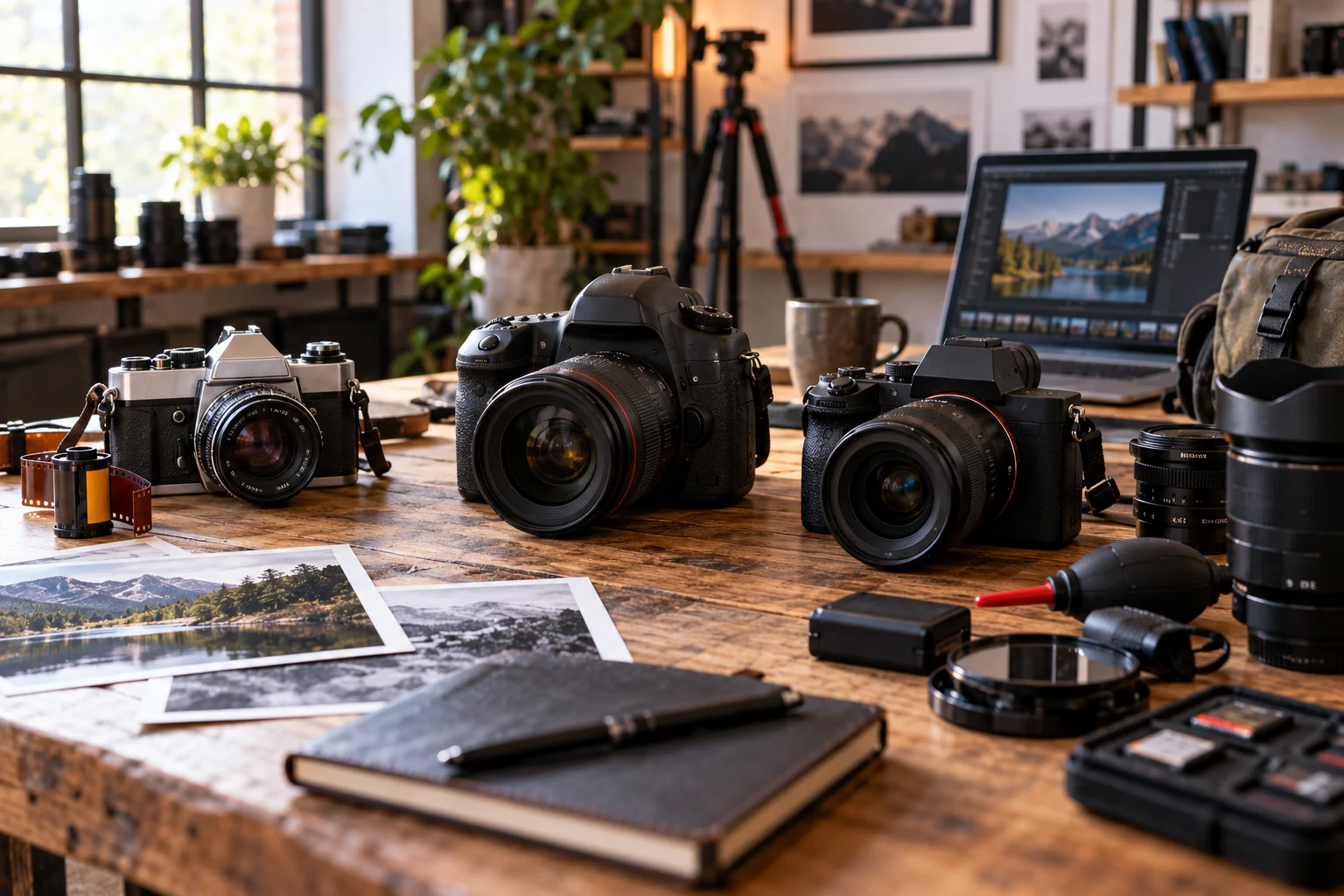
The terms SLR, DSLR and mirrorless are often used interchangeably, but they describe different camera designs and, in one case, a broader family of cameras.
SLR stands for Single-Lens Reflex. The defining feature is the reflex mechanism: light entering through the lens is redirected by a mirror toward an optical viewfinder. When you take a photograph, the mirror moves out of the way so light can reach the film or digital sensor.
A DSLR is simply a Digital Single-Lens Reflex camera. It uses that same fundamental reflex architecture but replaces photographic film with a digital image sensor.
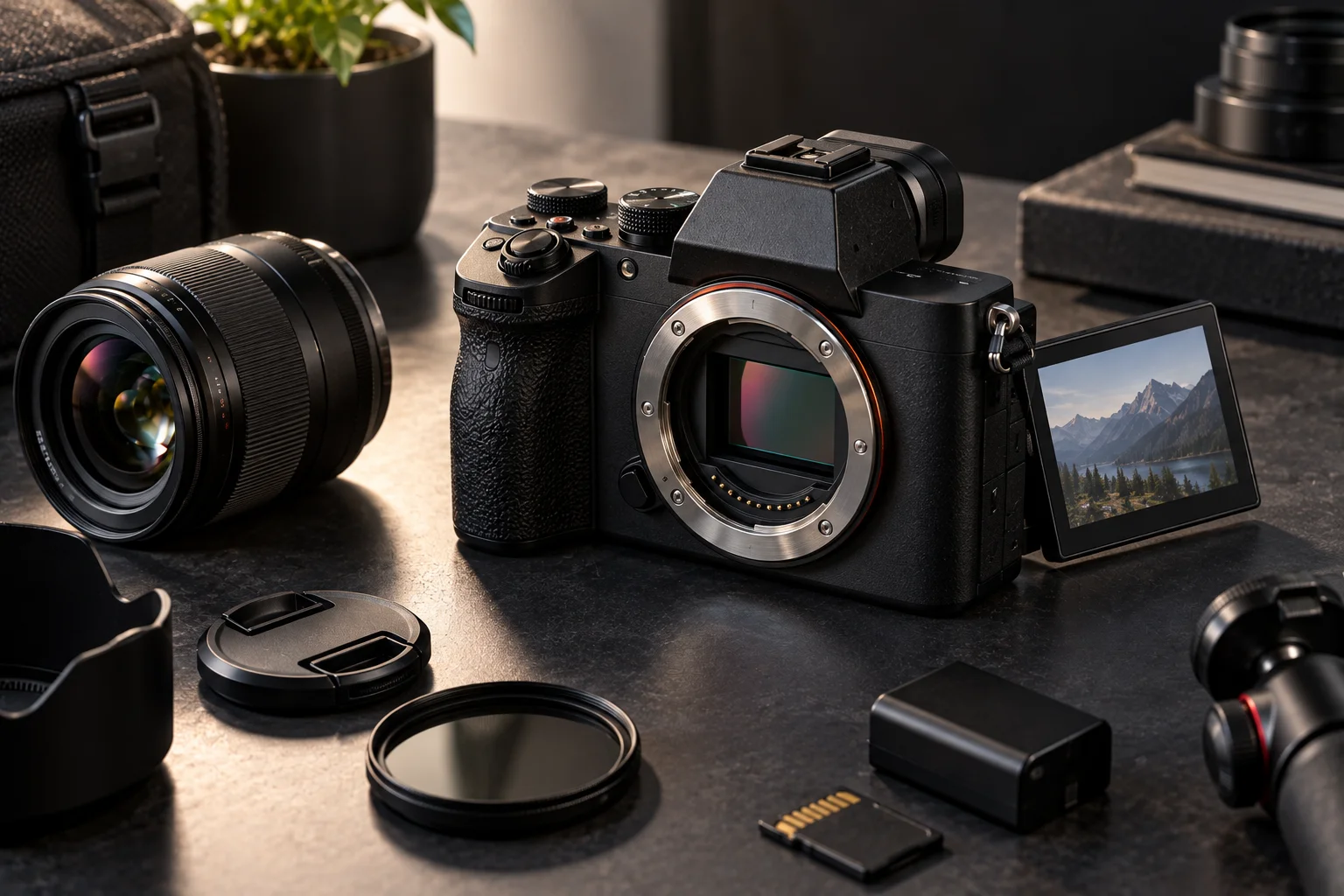
A mirrorless camera removes the reflex mirror entirely. Light travels directly through the lens to the image sensor, while the photographer composes through an electronic viewfinder (EVF), rear screen or both.
That mechanical difference affects size, viewfinder behavior, autofocus, battery life, shooting speed and even lens design.
What Does SLR Actually Mean?
SLR means Single-Lens Reflex, referring specifically to a camera that uses one lens for both viewing and capturing the image through a reflex mirror system.
The basic optical path looks like this:
Lens → mirror → focusing screen/prism → optical viewfinder
When you press the shutter:
Mirror flips up → shutter opens → light reaches film or sensor → image is captured
Because the photographer looks through the same lens that takes the photograph, an SLR avoids the parallax problem found in cameras that use separate viewing and taking lenses. Nikon describes this as one of the defining characteristics of the SLR design.
The important word is reflex. It refers to the mirror reflecting incoming light toward the viewfinder.
What Is the Difference Between SLR and DSLR?
An SLR can use film, while a DSLR uses a digital image sensor.
The optical mechanism is fundamentally similar.
Camera type | Recording medium | Reflex mirror | Viewfinder |
|---|---|---|---|
Film SLR | Film | Yes | Optical |
DSLR | Digital sensor | Yes | Optical |
Mirrorless | Digital sensor | No | Electronic and/or LCD |
A traditional film SLR records the image on photographic film.
A DSLR sends the light to a digital sensor instead.
So DSLR isn't a completely different camera mechanism from SLR. It's essentially the digital version of the single-lens reflex concept.
How Does a DSLR Reflex Mirror Work?
The DSLR mirror redirects light upward to the optical viewfinder before the photograph is taken.
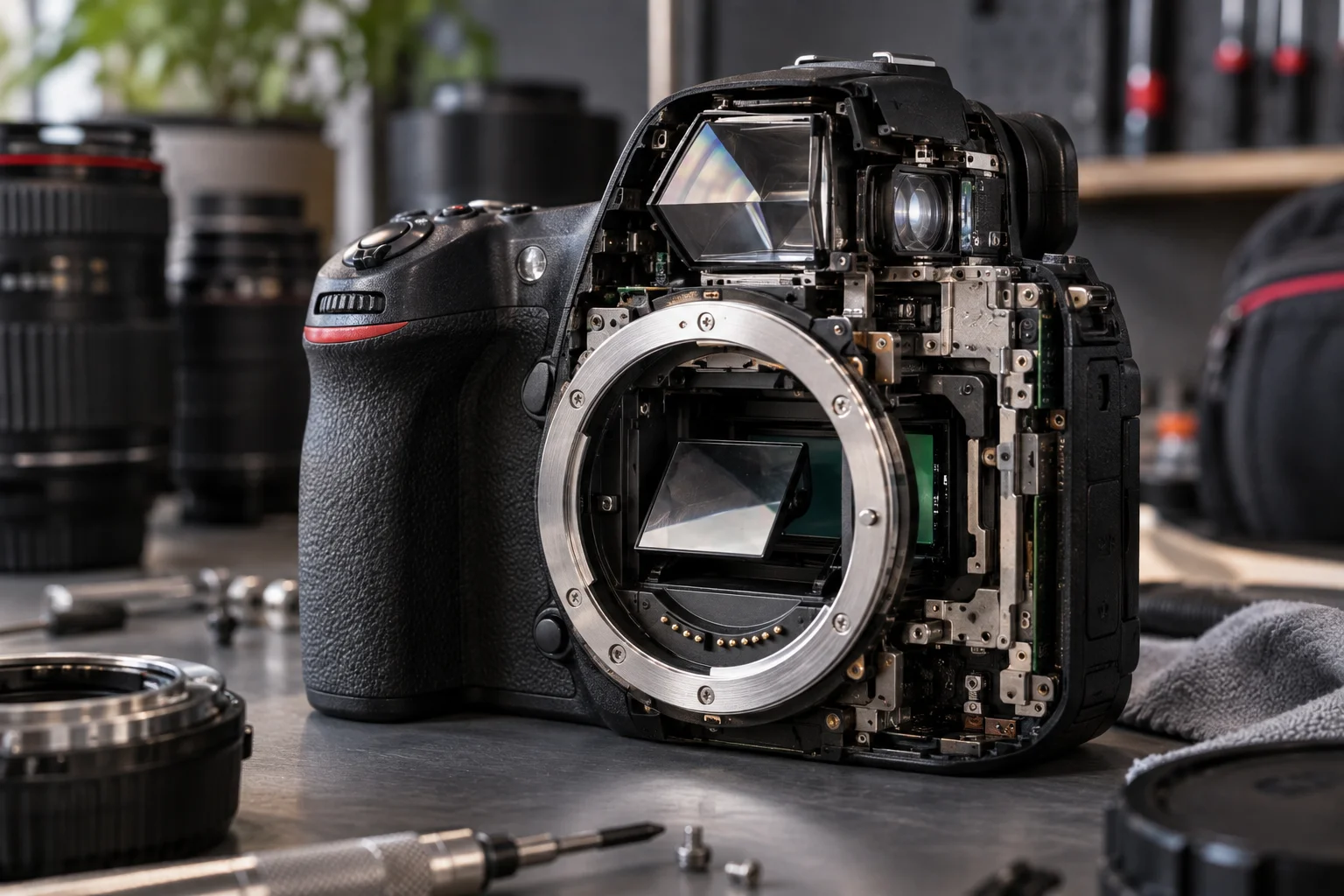
Inside the camera, the mirror sits between the lens and image sensor.
During normal viewfinder shooting, light entering the lens hits the mirror and is redirected upward toward a focusing screen and prism or pentamirror before reaching the photographer's eye.
When the shutter is released, the mirror moves out of the optical path. The sensor can then receive the incoming light.
That's why the optical viewfinder of a DSLR can temporarily go dark during exposure.
Canon's DSLR specifications, for example, describe a quick-return mirror as part of the optical SLR viewfinder system.
This is the mechanical feature that gives the SLR family its name.
How Is a Mirrorless Camera Different?
A mirrorless camera eliminates the reflex mirror and sends light directly from the lens to the image sensor.
The simplified path becomes:
Lens → image sensor → EVF/LCD
The sensor continuously receives light and generates the image information displayed on the electronic viewfinder or screen.
This allows the camera to show a preview that can reflect settings such as:
Exposure
White balance
Picture style
ISO
Aperture
Shutter speed
Nikon notes that this allows photographers to see an approximation of the final image before pressing the shutter.
Canon similarly highlights exposure simulation and the ability of modern EVFs to display a view corresponding to the camera's settings.
Why Does the SLR Mechanism Still Matter?
The reflex mechanism matters because it creates a fundamentally different viewing experience, even though modern mirrorless cameras have replaced it for many applications.

A DSLR optical viewfinder shows the actual scene through optics rather than displaying an electronic representation.
That means:
No sensor-generated preview is required.
There is no electronic display refresh involved.
The scene appears naturally through the optical path.
Battery consumption can be lower when composing through the optical finder.
Nikon notes that DSLRs can retain a battery-life advantage because their optical viewfinders don't require continuous electronic display operation.
For photographers who prefer an uninterrupted optical view of the scene, this remains a meaningful characteristic.
Why Are Mirrorless Cameras Usually Smaller?
Removing the mirror box and optical prism allows manufacturers to build a shorter camera body.
A DSLR needs physical space for:
The reflex mirror
Mirror movement
Focusing components
Focusing screen
Prism or pentamirror
Optical viewfinder
A mirrorless body doesn't need the same optical path.
Nikon says removing the mirror and prism contributes to the smaller and lighter design of its mirrorless cameras.
However, the size difference isn't always dramatic once you add a large lens. Professional mirrorless lenses can still be substantial because the optical requirements of a long or fast lens don't disappear.
DSLR vs Mirrorless: Which Has Better Autofocus?
Modern mirrorless cameras generally have an advantage in subject detection, autofocus coverage and continuous tracking, although older comparisons between DSLR and mirrorless autofocus are increasingly outdated.

Traditional DSLRs often used dedicated phase-detection autofocus sensors positioned beneath the mirror.
Modern mirrorless cameras can perform autofocus directly using the image sensor, allowing autofocus coverage across a much larger portion of the frame.
Canon notes that modern mirrorless systems can provide autofocus coverage approaching the entire frame and support sophisticated eye and subject detection.
This is particularly useful for:
Wildlife
Sports
Children
Events
Moving subjects
Portraits
The advantage isn't simply autofocus speed. Subject recognition and tracking have become major parts of modern autofocus.
Which Has the Better Viewfinder: Optical or Electronic?
An optical viewfinder provides a direct optical view, while an EVF provides more information and can preview the exposure.
An optical viewfinder can feel immediate and natural because you're looking at the scene through the lens.
An EVF, however, can show:
Exposure simulation
Focus peaking
Histograms
Subject detection
Focus information
White-balance changes
Low-light amplification
Canon points out that EVFs can make dim scenes easier to compose because the electronic display can brighten the preview.
For many photographers, this is one of the biggest practical advantages of mirrorless.
Does a DSLR Still Have Advantages?
Yes. DSLRs can still offer excellent image quality, optical viewfinders, long battery life and access to mature lens systems.
A DSLR doesn't suddenly produce worse photographs because mirrorless cameras are newer.
If you already own a good DSLR and lenses, there may be little reason to replace it simply because mirrorless exists.
DSLRs can still make sense for photographers who value:
Optical viewfinders
Long battery life
Familiar controls
Existing lens collections
Used-market value
Proven mechanical operation
Canon itself notes that a DSLR continues to take the same quality of photographs it was designed to capture, even as mirrorless systems have advanced.
Why Are Mirrorless Cameras Dominating New Camera Development?
Mirrorless designs give manufacturers more freedom to integrate modern autofocus, electronic viewing, video and computational features into the camera.

The absence of a moving mirror also makes continuous shooting and electronic shutter operation easier to integrate.
Modern mirrorless cameras can combine sensor-based autofocus with sophisticated subject recognition and high-speed processing.
The lens mount can also be positioned much closer to the sensor. Canon notes that its EOS R mirrorless system has a flange distance of 20mm compared with 44mm for its EOS DSLR design, giving optical designers greater flexibility.
That doesn't automatically make every mirrorless lens better, but it provides manufacturers with a different optical platform.
SLR vs DSLR vs Mirrorless: Which Should You Choose?
For someone buying a new interchangeable-lens camera in 2026, mirrorless is generally the most relevant design to investigate, while SLR and DSLR remain important if you value their optical experience or already own compatible equipment.
Choose a film SLR if you specifically want the analog photography experience.
Choose a DSLR if you value an optical viewfinder, long battery life, existing DSLR lenses or the used market.
Choose mirrorless if you want modern autofocus, compact designs, advanced EVFs, strong video capabilities and the latest lens systems.
The camera body is only part of the equation. Lenses, sensor size, ergonomics and your shooting style often matter more than the basic camera architecture.
Frequently Asked Questions About SLR, DSLR and Mirrorless Cameras
Is SLR the same as DSLR?
Not exactly. SLR means Single-Lens Reflex and can refer to film cameras. DSLR means Digital Single-Lens Reflex and uses a digital sensor instead of film.
Why is it called a reflex camera?
The term refers to the mirror that reflects light from the lens upward toward the optical viewfinder.
Do mirrorless cameras have a mirror?
No. Light passes directly through the lens to the image sensor. The photographer views the scene through an electronic viewfinder or screen.
Is a DSLR better than mirrorless?
Neither is universally better. DSLRs offer an optical viewing experience and can have advantages in battery life, while modern mirrorless cameras generally provide more advanced autofocus, electronic viewing and newer system designs.
Do mirrorless cameras take better pictures?
The absence of a mirror doesn't automatically improve image quality. Sensor, lens, processing, exposure and photographer technique are more important. Mirrorless cameras can, however, offer modern autofocus and lens designs that provide practical advantages.
Why are DSLR cameras bigger?
The reflex mirror, optical viewfinder and prism/pentamirror require additional physical space inside the camera body.
Are SLR cameras still used?
Yes. Film SLRs continue to be used by photographers who want an analog workflow, while DSLRs remain in use by photographers who already own them or prefer their optical viewfinders.
Does a mirrorless camera use more battery?
Often, yes, because the EVF or rear display and sensor are electronically active during composition. DSLR optical viewfinders can reduce electronic power consumption during framing.
The Bottom Line
The SLR mechanism is the key to understanding the entire SLR vs DSLR vs mirrorless debate.
An SLR uses a mirror to redirect light from the lens to an optical viewfinder. A DSLR combines that reflex mechanism with a digital sensor. A mirrorless camera removes the mirror and uses the sensor itself to provide the electronic view.
That change may look simple, but it affects almost everything about how the camera operates.
The optical viewfinder remains the defining appeal of DSLRs. Mirrorless cameras gain advantages from removing the mirror, including smaller body designs, sensor-based autofocus, sophisticated subject detection and exposure-preview capabilities.
For new camera buyers in 2026, understanding the mechanism is more useful than simply assuming newer means better. The right design is the one whose viewfinder, autofocus, lenses, handling and shooting experience fit the photography you actually do.