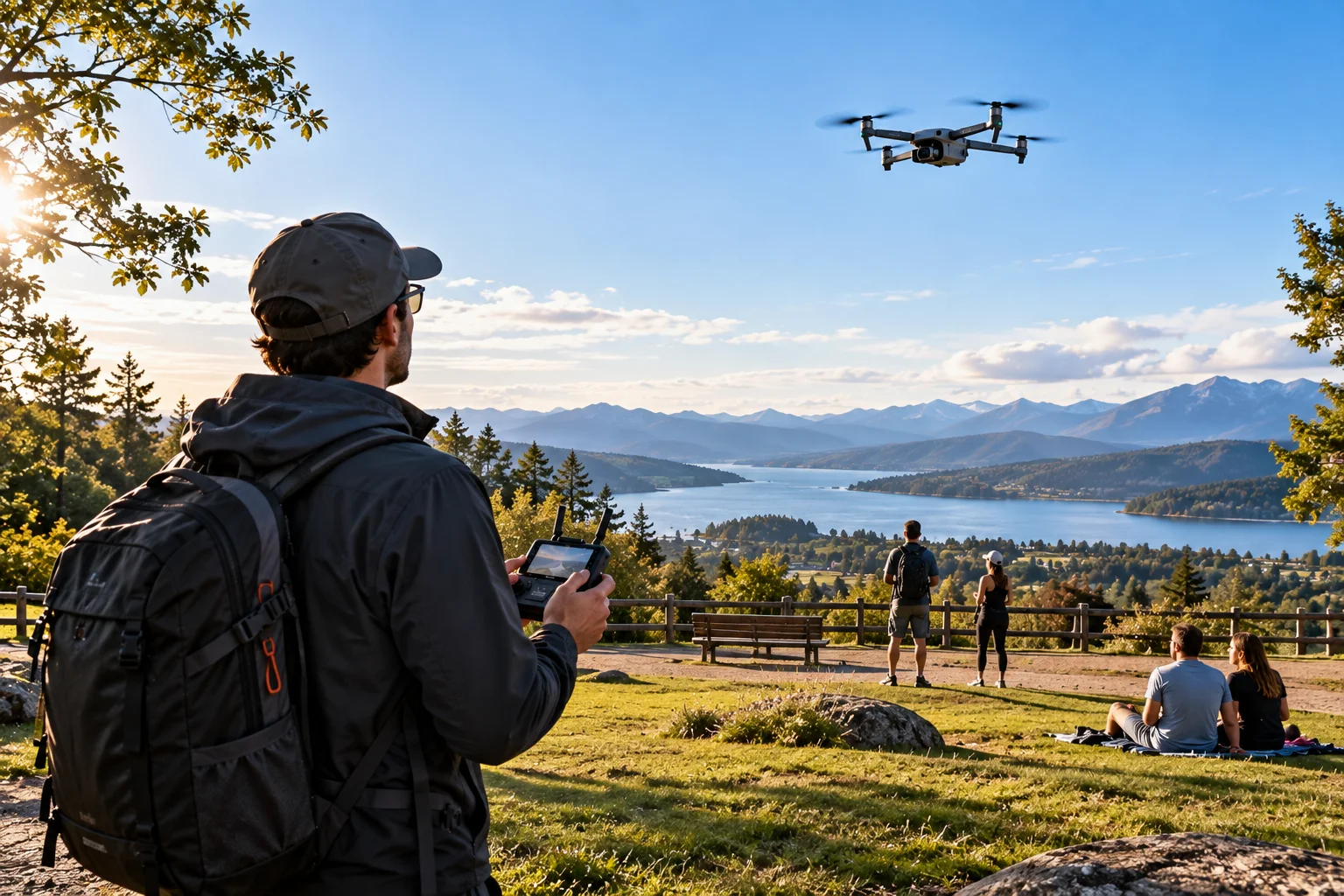
Choosing a drone isn't just about finding the model with the longest flight time or the highest camera resolution. A good drone is a combination of camera quality, flight performance, battery life, transmission range, stabilization, obstacle sensing and safety features.
The right specifications depend on what you actually plan to do with it.
A traveler may care most about portability and image quality. Someone filming sports may prioritize stabilization, tracking and wind resistance. A beginner may benefit more from reliable positioning and obstacle sensing than from a professional-grade camera.
It's also worth remembering that advertised specifications are usually measured under controlled conditions. For example, DJI rates the Air 3S for up to 45 minutes of flight time, but its test assumes specific conditions, including windless operation and controlled battery depletion.
Here's what to look at before buying.
How Do You Choose the Right Drone?
Start with your intended use, then compare the camera, flight time, size, sensing and safety features that actually support it.
A useful starting point is:
If you mainly want to... | Prioritize |
|---|---|
Travel | Compact size, camera, battery |
Take photos | Sensor size, RAW, gimbal |
Shoot video | Resolution, frame rates, dynamic range |
Film sports | Stabilization, tracking, wind resistance |
Learn to fly | Stability, obstacle sensing, easy controls |
Shoot professionally | Camera, codecs, transmission, reliability |
Fly long distances | Battery, transmission, regulatory limits |
You don't necessarily need the most expensive drone. You need the right combination of capabilities.
What Camera Quality Should You Look For in a Drone?
Sensor size usually tells you more about image quality than megapixel count alone.
A drone camera's image quality depends on the sensor, lens, processing, dynamic range, stabilization and recording format.
For example, DJI's Air 3S combines a 1-inch 50MP primary sensor with a 1/1.3-inch 48MP medium-telephoto camera. It can record up to 4K/120fps and supports 10-bit recording modes.
When comparing drone cameras, look for:
Sensor size
Lens aperture
Focal length
Maximum video resolution
Frame-rate options
Dynamic range
10-bit recording
RAW photo support
JPEG/DNG options
Gimbal stabilization
Don't automatically assume that a 48MP camera is better than a 12MP camera. The number of pixels is only one part of the imaging system.
Does a Larger Drone Camera Sensor Matter?
Yes, a larger sensor can provide advantages in difficult lighting, particularly for dynamic range and low-light performance.
A larger sensor can collect more light when paired with an appropriate lens and exposure, giving the camera more information to work with.
This becomes especially noticeable around sunrise, sunset, forests, city streets and other scenes containing both bright and dark areas.
That's why premium drones increasingly use larger sensors rather than simply increasing megapixel counts.
For example, DJI specifically highlights the Air 3S's 1-inch primary sensor and up to 14 stops of dynamic range as part of its imaging system.
Do You Need 4K Video on a Drone?
For most serious video work, 4K is a sensible minimum to look for, but resolution isn't everything.
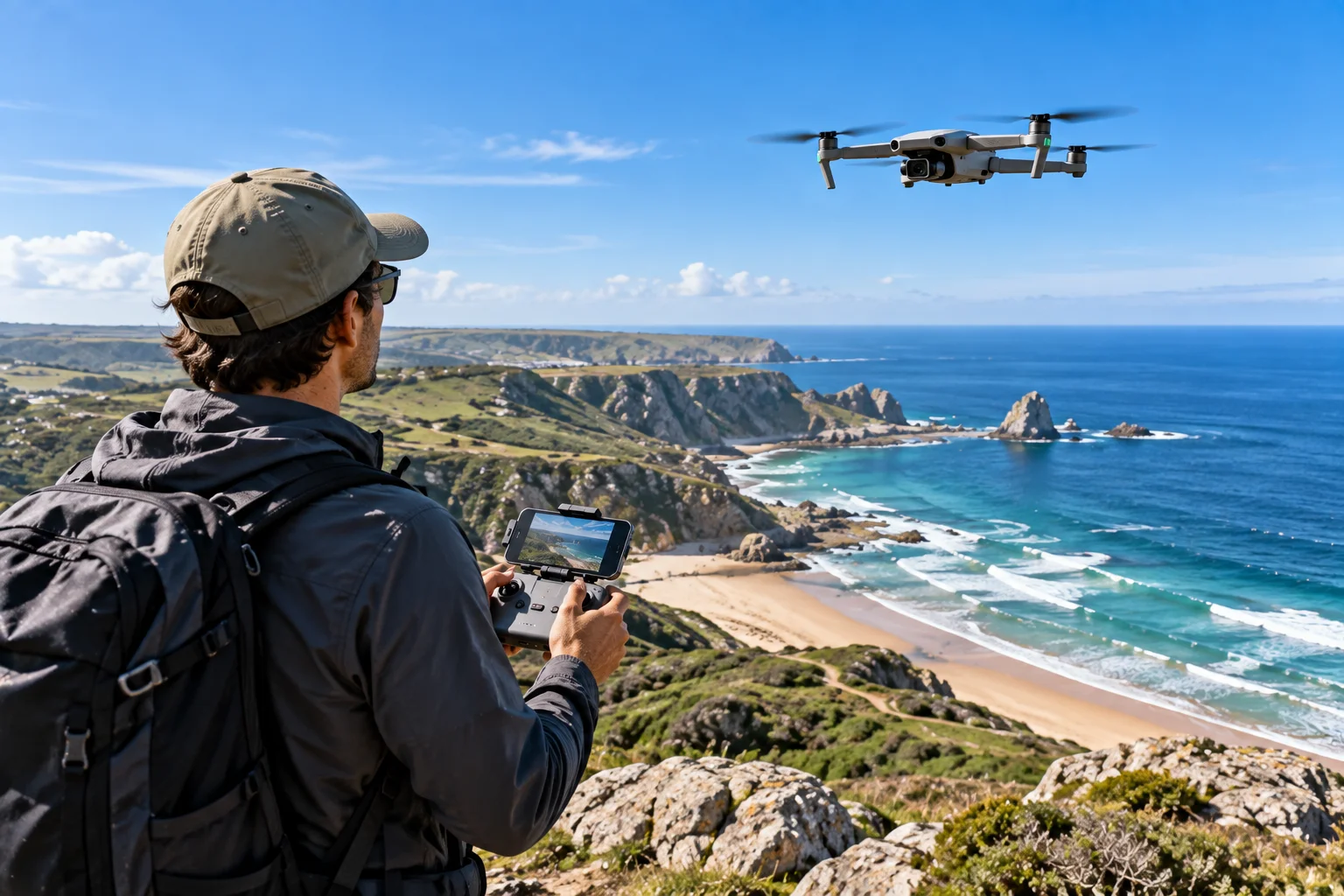
4K provides enough detail for high-quality viewing and gives editors some room to crop footage.
However, also check:
4K frame rates
Bitrate
HDR
10-bit color
Log recording
Codec
Low-light performance
A drone recording 4K video at 120fps offers a very different creative workflow from one limited to 4K/30fps.
For example, the Air 3S supports 4K at up to 120fps, although high-frame-rate modes can have different codec and color-mode limitations.
How Important Is a 3-Axis Gimbal?
A 3-axis mechanical gimbal is one of the most important features for smooth aerial video.
A drone can constantly pitch, roll and yaw as it flies. Without stabilization, those movements would make footage noticeably shaky.
A gimbal uses motors to compensate for these movements and keep the camera pointed in a controlled direction.
The DJI Air 3S, for example, uses a 3-axis mechanical gimbal covering tilt, roll and pan.
If cinematic video matters to you, don't judge a drone's camera solely by resolution. The stabilization system is equally important.
How Much Flight Time Do You Really Need?
Look at the manufacturer's rated flight time as a maximum reference, not as the amount of usable filming time you'll always get.
Wind, temperature, flying speed, payload, camera operation and other conditions can reduce actual endurance.
A drone advertised for around 30 minutes can therefore provide considerably less practical time once you account for takeoff, positioning, return-to-home margins and landing.
As an example, DJI rates the Air 3S at up to 45 minutes under controlled conditions and lists a 41-minute maximum hovering time under a separate controlled test.
For regular use, carrying spare batteries can be more useful than paying a large premium for a small increase in maximum flight time.
How Much Drone Range Do You Need?
Transmission range should be treated as a communication capability, not as a target distance for normal flying.
Manufacturers often advertise maximum transmission distances measured in open areas with little or no interference.
DJI lists up to 20 km of transmission distance for the Air 3S under certain regulatory standards and unobstructed conditions, while also noting that interference and physical obstacles can reduce the range substantially.
In a real environment, buildings, trees, radio interference and terrain can change the result.
More importantly, your legal operating limits may prevent you from using anything close to the advertised maximum distance.
For many recreational users, reliable connection quality matters more than the largest number printed on the specification sheet.
What Is Obstacle Avoidance and How Important Is It?
Obstacle sensing helps the drone detect objects and respond before a collision, but it isn't a guarantee that the aircraft cannot crash.
Modern drones can use combinations of:
Stereo or binocular vision
Infrared sensors
LiDAR
Downward sensors
Other cameras and depth-sensing systems
The DJI Air 3S, for example, combines omnidirectional binocular vision with forward-facing LiDAR and a downward infrared sensor.
This can help the drone detect obstacles in different directions and lighting conditions.
However, sensor performance depends on factors such as lighting, surface texture, object size, flight speed and the direction in which the sensor can see.
So treat obstacle avoidance as another layer of protection, not permission to fly carelessly.
Does GPS Matter When Choosing a Drone?
Yes, GPS/GNSS positioning is particularly useful for stable hovering, navigation and automated flight features.
Modern drones may use several satellite-navigation systems rather than GPS alone.
The Air 3S, for example, supports GPS, Galileo and BeiDou. DJI also lists different hovering accuracy figures depending on whether the aircraft is using vision positioning or satellite positioning.
GPS doesn't physically keep the drone in the air. The flight controller combines satellite positioning with other sensor information to estimate where the aircraft is and how it is moving.
For beginners, reliable positioning can make the aircraft considerably easier to control.
What Is Return to Home?
Return to Home, or RTH, is a safety function that allows a compatible drone to automatically return toward its designated home point under specified conditions.
It can be useful if the connection is lost or the battery reaches a configured threshold.
But RTH isn't something you should blindly trust.
The drone needs to know where it is, have enough battery to return and have an appropriate path and altitude. Trees, buildings, wires and other obstacles can still create hazards.
Before flying, understand how your particular drone's RTH system works and what altitude it uses.
How Important Is Wind Resistance?
Wind resistance matters more than many beginners expect, especially if you plan to fly outdoors regularly.
A drone that is stable in calm conditions may behave very differently in strong wind.
Manufacturers normally provide a maximum wind-resistance specification. DJI rates the Air 3S for wind speeds up to 12 m/s under its stated conditions.
Don't interpret this as a recommendation to fly whenever the wind reaches that level. Wind can change with altitude and terrain, and gusts can make conditions considerably less predictable.
For coastal areas, mountains and open landscapes, wind performance deserves extra attention.
Should You Buy a Foldable Drone?
A foldable design is worth considering if you'll travel with the drone frequently.
A smaller folded footprint makes it easier to carry in a backpack and reduces the temptation to leave the drone at home because it's inconvenient.
For travel, compare:
Folded dimensions
Weight
Battery weight
Controller size
Charging requirements
Spare-battery storage
Propeller protection
A slightly heavier drone with a substantially better camera may still be worthwhile if image quality is your priority.
What Safety Features Should a Drone Have?
Look for multiple layers of safety rather than relying on one feature.
Useful features include:
GNSS positioning
Return to Home
Low-battery warnings
Obstacle sensing
Automatic landing protection
Geofencing or airspace warnings where applicable
Strong connection monitoring
Battery health monitoring
Propeller and motor monitoring
Built-in lighting where appropriate
But technology doesn't replace responsible flying.
In the United States, for example, the FAA requires recreational flyers to follow applicable safety rules, including maintaining visual line of sight, giving way to manned aircraft and obtaining authorization for controlled airspace. Registration and Remote ID requirements also apply depending on the aircraft and operation.
Rules differ significantly between countries, so check the regulations where you actually intend to fly.
What Drone Weight Should You Look For?
Weight affects portability, regulations, wind performance and sometimes the features available on the aircraft.
A sub-250-gram drone can be attractive for travelers because it's easier to carry and may fall into different regulatory categories depending on the country.
But don't choose a drone solely because it's under a particular weight threshold.
A heavier aircraft may provide:
Larger sensors
Better wind performance
Longer endurance
More advanced cameras
More capable obstacle sensing
The best weight is the one that fits your travel needs and the rules governing where you plan to fly.
How Much Storage Does a Drone Need?
Prioritize removable storage and fast enough write speeds for the video modes you plan to use.
High-resolution video can fill a memory card surprisingly quickly, especially at high frame rates and bitrates.
Check the manufacturer's recommended card specifications before buying.
Also consider whether the drone has internal storage as a backup. DJI's Air 3S, for example, includes 42GB of internal storage.
For travel, carrying multiple memory cards can be more practical than relying entirely on internal storage.
What Is the Best Drone for a Beginner?
There isn't one universal “best” beginner drone.
Instead, look for a combination of stable flight, reliable positioning, automatic safety features, a good camera and manageable size.
A beginner doesn't necessarily need professional camera controls or an enormous transmission range.
In fact, an easy-to-fly drone with good obstacle sensing can be more useful for learning than a more powerful aircraft with a steeper learning curve.
A Simple Drone Buying Checklist
Before buying, check these specifications:
Camera
Sensor size
Resolution
4K frame rates
Dynamic range
RAW photos
10-bit or Log recording
Flight
Rated flight time
Wind resistance
Maximum takeoff weight
GPS/GNSS support
Hover stability
Safety
Obstacle sensing
Return to Home
Low-battery protection
Connection-loss behavior
Airspace warnings
Practicality
Folded size
Battery charging
Controller
Storage
Spare batteries
Replacement propellers
Regulations
Registration requirements
Weight limits
Remote ID or equivalent requirements
Airspace restrictions
Visual-line-of-sight rules
FAQs About Choosing a Drone
How much should I spend on my first drone?
There's no universal price point. Spend according to your intended use. Casual flyers can prioritize portability and ease of use, while serious photography or commercial work may justify a larger camera and more advanced sensing.
Is flight time more important than camera quality?
Not necessarily. If you primarily shoot video, camera quality and stabilization may matter more. If you're exploring large areas, endurance becomes more important.
Is a longer transmission range always better?
No. A longer advertised range doesn't mean you should fly that far. Actual range depends on interference and obstacles, and local regulations can impose much stricter operating limits.
Do I need obstacle avoidance?
It can be extremely useful, particularly for beginners, but it shouldn't replace visual awareness and safe flying practices.
Should I buy extra batteries?
For regular filming, extra batteries can be one of the most useful accessories. They let you extend a shooting session without depending on the maximum advertised flight time of a single battery.
The Bottom Line
The best way to choose a drone is to prioritize the features that match how you actually plan to fly.
For photography and video, look beyond megapixels and compare the sensor, lens, dynamic range, recording formats and gimbal.
For longer flights, examine realistic battery endurance rather than relying entirely on the headline flight-time number.
For outdoor flying, GPS/GNSS, wind resistance, reliable transmission and obstacle sensing can matter more than raw speed.
And for beginners, safety features and predictable flight behavior are worth prioritizing over specifications you'll rarely use.
A drone should ultimately make aerial photography easier, not turn every flight into a technical exercise. Choose the camera for the images you want, the aircraft for the places you want to fly, and the safety systems for the mistakes you hope never happen.