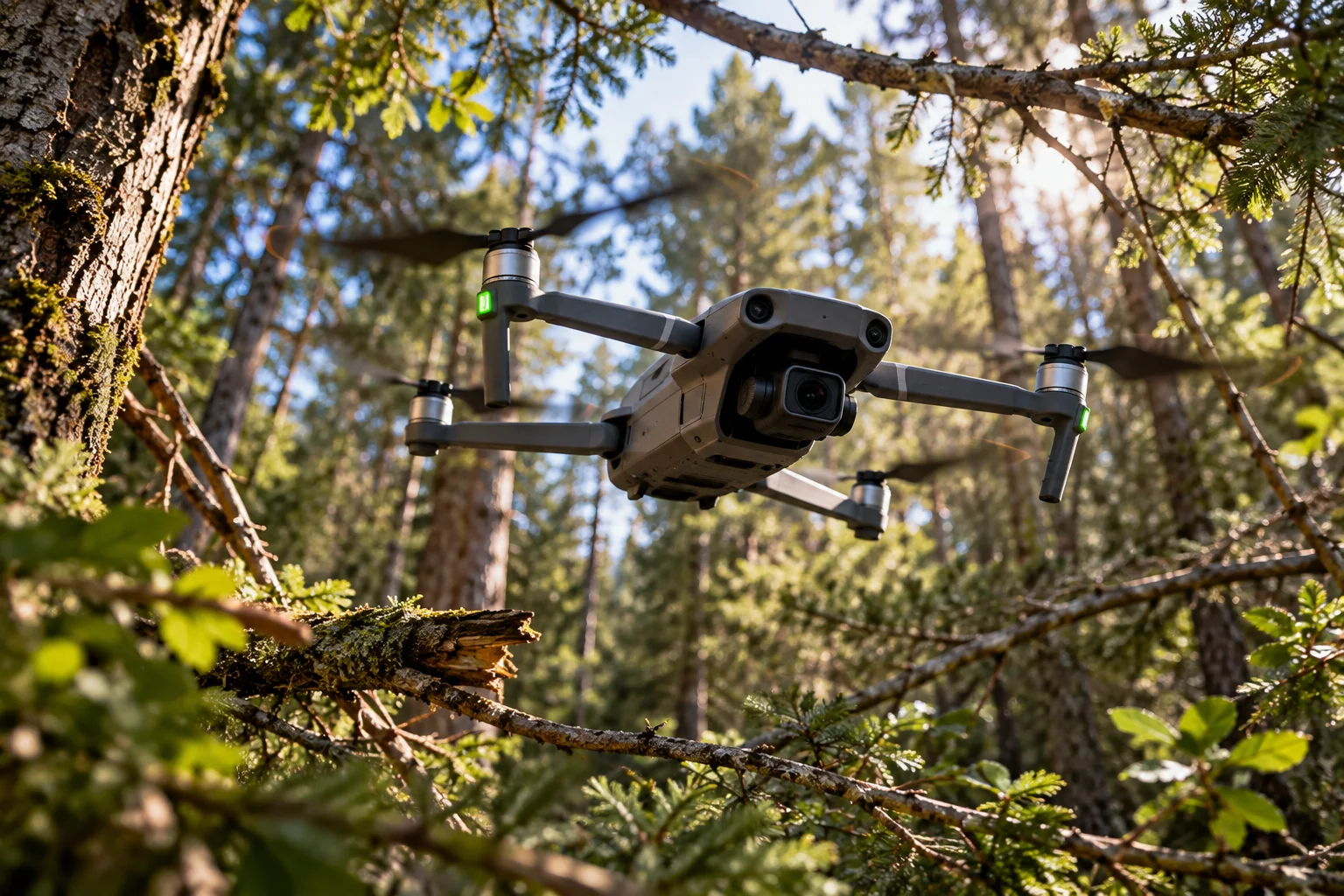
A modern drone stays in the air by constantly measuring how it is moving, where it is, and what is around it, then adjusting its motors many times per second.
At the center of the system is the flight controller, essentially the drone's onboard computer. It receives information from sensors such as gyroscopes, accelerometers, barometers, compasses and GPS/GNSS receivers. It then calculates how the drone should respond and sends commands to the electronic speed controllers (ESCs), which adjust the individual motor speeds.
That happens continuously while the drone is flying.
GPS is only one part of the system. It helps determine the drone's global position, while the IMU measures movement and rotation. A barometer helps estimate altitude, cameras and other sensors can detect the ground or obstacles, and the flight controller combines this information to keep the aircraft stable.
The camera is another subsystem entirely. It captures photos or video, while a gimbal may physically stabilize the camera separately from the aircraft itself.
What Makes a Drone Fly?
A typical quadcopter flies using four motors and four propellers.
Each propeller produces thrust by accelerating air downward. When the combined upward thrust becomes greater than the drone's weight, the aircraft rises.

The interesting part is how the drone controls direction.
The flight controller doesn't simply tell all four motors to “fly forward.” Instead, it changes the speed of individual motors.
For example, to increase altitude, the controller can increase the speed of all four motors. To tilt forward, it changes the relative thrust between the front and rear motors, causing the aircraft to pitch forward. DJI describes this process as precise motor-speed adjustment through electronic speed controllers.
This happens continuously, allowing the drone to correct small changes in position before the pilot even notices them.
What Is the Flight Controller in a Drone?
The flight controller is the brain of the aircraft.
It receives sensor measurements, interprets pilot commands and calculates the motor outputs required to achieve the requested movement.
A simplified version looks like this:
Sensors → Flight Controller → ESCs → Motors → Propellers
The controller also has to account for the drone's current state.
If the aircraft begins tilting because of wind, its sensors detect the change. The flight controller calculates a correction and changes motor speeds to bring the aircraft back toward the desired attitude.
PX4 identifies the gyroscope, accelerometer, magnetometer and barometer as the minimum core sensors for its flight-control system, with GNSS/GPS used for global positioning and additional automated modes.
How Does a Drone Stay Stable?
A drone stays stable by constantly measuring rotation and acceleration.
The gyroscope measures angular motion, telling the flight controller how quickly the aircraft is rotating around its axes.
The accelerometer measures changes in acceleration and helps determine the aircraft's orientation relative to gravity.
These sensors form part of an IMU, or Inertial Measurement Unit.
If the drone starts rolling slightly to one side, the flight controller detects that movement and adjusts individual motor speeds to counteract it.
This process happens continuously rather than as a single correction.
That's why a modern drone can appear to hover almost motionless even though its motors are constantly making tiny adjustments.
What Does GPS Do on a Drone?
GPS, more accurately part of a broader GNSS positioning system on many modern drones, tells the aircraft where it is in the world.
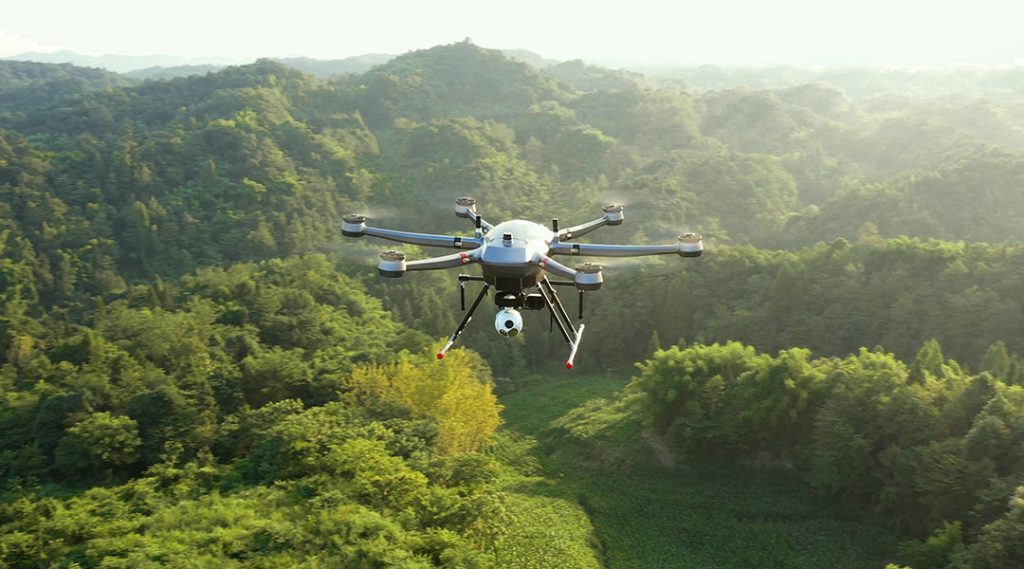
The receiver calculates its position from signals received from navigation satellites.
That information can be used for functions such as:
Position holding
Return-to-home
Waypoint navigation
Flight logging
Automated flight
Geofencing or location-based functions, depending on the system
GPS isn't what physically keeps the drone balanced.
The IMU handles extremely rapid measurements of movement and orientation, while GPS provides a slower global reference for position.
DJI's flight-control documentation, for example, distinguishes GPS altitude, fused altitude and altitude information derived from other sensors.
Can a Drone Fly Without GPS?
Yes. GPS isn't required for basic aerodynamic flight.
A drone can remain airborne using its internal flight-control sensors, although its ability to hold a precise position can be reduced depending on the aircraft and available additional sensors.
Modern drones may use vision positioning, optical flow, range sensors or other perception systems when GNSS isn't available.
DJI documentation describes visual positioning systems that use cameras and other sensors to estimate movement and position without GPS.
This is particularly useful indoors, under structures, or in environments where satellite signals are weak or unavailable.
What Does the Barometer Do?
A barometer measures air pressure, which changes with altitude.
The flight controller can use those pressure changes to estimate how high the drone is relative to its surroundings.
It isn't as straightforward as reading a ruler from the ground because atmospheric pressure also changes with weather and location. That's why modern aircraft typically combine barometric information with other sensor data.
DJI describes fused altitude as using barometer information together with IMU data and, depending on the aircraft, GPS, RTK and vision sensors.
The result is a more useful estimate of the drone's current altitude.
What Does the Compass Do?
The drone's magnetometer, commonly called its electronic compass, detects the Earth's magnetic field to help determine heading.
Knowing which direction the aircraft is facing helps the flight controller interpret navigation commands correctly.
For example, if you tell the drone to move north, the aircraft needs to know its current orientation before it can translate that command into the appropriate motor movements.
Modern flight systems combine compass information with other sensors rather than relying on it alone. PX4 lists the magnetometer as part of its core sensor set.
How Do Drones Avoid Obstacles?
Obstacle avoidance depends on the sensors installed on the particular drone.
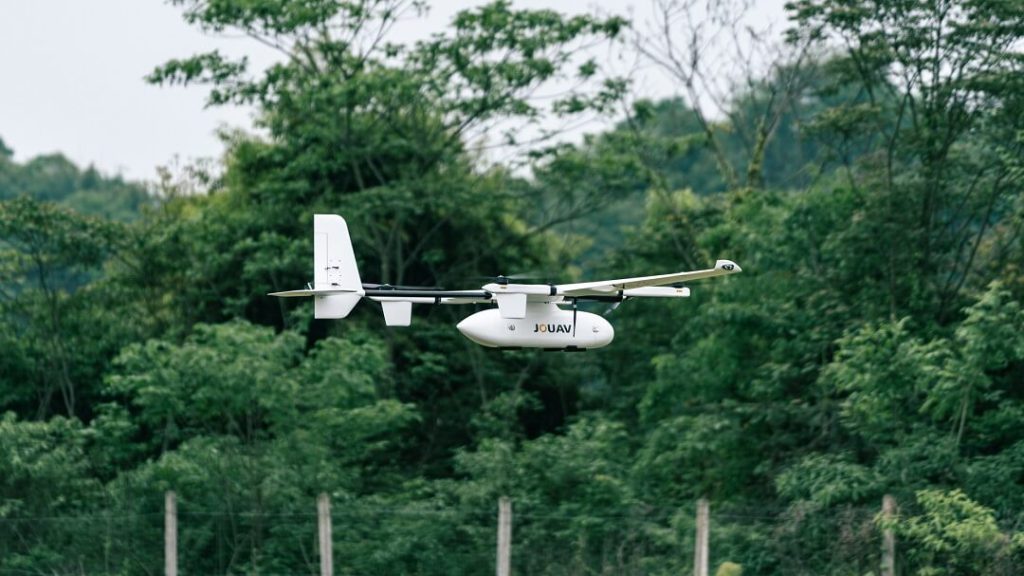
Modern systems can use:
Cameras
Stereo vision
Infrared sensors
LiDAR
Radar
Time-of-flight sensors
Other depth-sensing technologies
These sensors look for objects around the aircraft and provide information that the flight-control system can use to slow, stop, reroute or otherwise respond to obstacles.
DJI's current enterprise platforms, for example, can combine vision, infrared, LiDAR and millimeter-wave radar sensing for perception and positioning.
But obstacle sensing isn't the same thing as guaranteed collision avoidance. Sensor performance depends on the environment, lighting, object characteristics, aircraft speed and the specific system.
How Does a Drone Camera Work?
The drone's camera works much like a compact digital camera.
It has an image sensor and lens that capture light and convert it into digital image data.
The difference is that the camera is often mounted on a gimbal.
A gimbal uses motors and sensors to counteract unwanted aircraft movement. If the drone tilts or rotates, the gimbal can move the camera in the opposite direction to keep the image level.
This separates two jobs:
Flight stabilization: keeps the drone itself stable.
Camera stabilization: keeps the recorded image steady.
Some drones also use electronic stabilization or image-processing algorithms in addition to mechanical gimbal stabilization.
How Does a Drone Follow a Person or Vehicle?
Tracking features combine the drone's flight-control system with computer vision and positioning information.
The camera identifies a selected subject, and the aircraft continually estimates where that subject is in the camera's view.
The flight controller then adjusts the aircraft's movement to maintain the desired relationship with the subject.
For example, a tracking system might maintain a particular distance and angle while the subject moves.
DJI's current tracking documentation describes modes that can follow a subject while maintaining a specified relative position, while other modes keep the camera pointed at a selected subject without automatically flying behind it.
So the drone isn't simply “following a GPS dot.” In many intelligent tracking modes, the camera's visual information is an important part of the process.
How Does the Remote Controller Control the Drone?
The pilot's control sticks send movement commands to the aircraft.
Depending on the flight mode, those commands may represent things such as:
Increase or decrease altitude
Move forward or backward
Move sideways
Rotate left or right
The flight controller translates those commands into the motor-speed changes required to produce the requested movement.
DJI's documentation distinguishes body coordinates, horizontal position control, vertical position control and yaw-angle control, showing that the controller interprets pilot inputs according to the selected flight mode.
This is why moving a control stick doesn't directly mean “motor number three goes faster.” The flight controller decides what combination of motor changes is necessary.
What Happens If the Drone Loses Connection?
Many modern drones have programmed failsafe behavior for situations such as loss of remote-controller connection or low battery.
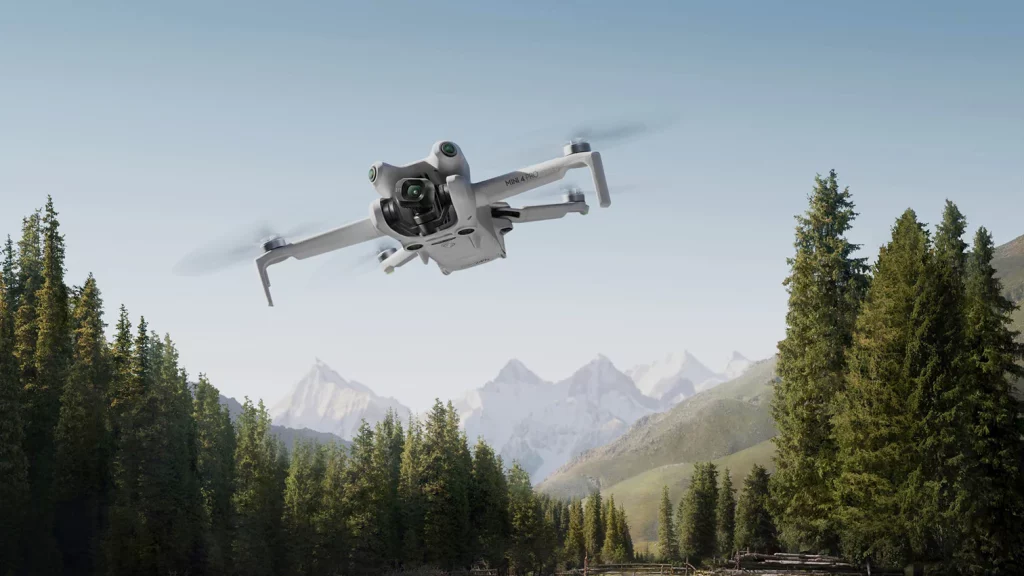
Depending on the aircraft and configuration, a drone may hover, land or initiate Return to Home.
Return-to-home systems use stored positioning information and the aircraft's navigation system to attempt to return toward its designated home point.
DJI's flight-control system includes dedicated takeoff, landing and Return-to-Home commands, while its remote controllers provide a dedicated RTH function.
The exact behavior depends on the aircraft, flight mode, settings and environment, so pilots should understand their specific drone's failsafe configuration before flying.
How Do Drone Motors and ESCs Work Together?
The motors provide the mechanical power, but ESCs control how those motors behave.
An electronic speed controller receives instructions from the flight controller and regulates the electrical power delivered to the motor.
The flight controller might decide that one motor needs to speed up while another needs to slow down.
The ESCs execute those commands.
DJI explains that its ESCs also monitor information such as motor speed, voltage, temperature and current and can send that information back to the main controller.
This creates a feedback loop:
Measure → Calculate → Adjust → Measure again
That loop is fundamental to stable drone flight.
How Do Drones Know Where They Are?
There isn't usually one sensor that answers this question.
Instead, the drone estimates its state by combining information from multiple systems.
A simplified example might look like this:
System | What it tells the drone |
|---|---|
Gyroscope | How quickly it is rotating |
Accelerometer | How it is accelerating and oriented |
Barometer | Estimated altitude |
Compass | Heading |
GPS/GNSS | Global position |
Vision sensors | Movement and nearby features |
Range sensors | Distance to nearby surfaces |
Camera | Visual information and imagery |
This process is often called sensor fusion.
The flight controller combines the measurements because every sensor has limitations. DJI describes using multiple sensor sources and algorithms to cross-check flight information and improve reliability.
The Bottom Line
A drone works because its flight controller continuously combines sensor data with pilot commands and adjusts the motors to keep the aircraft where it is supposed to be.
GPS tells the drone where it is globally. The IMU measures movement and rotation. The barometer helps estimate altitude. The compass provides heading information. Cameras and other perception sensors can help with positioning, tracking and obstacle detection.
The motors and propellers provide thrust, while ESCs control the individual motors.
And the camera is essentially another sophisticated system attached to the aircraft, often stabilized by a gimbal so that the footage remains smooth even while the drone is moving.
The clever part isn't any single component. It's the constant feedback loop between sensors, software and motors.
A drone is essentially making tiny flight corrections over and over again, fast enough that to the person holding the controller, the aircraft simply appears to know how to fly.
FAQs About How Drones Work
Do drones need GPS to fly?
No. GPS helps with positioning and automated functions, but the fundamental flight-control system can operate using inertial and other onboard sensors. Some aircraft can also use vision-based positioning when GNSS isn't available.
How does a drone stay in one place?
The flight controller continually compares the aircraft's measured movement with its desired position and adjusts motor speeds. Depending on the drone, GPS/GNSS, vision sensors, IMU data and other sensors can contribute to position holding.
Can drones fly indoors?
Some can, but GPS may not be available indoors. Drones equipped with suitable vision, optical-flow or other positioning systems can use those sensors instead. The specific aircraft determines how well it can maintain position indoors.
How does a drone know its altitude?
It can combine barometer measurements with GPS/GNSS, IMU, vision and range-sensor data. Modern flight systems often use a fused altitude estimate rather than relying on one sensor.
What makes a drone move forward?
The flight controller changes the relative speed of the motors so the aircraft tilts forward. The resulting thrust vector then has a forward component, causing the drone to accelerate in that direction.