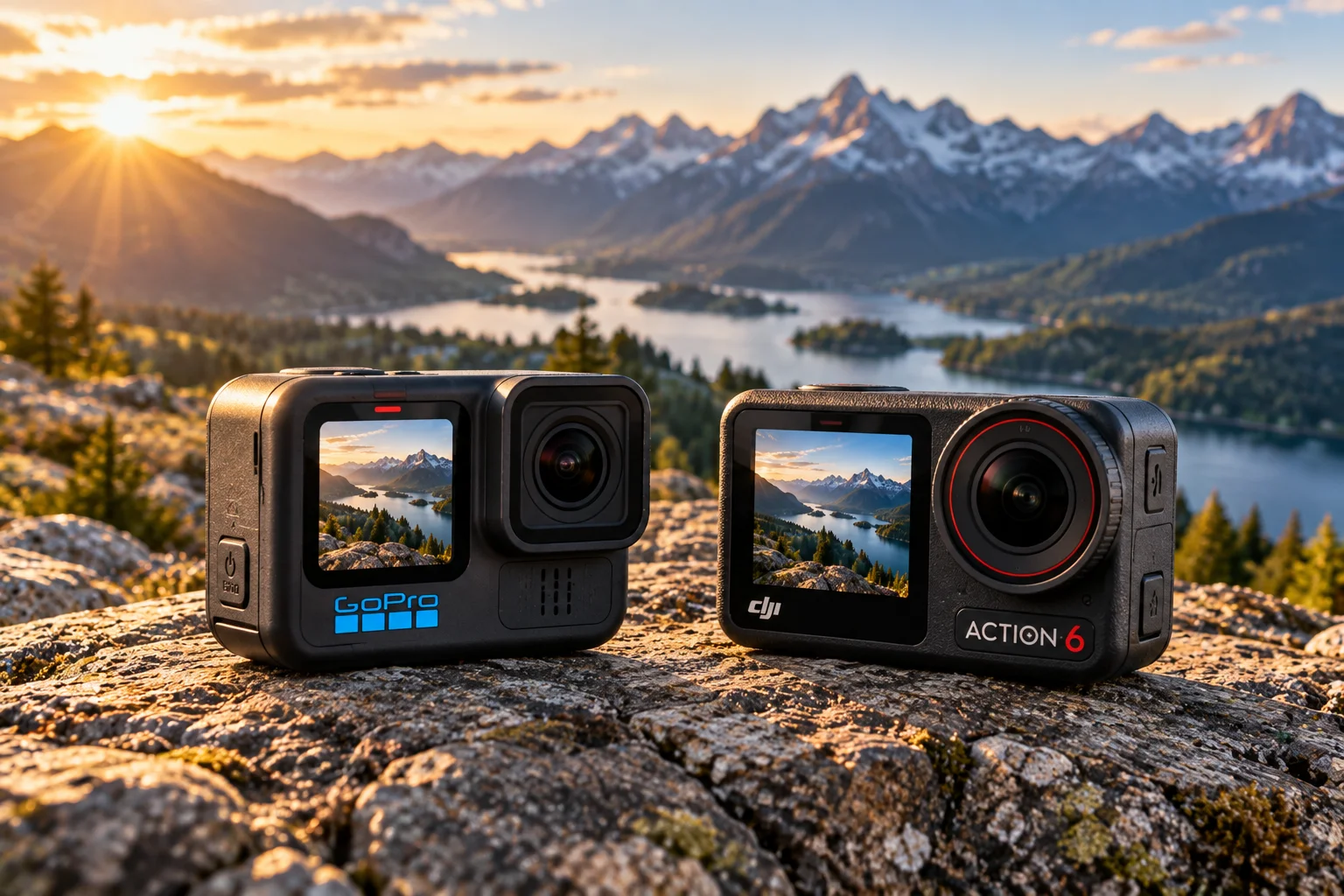
GoPro and DJI are two of the biggest names in action cameras, but their latest cameras take slightly different approaches to capturing outdoor video.
The GoPro HERO13 Black focuses on a proven action-camera formula: 5.3K video, strong stabilization, a tall 8:7 sensor format, interchangeable lens mods and a huge mounting ecosystem. DJI's Osmo Action 6 takes a more imaging-focused approach, with a larger 1/1.1-inch square sensor, variable f/2.0–f/4.0 aperture, 8K recording and up to 4K/120fps capture.
That makes the choice less about which brand is “better” and more about what kind of footage you shoot.
GoPro has some important advantages for traditional action shooting and its accessory ecosystem. DJI has made major advances in low-light performance, flexible framing and battery endurance.
GoPro vs DJI: What Is the Biggest Difference?
The biggest difference is how each manufacturer approaches image capture and the overall shooting workflow.
Feature | GoPro HERO13 Black | DJI Osmo Action 6 |
|---|---|---|
Maximum video resolution | 5.3K | 8K |
High-frame-rate 4K | Up to 120fps | Up to 120fps |
Main sensor | 1/1.9-inch class | 1/1.1-inch |
Aperture | Fixed | Variable f/2.0–f/4.0 |
Stabilization | HyperSmooth 6.0 | RockSteady 3.0/3.0+ |
Horizon stabilization | Available | Available |
Waterproofing | 10m without case | 20m without case |
Built-in storage | No | 64GB, 50GB usable |
Best known for | Action ecosystem and stabilization | Sensor, low light and versatility |
Specifications can vary by shooting mode, so the headline numbers don't tell the entire story.
Which Has Better Image Quality?
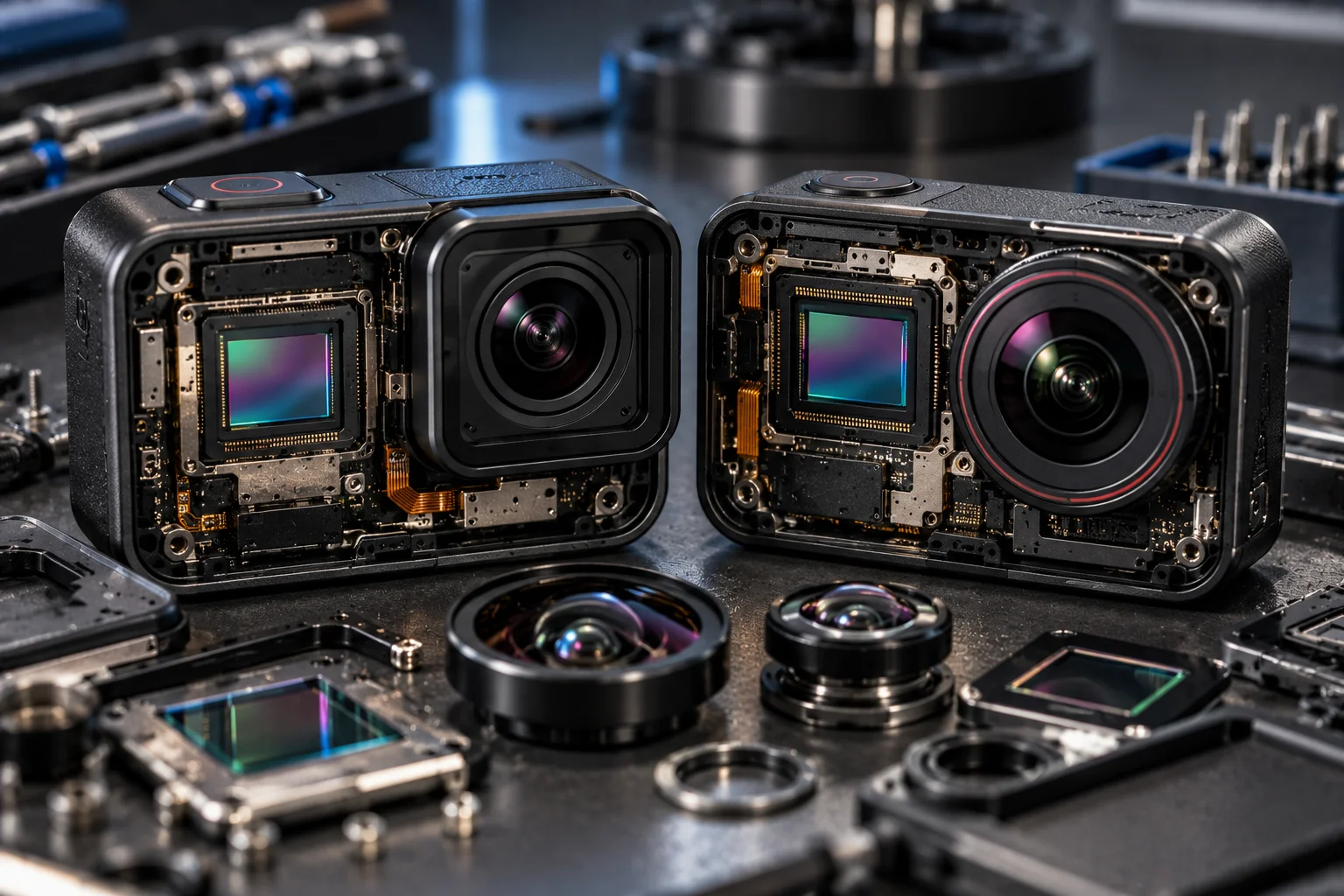
DJI's Osmo Action 6 has the more ambitious imaging hardware on paper, particularly because of its larger sensor and variable aperture.
The Action 6 uses a 1/1.1-inch square CMOS sensor with 2.4 μm equivalent pixels and up to 13.5 stops of dynamic range. It also has a variable f/2.0–f/4.0 aperture, something unusual for an action camera.
The larger sensor gives DJI more light-gathering capability, while the f/2.0 aperture can be useful in darker environments.
GoPro's HERO13 Black takes a different approach. Its tall 8:7 sensor allows it to capture footage that can later be used for different framing and aspect ratios. It records up to 5.3K at 60fps and supports 10-bit HDR video.
For pure sensor hardware and low-light potential, the DJI has an important advantage.
For action-oriented framing flexibility, GoPro's 8:7 capture remains highly useful.
Is 8K on DJI Better Than 5.3K on GoPro?
Not automatically.
DJI's Action 6 can record 8K at up to 30fps, while GoPro HERO13 Black reaches 5.3K at up to 60fps.
8K provides substantially more pixels, which can be useful when cropping or creating high-resolution footage.
But resolution isn't the only factor affecting image quality.
Sensor performance, lens quality, exposure, stabilization, bitrate, processing and lighting all matter.
For fast-moving action, 5.3K/60fps can sometimes be more useful than 8K/30fps, because the higher frame rate produces smoother motion and more flexibility for slow-motion editing.
So don't buy the Action 6 simply because “8K” is printed on the specification sheet.
Which Has Better Low-Light Performance?
DJI's Osmo Action 6 has a stronger hardware argument for low-light shooting.
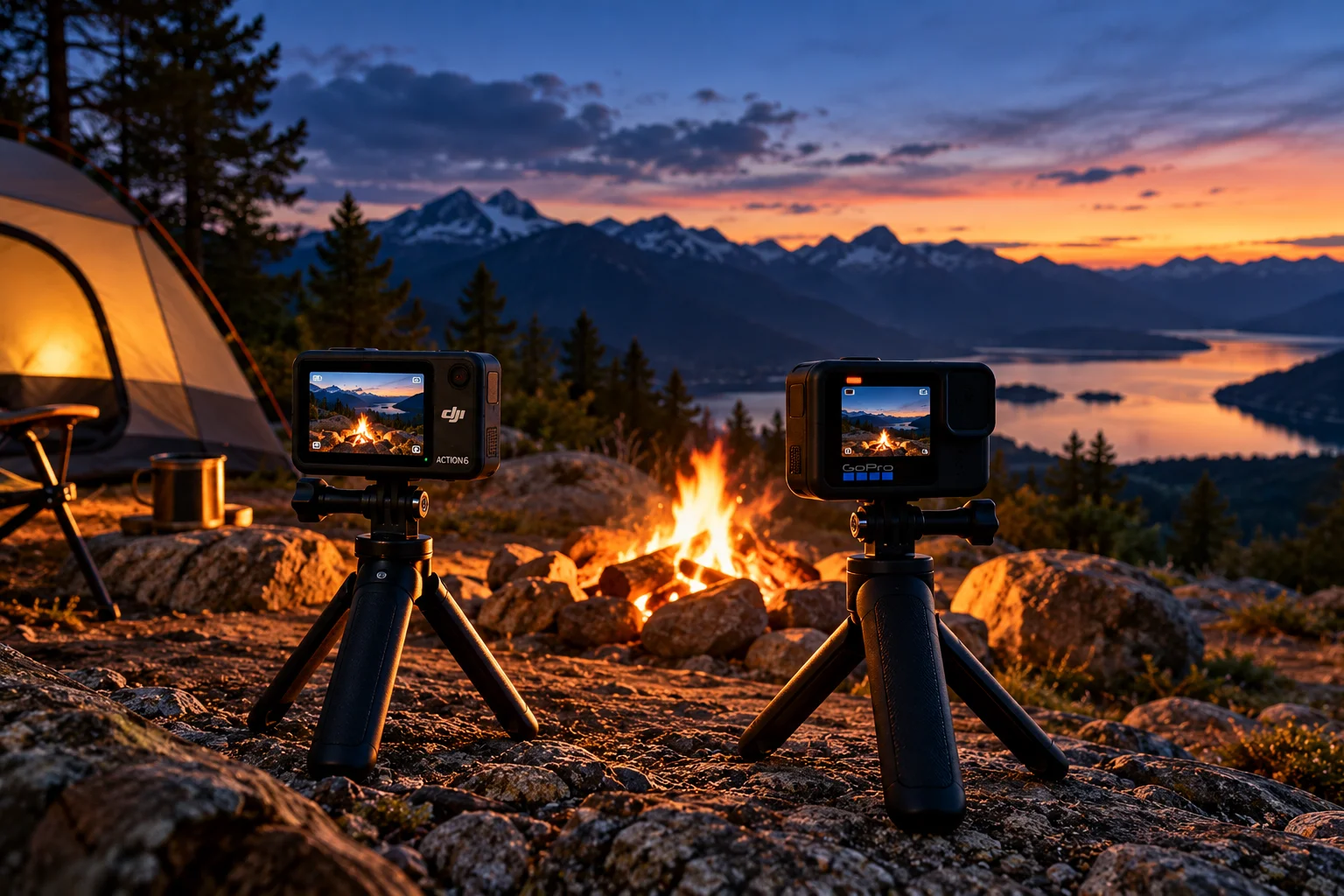
Its 1/1.1-inch sensor and f/2.0 maximum aperture are specifically designed to improve light capture. DJI also includes a SuperNight mode capable of recording up to 4K/60fps.
This can make a meaningful difference when you're recording:
Night walks
Campfires
City streets
Indoor action
Sunset scenes
Evening cycling
Concerts and events
GoPro's HERO13 Black can still produce good footage in challenging conditions, but its imaging system isn't built around the same large-sensor and variable-aperture strategy.
Which Has Better Stabilization?
Both have highly capable electronic stabilization, but they use different systems.
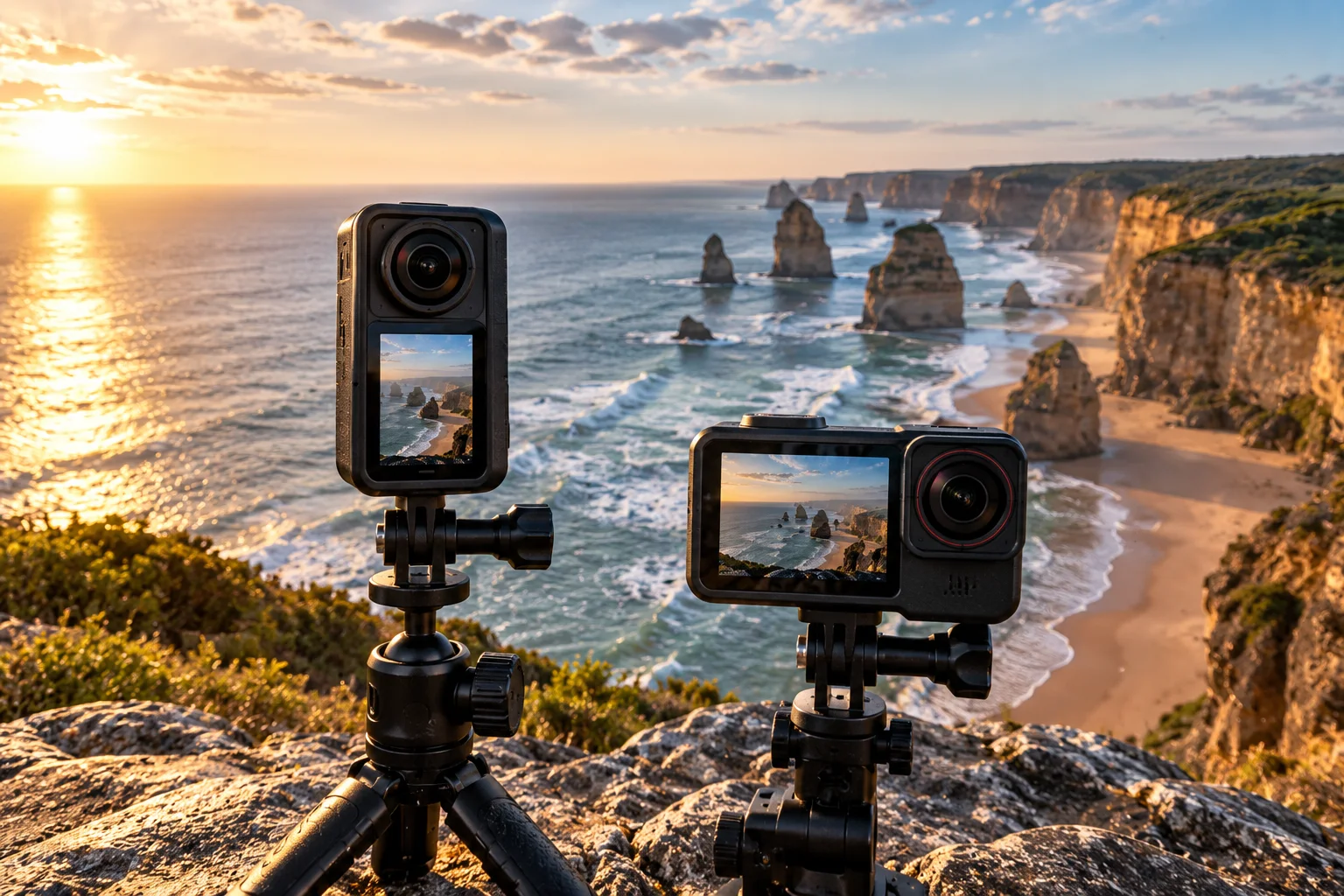
GoPro uses HyperSmooth 6.0, which is one of the defining features of HERO cameras. HERO13 Black also supports Horizon Lock and other stabilization options depending on the shooting configuration.
DJI uses RockSteady 3.0/3.0+, along with HorizonSteady and HorizonBalancing. DJI's Action 6 supports 4K HorizonSteady and 4K HorizonBalancing under supported settings.
For ordinary biking, hiking, skiing and running, both systems can produce very stable footage.
The differences become more apparent when you compare specific modes and extreme movement rather than simply asking which brand has “better stabilization.”
Which Has Better Battery Life?
DJI has made battery endurance a major selling point for the Action 6.
DJI advertises up to four hours of operating time under its specified test conditions. The camera also uses a removable battery.
GoPro's HERO13 Black introduced a larger-capacity Enduro battery designed to improve runtime across different temperatures.
Actual runtime depends heavily on resolution, frame rate, stabilization, temperature and other settings.
So the useful takeaway is simple:
DJI puts more emphasis on long continuous operation, while GoPro's battery system is built around the established HERO ecosystem.
If you're filming long hikes or extended travel days, battery performance deserves particular attention.
Which Is More Waterproof?
DJI currently has the deeper built-in waterproof rating.
The Osmo Action 6 is rated to 20 meters without a waterproof case and up to 60 meters with DJI's Waterproof Case.
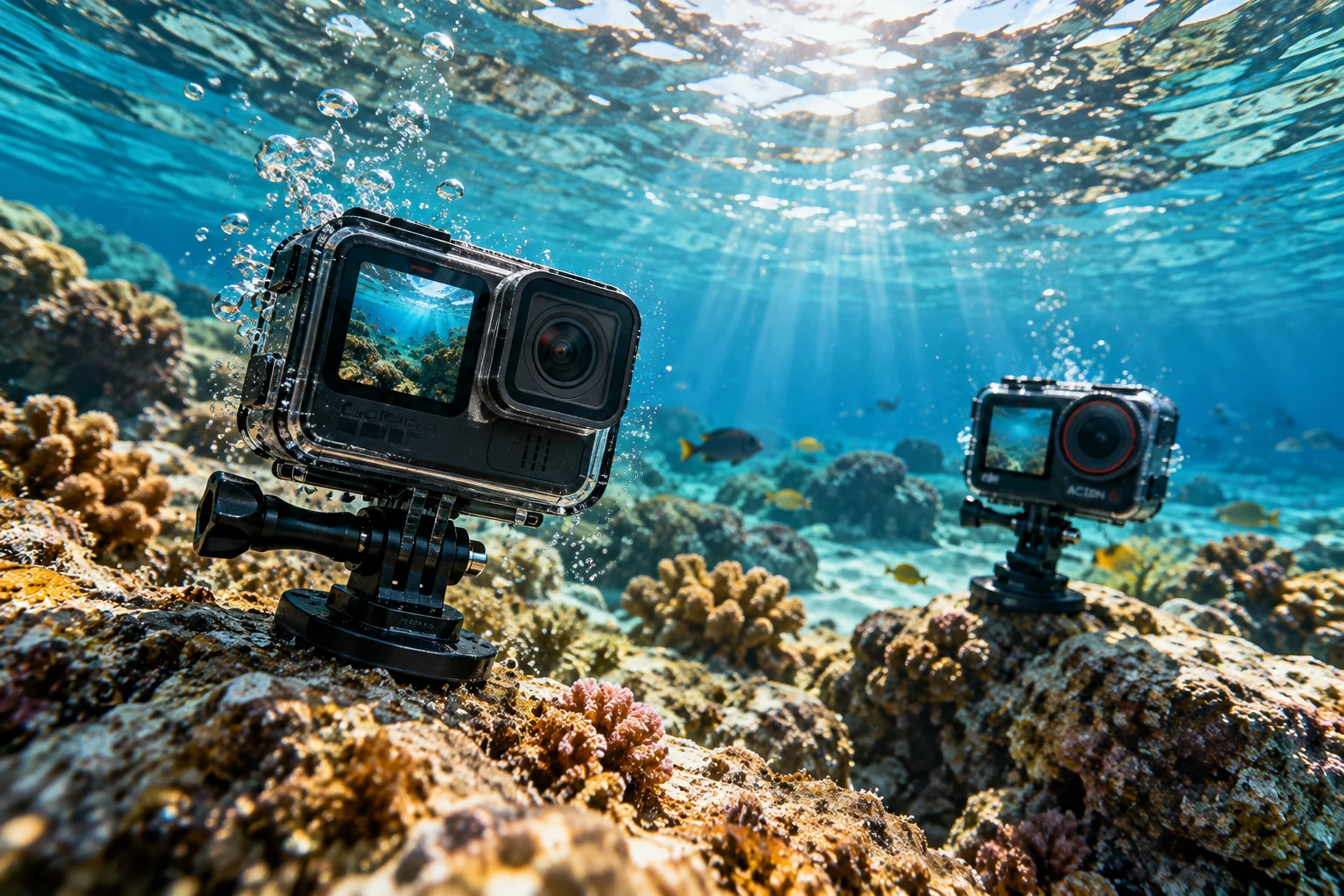
The HERO13 Black is waterproof to 33 feet, or approximately 10 meters, without a case. GoPro also offers additional waterproof protection through accessories.
For swimming, snorkeling and water sports, DJI therefore has a clear specification advantage.
But depth ratings aren't the only consideration. Water temperature, impact, seals, saltwater exposure and the condition of the lens and battery covers can all affect real-world reliability.
Which Is Better for Vertical Video?
Both are capable of producing vertical content, but they approach it differently.
GoPro's 8:7 sensor is particularly useful for creators who want to capture a tall frame and then decide how to crop it later. GoPro explicitly promotes its ability to shoot wide, vertical or full-frame footage from the tall sensor.
DJI's Action 6 takes another interesting approach with its square sensor and 4K Custom mode, allowing footage to be cropped later for different creative formats. It also supports native 9:16 recording.
For social-media creators, both provide considerable flexibility.
Which Has the Better Accessory Ecosystem?
GoPro has a major advantage in the maturity and breadth of its mounting ecosystem.
GoPro has spent years building a large range of mounts, housings, lens mods and activity-specific accessories.
HERO13 Black also introduced a modular lens system with compatible HB-Series lens mods.
DJI has a strong accessory ecosystem of its own, including quick-release mounting, waterproof cases, microphones and specialized lenses.
If you already own GoPro mounts and accessories, staying within that ecosystem can be particularly convenient.
Which Is Easier to Use?
Both are designed for straightforward point-and-shoot operation, but your preferred workflow may determine which feels easier.
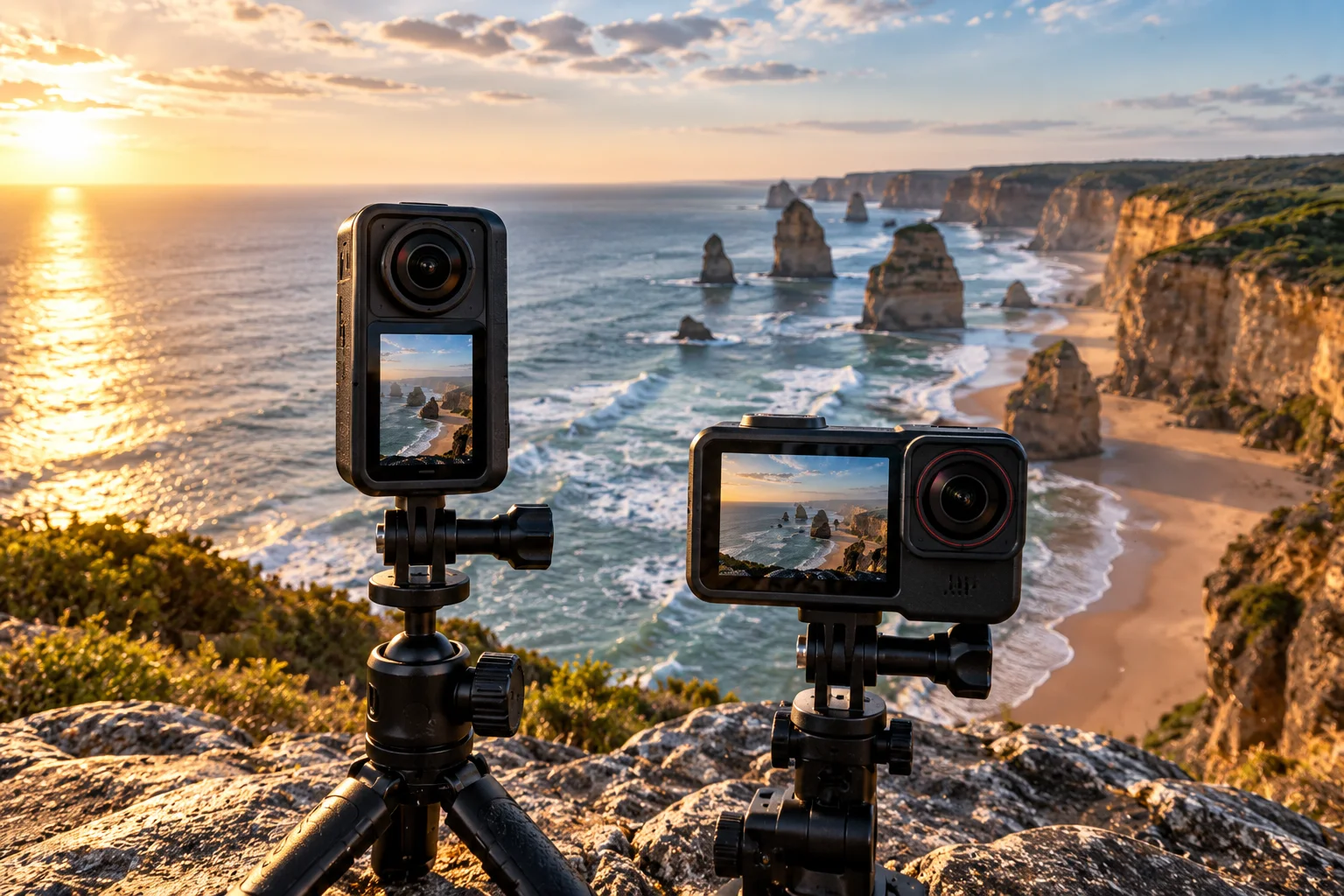
GoPro has the advantage of a mature shooting ecosystem and the Quik app for transferring, editing and reframing footage.
DJI's Action 6 adds features such as gesture control, subject tracking, built-in storage and multiple shooting modes. DJI also supports direct microphone connections through its OsmoAudio system.
The better workflow depends on whether you want a simple rugged camera or more control over how you create and reframe footage.
Which Is Better for Travel?
DJI is particularly compelling for travelers who prioritize battery life, low-light shooting and waterproofing.
The Action 6's 20-meter waterproof rating, larger sensor, variable aperture and built-in storage are useful when you're trying to travel light.
GoPro makes more sense if you already have a collection of mounts, lens mods and accessories or if you prefer its established editing ecosystem.
For travel, the differences are less about absolute image quality and more about which camera fits your workflow.
Which Is Better for Sports?
Both are excellent for sports, but GoPro remains particularly well suited to traditional action-camera shooting.
Its 5.3K/60fps recording, HyperSmooth stabilization, rugged design and extensive mounting ecosystem make it easy to attach to helmets, bikes, boards and other equipment.
DJI counters with 4K/120fps, strong stabilization, subject tracking and a larger sensor.
For skiing, cycling, surfing and similar activities, either can work extremely well.
The more important question is whether you value GoPro's mounting ecosystem or DJI's newer imaging hardware.
Which Should You Choose?
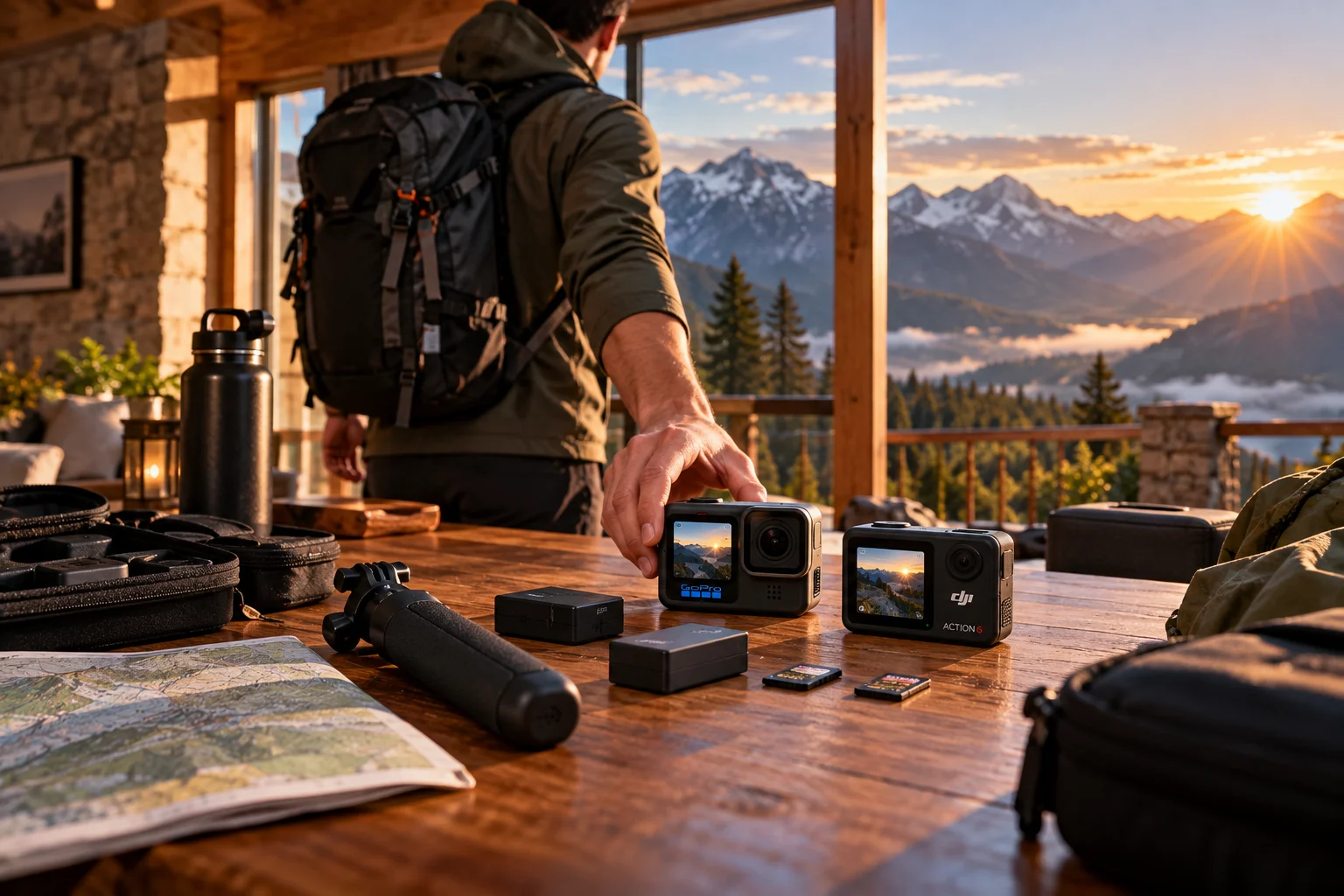
Choose GoPro HERO13 Black if you care most about:
HyperSmooth stabilization
5.3K/60fps action footage
The 8:7 sensor format
Lens mods
A large mounting ecosystem
Established GoPro accessories
A familiar action-camera workflow
Choose DJI Osmo Action 6 if you care most about:
Larger 1/1.1-inch sensor
Variable f/2.0–f/4.0 aperture
Low-light performance
8K recording
4K/120fps
20-meter waterproofing
Built-in storage
Long operating time
The two cameras are now close enough that your shooting style matters more than the logo on the front.
FAQs About GoPro vs DJI Action Cameras
Is GoPro better than DJI?
Neither is universally better. GoPro has major strengths in stabilization, lens options and its accessory ecosystem, while DJI's latest Action 6 emphasizes sensor size, low-light performance, variable aperture and long operating time.
Is DJI Action 6 better in low light?
Its larger 1/1.1-inch sensor and f/2.0 maximum aperture give it strong hardware advantages for low-light recording, and DJI offers a dedicated SuperNight mode.
Does GoPro have better stabilization than DJI?
Both offer advanced electronic stabilization. GoPro uses HyperSmooth 6.0, while DJI uses RockSteady 3.0/3.0+ and HorizonSteady. The practical difference depends on the specific shooting mode and activity.
Is DJI Action 6 really 8K?
Yes. It can record 8K video at 24, 25 or 30fps, although 8K has limitations compared with other shooting modes.
Which is better for underwater recording?
On the headline specifications, DJI has the deeper built-in waterproof rating: 20 meters versus 10 meters for HERO13 Black.
The Bottom Line
GoPro and DJI are no longer separated by one obvious strength.
GoPro remains a highly capable action-camera platform built around stabilization, ruggedness, flexible 8:7 capture and a mature accessory ecosystem.
DJI's Osmo Action 6 pushes harder on camera hardware, using a larger sensor, variable aperture, 8K recording, strong low-light capabilities and deeper built-in waterproofing.
If you're mainly shooting fast-moving outdoor action and already use GoPro accessories, HERO13 Black remains a natural fit.
If you care more about sensor performance, night footage, long recording sessions and maximum imaging flexibility, DJI's newer approach deserves serious consideration.
The real difference isn't simply GoPro vs DJI.
It's a mature action-camera ecosystem versus a newer imaging-focused approach to the same basic idea.