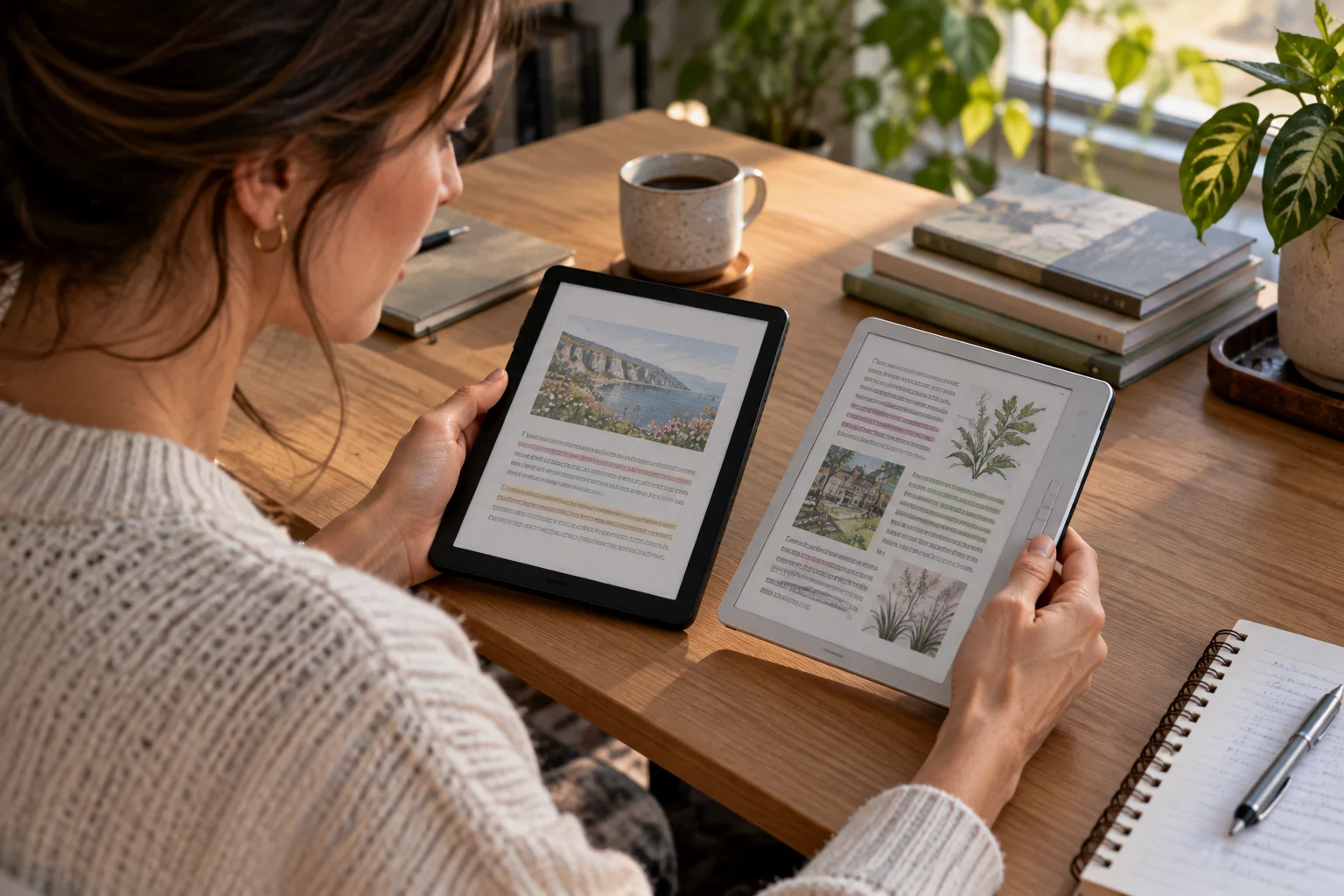
Kindle and Kobo have taken noticeably different approaches to e-readers in 2026. Amazon is pushing Kindle further into color, AI-assisted reading and digital note-taking, while Kobo continues to emphasize color E Ink, handwriting, library access and a more open reading experience. The biggest Kindle developments come from the newer Colorsoft and Scribe families, while Kobo's current lineup remains centered around devices such as the Libra Colour, Clara Colour, Clara BW, Sage and Elipsa 2E.
Amazon's newer Kindle Scribe range is particularly interesting because it combines e-reading with AI-powered notebook features. The Scribe can summarize notes, search handwritten content, convert handwriting to text and work with documents from services such as Google Drive and Microsoft OneDrive. Amazon has also introduced Story So Far and Ask This Book, bringing AI assistance directly into the reading experience on supported Kindle titles.
Kobo, meanwhile, has made color one of its biggest selling points. The Kobo Libra Colour adds a 7-inch color E Ink display, page-turn buttons and optional stylus support, while the smaller Clara Colour brings color to a more compact 6-inch format.
If you're shopping for an e-reader in the US or UK in 2026, the interesting question isn't simply Kindle or Kobo. It's whether you want Amazon's ecosystem and newer AI features or Kobo's emphasis on color reading, handwriting and reading flexibility.
What are the biggest Kindle changes in 2026?
The biggest Kindle developments are color displays, AI-assisted reading, redesigned Scribe hardware and more capable digital note-taking.

Amazon's Kindle lineup has changed considerably over the last couple of years.
The standard Paperwhite remains a conventional black-and-white E Ink reader, but the wider Kindle family now includes color models and large-format writing devices.
Amazon's current lineup includes the Kindle Paperwhite 12th Generation, Paperwhite Signature Edition, Kindle Colorsoft, Colorsoft Signature Edition, Kindle Scribe 3rd Generation and Kindle Scribe Colorsoft. Amazon also lists a Scribe without a front light as a 2026 model.
The shift toward color is probably the most obvious change.
But AI is arguably the more interesting one.
Is Kindle finally becoming an AI-powered e-reader?
Yes. Amazon is adding AI features that can summarize books and notes, answer questions about passages and help users organize handwritten content.
Amazon's newer Kindle Scribe devices include AI-powered reading tools such as Story So Far and Ask This Book.
Story So Far can help readers catch up on what they've already read without revealing future plot points. Ask This Book lets readers highlight a passage and ask questions about characters, motivations or events while keeping the answers spoiler-free. Amazon says these features are available for thousands of Kindle books in the US.
That's an interesting use of AI because it doesn't try to replace the book.
Instead, it sits beside the reading experience.
You're still reading the novel yourself. AI simply becomes a tool you can call upon when a character's name has slipped your mind or you need to understand something from an earlier chapter.
The Scribe's notebook tools go further.
Amazon says its newer Scribe can search handwritten notes, generate summaries and convert handwriting to text.
For students, researchers and people who use an e-reader as a notebook, that's potentially more useful than an AI chatbot bolted onto the home screen.
What is new about Kindle Colorsoft?
Kindle Colorsoft brings color E Ink to Amazon's mainstream Kindle experience, allowing book covers, illustrations and highlights to appear in color while retaining the paper-like characteristics of an E Ink display.
The Colorsoft has a 7-inch color display and supports color highlighting. Amazon says it can provide up to eight weeks of battery life and is waterproof.
The color display isn't intended to compete with an OLED tablet.
That's not really the point.
Color E Ink is useful for things such as:
Book covers
Comics and graphic novels
Maps
Illustrated books
Children's books
Color-coded highlights
Magazine-style content
There's also a Colorsoft Signature Edition with 32GB storage, an auto-adjusting front light and wireless charging.
So Kindle's color strategy is becoming much more than a one-off experiment.
What has changed with Kindle Scribe?
The latest Kindle Scribe is thinner, lighter and faster, while adding color, AI notebook tools and more flexible document workflows.
Amazon redesigned the Scribe around a more paper-like form factor.
The newer Scribe is 5.4mm thick, weighs about 400 grams and is claimed to be 40% faster for writing and page turns compared with the previous generation.
The lineup is also broader now.
There is a standard Kindle Scribe, a Kindle Scribe Colorsoft and a Scribe without a front light. Amazon's product documentation lists the latter as a 2026 release.
The Colorsoft version is particularly interesting because it combines the advantages of a large writing surface with color handwriting and highlighting.
For someone who wants one device for reading books, marking PDFs and keeping handwritten notes, this is a very different proposition from the traditional Kindle.
What is new with Kobo e-readers?
Kobo's biggest recent developments remain color E Ink, stylus support, improved lighting and a broader choice of reading formats and device sizes.
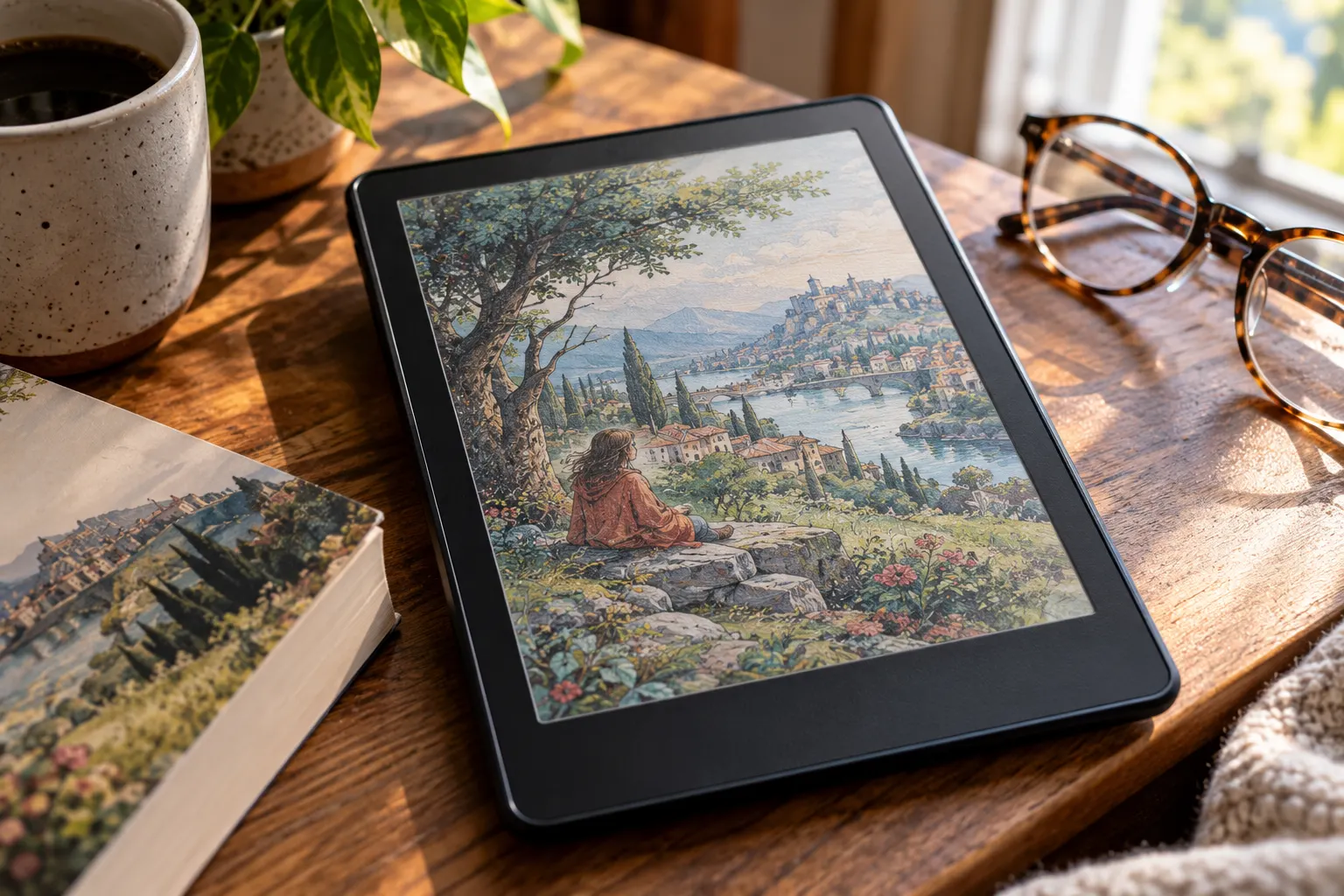
Kobo's lineup is less about adding AI to the reading experience and more about making the underlying e-reader more flexible.
The Kobo Libra Colour is the standout model.
It has a 7-inch color E Ink display, 32GB of storage, physical page-turn buttons, adjustable lighting, dark mode and IPX8 waterproofing. It also supports the Kobo Stylus 2 for handwriting and annotations.
Then there's the smaller Kobo Clara Colour, which uses a 6-inch color E Ink display and 16GB of storage. Kobo also continues to sell the black-and-white Clara BW for readers who don't need color.
Kobo's approach is refreshingly straightforward.
Color when you want it.
Black and white when you don't.
And handwriting when you need it.
How good are Kobo's color e-readers in 2026?
Kobo's color models are particularly well suited to readers who want color highlighting, illustrations, comics or handwritten annotations without moving to a traditional LCD or OLED tablet.
Kobo uses E Ink Kaleido 3 technology in the Libra Colour and Clara Colour.
The Libra Colour displays black-and-white content at 300 ppi and color content at 150 ppi. It also supports color handwriting and highlighting when paired with the optional Stylus 2.
The color isn't as vivid as what you'd get from a tablet.
That's expected.
But the advantage is that you're still getting the glare-free, paper-like quality that makes E Ink so comfortable for long reading sessions.
For someone who reads graphic novels occasionally but doesn't want a tablet, that compromise makes sense.
Which has better note-taking, Kindle or Kobo?
Kindle has moved further into AI-assisted note management, while Kobo offers a more established handwriting and annotation experience across several devices.
The Kindle Scribe is effectively Amazon's answer to the digital notebook.
Its newer models can convert handwriting to text, summarize notes and search through handwritten material. You can also import documents from Google Drive and Microsoft OneDrive.
Kobo offers handwriting on devices including the Libra Colour, Sage and Elipsa 2E. The Elipsa 2E has a large 10.3-inch display and includes the Kobo Stylus 2 for notes and PDF markup.
The difference is subtle but important.
Kindle is increasingly adding AI to the notebook. Kobo is concentrating on the notebook experience itself.
If you want summaries and AI-assisted organization, Kindle's approach is more interesting.
If you simply want to write, highlight and annotate without needing AI, Kobo remains a strong alternative.
How do Kindle and Kobo compare for color?
Both now offer color E Ink, but Kobo has built color more deeply into its mainstream reader lineup, while Amazon offers color through the Colorsoft family and the Scribe Colorsoft.

Here's how the current options broadly compare:
Model | Screen | Color | Stylus | Waterproof |
|---|---|---|---|---|
Kindle Paperwhite | 7-inch | No | No | Yes |
Kindle Colorsoft | 7-inch | Yes | No | Yes |
Kindle Scribe | Large | No | Yes | No |
Kindle Scribe Colorsoft | Large | Yes | Yes | No |
Kobo Clara BW | 6-inch | No | No | Yes |
Kobo Clara Colour | 6-inch | Yes | No | Yes |
Kobo Libra Colour | 7-inch | Yes | Yes | Yes |
Kobo Sage | 8-inch | No | Yes | Yes |
Kobo Elipsa 2E | 10.3-inch | No | Yes | No |
Kobo's Libra Colour is particularly unusual because it combines color, physical page-turn buttons, waterproofing and stylus compatibility in one relatively compact reader.
Which is better for library books, Kindle or Kobo?
Kobo has a particularly strong proposition for readers who rely on public-library borrowing, while Kindle's biggest advantage remains Amazon's enormous Kindle Store and Kindle Unlimited ecosystem.
Kobo supports OverDrive and Libby integration on compatible devices, allowing readers to borrow library books. WIRED notes that the Libra Colour works with OverDrive's Libby service, although the process can require signing into OverDrive directly on the Kobo.
Kindle also works with Libby in the US, but the borrowing experience is closely tied to Amazon's ecosystem.
This distinction matters more than some of the hardware specifications.
If most of your books come from Amazon, Kindle fits naturally into that routine.
If you buy ebooks from multiple sources or make heavy use of library borrowing, Kobo's approach can be more attractive.
What are the biggest differences between Kindle and Kobo in 2026?
Kindle is increasingly focused on Amazon's content ecosystem, AI and digital productivity, while Kobo emphasizes flexible reading, color E Ink, physical controls and library access.
Category | Kindle | Kobo |
|---|---|---|
Color readers | Colorsoft range | Clara Colour, Libra Colour |
AI reading | Story So Far, Ask This Book | Less emphasis on AI |
AI notes | Yes, on newer Scribe models | More traditional notebook tools |
Handwriting | Scribe | Libra Colour, Sage, Elipsa 2E |
Page-turn buttons | Limited | Libra Colour |
Library borrowing | Libby in supported markets | OverDrive/Libby integration |
Book ecosystem | Kindle Store, Kindle Unlimited | Kobo Store |
Large notebook | Scribe | Elipsa 2E |
Waterproof color option | Colorsoft | Libra Colour and Clara Colour |
Ecosystem | Amazon | Rakuten Kobo |
There isn't one feature that settles the entire comparison.
It really depends on what you do with the device after you buy it.
Are Kindle and Kobo e-readers getting better in 2026?
Yes, but the improvements are moving beyond simply making E Ink screens sharper or batteries larger. Color, handwriting, AI and software ecosystems are becoming the bigger differentiators.
The interesting thing about 2026 is that E Ink itself isn't changing the basic reading experience dramatically.
You still get a paper-like screen.
You still get weeks rather than hours of battery life.
And you still don't have a distracting collection of social media apps staring back at you.
What's changing is everything around the page.
Amazon is adding AI that can help you understand books and organize notes. Kobo is making color, annotation and library access more capable. Meanwhile, both companies are offering devices for readers who want something more specialized than a basic black-and-white Kindle.
That's probably where the e-reader market is heading.
Not toward becoming another tablet.
Toward becoming a better dedicated reading and writing tool.
Which Kindle or Kobo should you look at in 2026?
For a conventional Kindle, the Paperwhite remains the key model; for color, look at Kindle Colorsoft or Kobo Libra Colour; and for serious reading plus handwriting, compare Kindle Scribe with Kobo Elipsa 2E.
A simple way to narrow it down:
For everyday Kindle reading: Kindle Paperwhite.
For Kindle color: Kindle Colorsoft.
For AI-assisted reading and note-taking: Kindle Scribe.
For a compact color Kobo: Kobo Clara Colour.
For color plus physical page buttons: Kobo Libra Colour.
For a large Kobo notebook: Kobo Elipsa 2E.
Current 2026 buying guides continue to feature the Paperwhite, Colorsoft, Libra Colour and Clara Colour among the major e-reader choices, although pricing and availability can change during sales.
The bottom line on Kindle and Kobo in 2026
The e-reader market is becoming more capable without losing sight of its original purpose: reading without the distractions of a tablet.
Kindle's biggest move is toward AI and productivity. The latest Scribe models can help summarize notes, search handwriting and interact with books using AI, while Colorsoft brings color to Amazon's dedicated reading ecosystem.
Kobo's strongest direction is choice. The Libra Colour and Clara Colour bring color E Ink to different sizes, while the Libra Colour adds physical page buttons and stylus support. Kobo also continues to offer larger writing-focused devices such as the Elipsa 2E.
So, if you're buying an e-reader in 2026, don't just ask which screen looks better.
Ask where you get your books, whether you need color, whether you'll write on the device, how much you value AI features and whether you want to be tied closely to Amazon's ecosystem.
Those choices will tell you far more about which reader makes sense than the Kindle or Kobo name on the front.