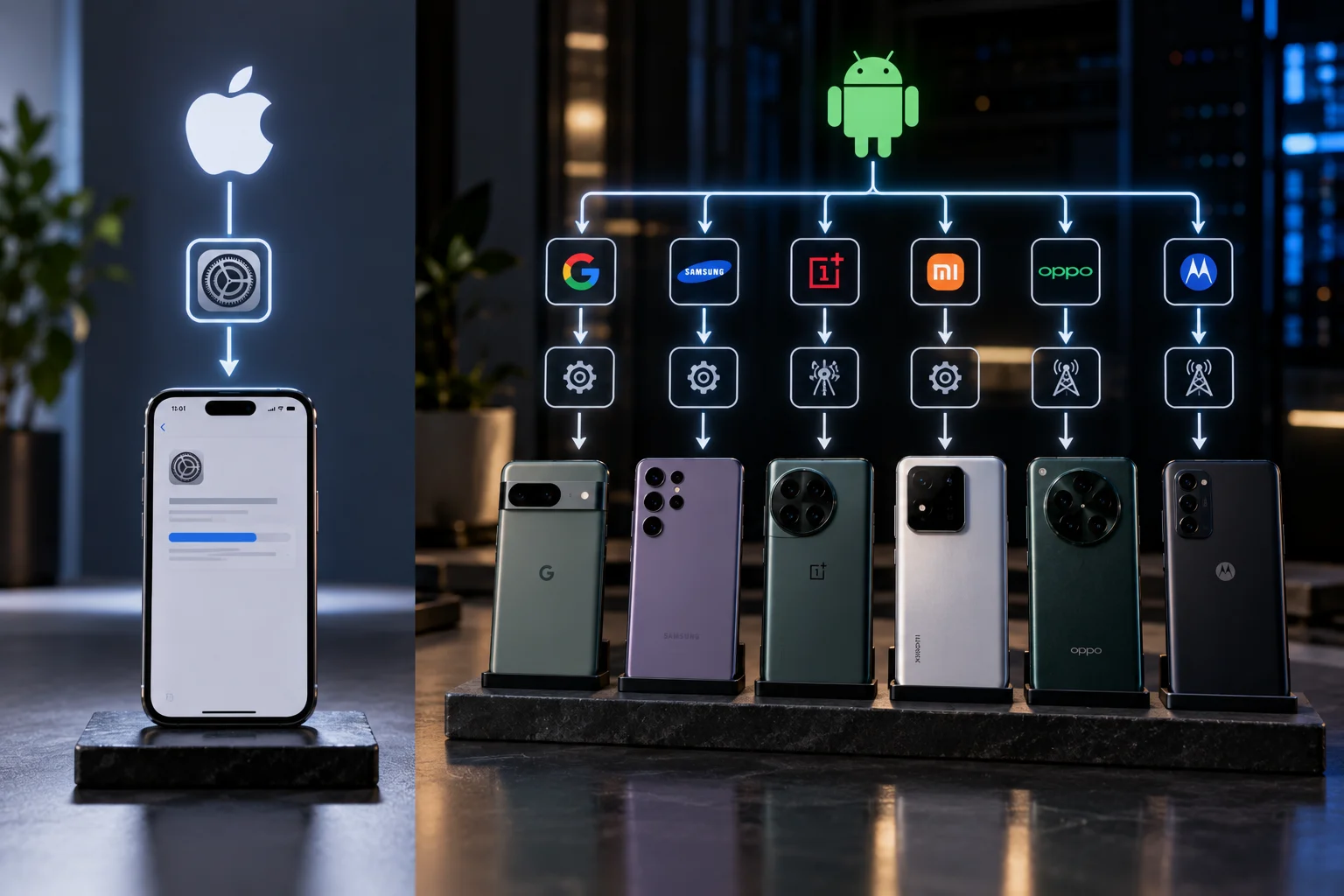
Android and iOS both receive regular security updates, but the path from a vulnerability being discovered to a fix reaching your phone is very different. Apple controls both the iPhone hardware and iOS, allowing it to distribute security updates directly to a large, relatively consistent group of supported devices. Android is more fragmented: Google develops the core operating system, but individual manufacturers and sometimes carriers must adapt and distribute updates for their own phones.
Google publishes Android Security Bulletins on a regular schedule and makes patches available through the Android Open Source Project. Pixel phones begin receiving Google's monthly updates on the bulletin date, although the rollout can take around a week and a half to reach all Google devices.
Apple also releases security updates across supported iPhones and now supplements conventional updates with Background Security Improvements, which can deliver smaller protections between full software releases.
The important catch is that "Android vs iOS" isn't really the whole comparison. A Google Pixel can receive an Android security fix quickly, while another Android phone may receive the same underlying fix later. With iPhone, the distribution chain is much shorter.
How quickly do Android and iPhone security updates arrive?
Apple can distribute an iOS security fix directly to supported iPhones, while Android security patches first move through Google's Android ecosystem and may then require manufacturer and carrier work before reaching individual devices.
This difference starts with how the platforms are built.
Google publishes security fixes through the Android Security Bulletin. The bulletin normally appears on the first Monday of each month unless that day is a holiday. Android's September 2026 bulletin, for example, was published on September 8 and included a critical System vulnerability that could potentially allow remote code execution without user interaction.
Google then makes the relevant platform patches available through AOSP. Manufacturers can pick up those fixes and integrate them into their own software.
With Apple, there's no equivalent manufacturer layer between Apple and the iPhone.
Apple publishes the security update and distributes it to supported devices through its own software-update system.
That's a major reason the two ecosystems can feel different when a serious vulnerability needs to be patched.
How fast do Google Pixel phones get Android security patches?
Pixel phones are among the fastest Android devices to receive Google's monthly security fixes because Google controls both the Android software and Pixel hardware.
Google's Pixel Update Bulletins state that supported Pixel devices begin receiving OTA updates on the same day the monthly bulletin is released. Google says it generally takes about one and a half calendar weeks for the OTA to reach every Google device.
The September 2026 Pixel update, for example, was published on September 15 with a September 5 security patch level. Google says supported Pixel devices receive the 2026-09-05 patch level.
Pixel updates can still arrive in phases.
Google's Pixel support documentation says availability can depend on the carrier and device, meaning two owners with ostensibly the same phone don't necessarily see the update at exactly the same moment.
So even Google's own phones aren't necessarily an instant, simultaneous update.
But the distribution chain is relatively short.
Why can Samsung and other Android phones take longer?
Other Android phones can take longer because manufacturers need to integrate Google's security patches with their own software, hardware drivers and device-specific components, and availability can also vary by model, region and carrier.
Samsung is a useful example because its Galaxy range spans everything from flagship phones to inexpensive models.
Samsung says security-update availability can vary by device and market, and its support information describes monthly or quarterly security-update schedules depending on the device.
This creates an important distinction:
A phone receiving quarterly security updates isn't necessarily unsupported.
It may simply be on a less frequent update schedule.
Samsung also acknowledges that delivery timing can vary by region and model.
That means an Android vulnerability could be patched by Google in September while a particular Galaxy, Motorola, OnePlus or other manufacturer's phone receives the corresponding fix later.
And that's before considering carrier certification in some markets.
Does every Android phone receive the same security patch?
No. Android security coverage depends on the device, manufacturer, software build and the particular vulnerability being addressed.
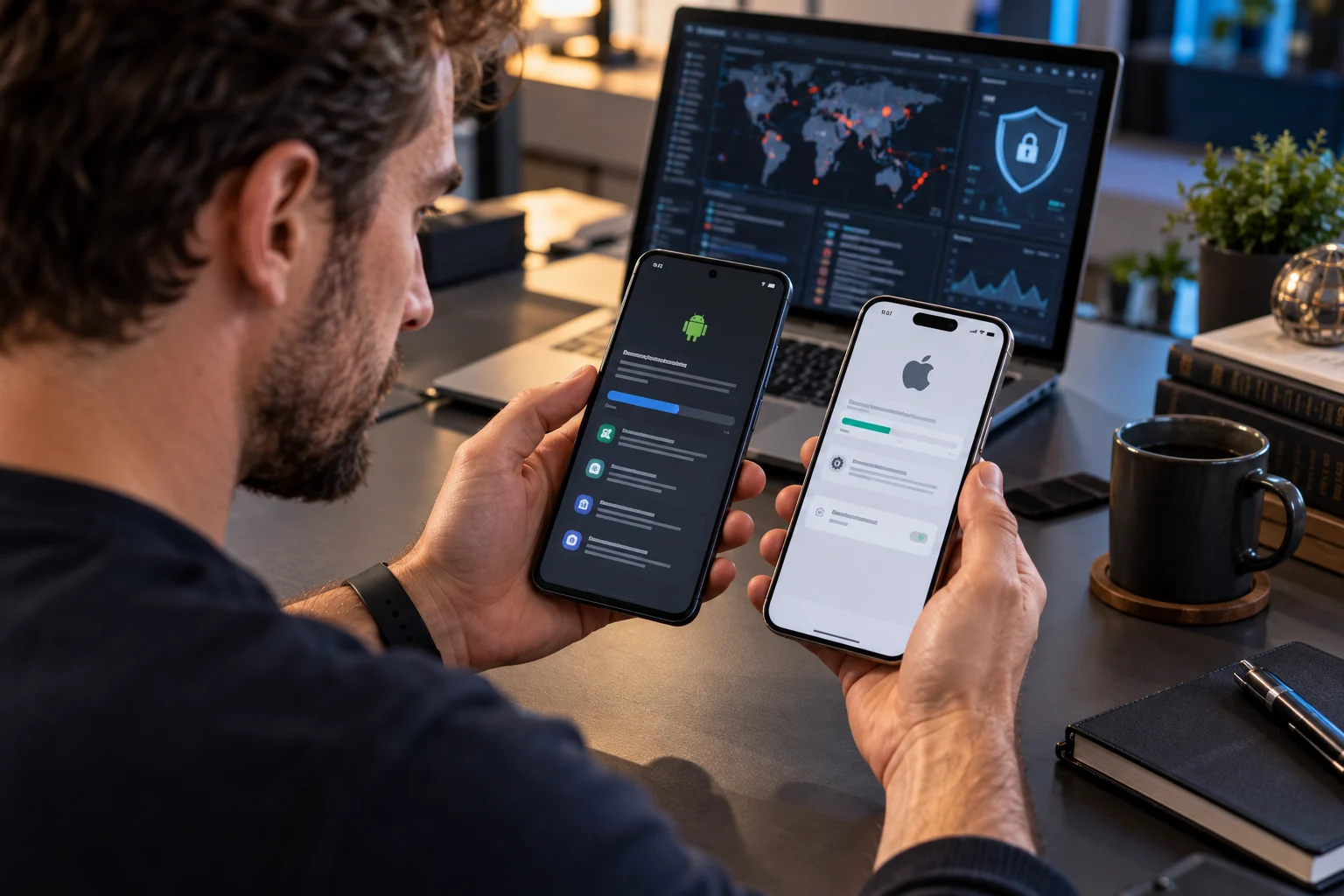
Google's Android Security Bulletin uses different patch levels partly because manufacturers may address groups of vulnerabilities at different speeds. Google explains that devices using the earlier patch level receive one subset of fixes, while the later patch level includes additional applicable patches.
There's another layer too.
Android devices can receive security protections through Google Play system updates and Google Play Protect, which aren't necessarily identical to the monthly Android OS security patch.
Google says Play Protect is enabled by default on devices with Google Mobile Services and helps protect against potentially harmful applications.
So looking only at the Android version number isn't enough.
The security patch level is often the more useful thing to check.
How does Apple distribute critical iPhone security fixes?
Apple can push security fixes directly to supported iPhones without waiting for a separate phone manufacturer to adapt the operating system.
Apple's security-release history illustrates how frequently it can issue updates when necessary.
For example, Apple released iOS 27 on September 14, 2026, followed by iOS 27.0.1 on September 28. Apple also continued providing iOS 26.7.1 to supported devices on September 28.
That last point is easy to overlook.
Apple doesn't necessarily force every supported iPhone onto the newest major operating system to receive a security fix. Older supported software branches can continue receiving security updates.
The result is a relatively direct relationship:
Apple discovers or receives information about a vulnerability → develops the fix → releases it → supported iPhones can install it.
There are still variables such as automatic-update settings, internet access and whether a user installs the update.
But there isn't a Samsung-style manufacturer layer between Apple and the phone.
What are Apple's Background Security Improvements?
Background Security Improvements are smaller security releases designed to protect iPhones between conventional software updates, particularly for components such as Safari, WebKit and system libraries.
Apple introduced this mechanism starting with iOS 26.1.
Apple describes Background Security Improvements as lightweight security releases that can be delivered between normal software updates. They can address components such as Safari and WebKit without requiring the same kind of full operating-system update.
On iPhone, users can manage automatic installation under:
Settings → Privacy & Security → Background Security Improvements
Apple recommends keeping automatic installation enabled for additional protection.
This changes the traditional idea that you have to wait for a numbered iOS update before a security improvement can arrive.
It's a useful response to a modern problem: vulnerabilities can become relevant between scheduled releases.
What happens when a vulnerability is actively exploited?
The speed of the response becomes especially important when attackers are already exploiting a vulnerability, and both Apple and Google can issue security fixes outside their normal major-version schedules.
Apple's September 2026 security releases provide a good example.
Apple's iOS 26.7.1 security documentation says a vulnerability in CoreGraphics could allow arbitrary code execution from a maliciously crafted file and that Apple was aware of a report indicating exploitation in an extremely sophisticated targeted attack against specific individuals on older iOS versions.
That update was released on September 28.
This is why security-update cadence matters, but the date a vendor publishes a fix isn't the same as the date every individual phone actually receives or installs it.
For Android, Google's monthly bulletin can identify a critical issue and publish the fix, but manufacturers still need to distribute the relevant update to their affected devices.
For Pixel, that process is much closer to Google's own release.
For other Android phones, it can take longer.
Android vs iOS: How does the update process actually work?
The biggest difference is the number of organizations involved between the security researcher and the user's phone.
A simplified Android process looks like this:
Security vulnerability → Google develops Android fix → Android Security Bulletin/AOSP → manufacturer integration → device testing → possible carrier involvement → regional rollout → user installation
For Pixel, the process is shorter:
Security vulnerability → Google fix → Pixel rollout → user installation
Apple's process is more centralized:
Security vulnerability → Apple develops fix → Apple software release → supported iPhone rollout → user installation
That doesn't mean every Apple update appears instantly on every iPhone.
It means Apple has much more direct control over the distribution chain.
Does Android's fragmentation make it less secure?
Fragmentation can make security-update distribution more complicated, but it doesn't automatically mean that an Android phone is poorly protected. The actual security experience depends heavily on the manufacturer, device model, update policy and how quickly the phone receives patches.
Modern Android also has security layers that operate independently of full operating-system updates.
Google Play Protect can identify potentially harmful applications, while Google Play system components can receive updates independently on supported devices.
Manufacturers also add their own security frameworks.
Samsung, for example, integrates security patches addressing Android vulnerabilities alongside issues affecting Samsung devices, chipsets and carrier networks.
So the situation isn't simply:
iPhone = secure, Android = insecure.
That's far too simplistic.
A more useful distinction is:
How quickly does this particular phone receive important security fixes, and for how many years?
How long do Android and iPhone phones receive security updates?
Update longevity has improved significantly on both platforms, but Android support varies by manufacturer and model, while Apple controls the supported-device list itself.
Google currently promises seven years of OS and security updates for Pixel 8 and newer phones, measured from when each device first became available on the Google Store in the US. Older Pixel models have shorter support periods.
Apple supports a broad range of iPhones simultaneously.
As of September 2026, Apple lists iOS 27 as available for iPhone 11 and later, while it also released iOS 26.7.1 for supported devices.
The practical lesson is straightforward.
When buying an Android phone, check the manufacturer's specific security-support commitment for that exact model.
Don't assume the policy for a flagship applies identically to every phone in the brand's lineup.
What should you check when buying a phone for security?
Look at three things: how often security patches arrive, how long the manufacturer promises to provide them, and how quickly the company has historically delivered important updates.
A useful checklist is:
Security-update frequency: Monthly, quarterly or as-needed?
Guaranteed support period: How many years of security updates?
Patch-level visibility: Can you easily check the security patch date?
Manufacturer history: Does the company consistently deliver updates?
Carrier dependence: Can your carrier delay updates?
Automatic installation: Is automatic updating enabled?
Emergency protections: Does the platform have additional security mechanisms?
App security: Does the phone receive Play Protect or equivalent protections?
For Android, also check the exact model rather than relying on the manufacturer's reputation.
A flagship and a budget phone from the same company can have very different support schedules.
Android vs iOS security updates: The key differences
Factor | Android | iOS |
|---|---|---|
Core security patches | Google publishes Android Security Bulletins | Apple publishes security releases |
Direct Google hardware | Pixel | Apple controls iPhone hardware |
Manufacturer involvement | Usually required outside Pixel | None |
Carrier involvement | Can affect some Android rollouts | Less fragmented |
Patch frequency | Varies by manufacturer/model | Apple controls release cadence |
Emergency fixes | Can be issued outside normal OS releases | Apple can issue point releases and Background Security Improvements |
App protection | Google Play Protect and other layers | Apple's platform security and App Store controls |
Long-term support | Depends on manufacturer/model | Centrally managed by Apple |
Security patch visibility | Security patch level | iOS build/version and security releases |
Rollout consistency | Varies significantly | Generally more centralized |
So how quickly do phones actually get critical fixes?
There isn't one universal Android-versus-iOS answer. The fastest Android phones can receive patches very quickly, while other Android models can take longer; Apple's centralized control generally makes iPhone security-update distribution more consistent across supported devices.
Google's own data illustrates the difference within Android itself: Pixel devices begin receiving monthly updates when the bulletin is released, but Google says the rollout can take roughly one and a half weeks to reach every Google device.
Other Android manufacturers add another layer of distribution.
Apple's model is more centralized, and its newer Background Security Improvements mechanism allows some security protections to arrive between conventional software updates.
So if security-update speed is a major buying consideration, don't stop at Android vs iOS.
Ask a more useful question:
"How quickly does this exact phone receive critical security fixes, and how long will it keep receiving them?"
For Android, a recent Pixel gives you a particularly direct Google update path. For iPhone, Apple's centralized software model means supported devices are handled through one vendor rather than a network of manufacturers and carriers.
And whichever phone you use, the final step still matters: install the update when it becomes available. A security patch sitting in your notification panel isn't protecting the device until it's actually installed.