
Digital note-taking used to mean replacing a paper notebook with a stylus and a screen. In 2026, that definition is changing. New writing-focused devices can recognize handwriting, convert it into digital text, search across handwritten pages and use AI to summarize or organize what you've written.
Amazon's latest Kindle Scribe models can search handwritten notebooks, while GenAI features can summarize notes and refine handwriting. reMarkable has also added handwriting search and AI-powered conversion that can turn handwritten notes into typed content, summaries and actionable next steps.
The important change isn't simply better handwriting recognition. These devices are beginning to treat handwriting as structured information rather than an image of ink on a digital page.
That could make digital notebooks considerably more useful for students, professionals, researchers and anyone who prefers writing by hand but still needs the organization and searchability of digital files.
How does AI turn handwriting into searchable notes?
The basic process combines handwriting recognition with text indexing. The device captures your pen strokes, interprets the writing and creates a searchable representation of the content.
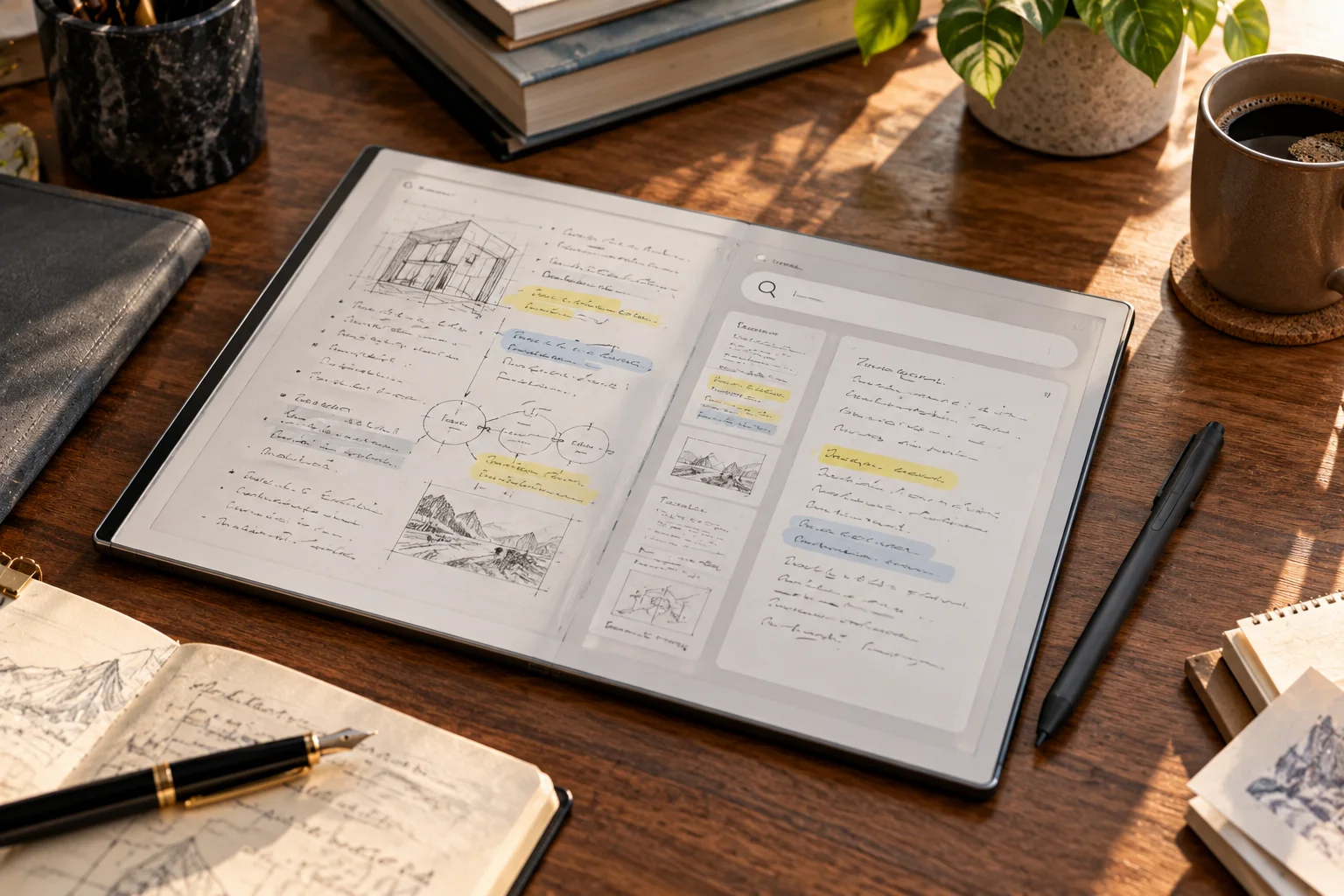
You don't necessarily have to rewrite your notes using a keyboard.
For example, Amazon's newer Kindle Scribe supports searching handwritten notebook content. You can type keywords into the search interface or handwrite a search term, with results pointing you toward relevant notebook pages.
This changes the practical value of handwriting. A handwritten meeting note from six months ago isn't simply buried somewhere in an archive anymore. If the system recognizes the relevant words, you can search for the topic and jump back to the page.
What can Kindle Scribe do with handwritten notes?
Newer Kindle Scribe models combine handwriting recognition with AI-powered search, summarization and writing refinement.
Amazon says its AI-powered notebook search can find information across notebooks using natural-language queries and provide AI-generated summaries of relevant notes.
The Scribe can also summarize handwritten notebooks and refine writing. Summarization can process up to 15 pages, while the refinement feature can process up to 10 pages at a time. Amazon says these GenAI features are currently available in the US, UK, Ireland, Germany, Canada and Australia, with support for English, Canadian French and German.
That makes the device useful beyond simple note storage.
Imagine finishing a long meeting with several pages of handwriting. Instead of manually reviewing everything, you could ask the device to produce a concise version of the key points.
How does reMarkable's handwriting search work?
reMarkable lets users search handwritten and typed notes, making handwriting behave more like conventional digital text.
Its current software includes Handwriting Search, which can search the contents of handwritten notes alongside typed content. The feature is available through its Connect subscription.
The company has also introduced AI-powered conversion. With its Convert and share feature, handwritten notes can be converted into typed text and processed into summaries and actionable next steps.
That's particularly useful when handwriting is only the first stage of a workflow.
You can write ideas during a meeting, convert them later and then move the resulting text into an email, document or another work application.
Is handwriting recognition accurate enough to replace typing?
It can be highly useful, but it isn't a perfect substitute for typing.

Recognition quality depends on handwriting style, language, writing speed and the complexity of what you're writing.
Simple handwritten sentences are easier for AI systems to interpret than highly abbreviated notes, unusual handwriting, mathematical notation or complicated diagrams.
reMarkable, for example, says its handwriting conversion supports block letters and cursive, but some symbols and diagrams aren't converted.
That distinction matters. These devices are becoming very good at turning handwriting into text, but they shouldn't be treated as flawless transcription systems.
Can AI understand the meaning of handwritten notes?
Increasingly, yes. The more interesting development is moving from transcription toward understanding.
Converting handwriting into text is only the first step. Once the content becomes machine-readable, AI can summarize it, identify key points and help turn rough notes into something more useful.
Amazon's Kindle Scribe can generate summaries from handwritten notes, while reMarkable describes its AI-powered conversion as capable of producing summaries, reflections and clear next steps.
This creates a new workflow:
Write → recognize → search → summarize → act.
Instead of treating a notebook as an archive, AI can turn it into an active information source.
What are the advantages of AI-powered digital notebooks?
The biggest advantage is keeping the natural experience of handwriting while gaining some of the organizational benefits of digital text.

For students, handwritten lecture notes can become searchable study material.
For professionals, meeting notes can be converted into summaries or follow-up actions.
For writers and researchers, handwritten ideas can be retrieved months later without remembering which notebook or page contains them.
There is also less friction during the initial note-taking process. You can write naturally instead of stopping to format every thought.
The important part is what happens after the writing.
Are digital writing devices replacing traditional tablets?
Not really. They are becoming a separate category designed around focused writing and reading.
Devices such as reMarkable prioritize a paper-like writing experience and distraction-free workflows. Kindle Scribe combines writing with Kindle's reading ecosystem. Other E Ink writing devices, including Android-based models, can offer broader application support.
A conventional iPad or Android tablet remains more versatile because it can run a much wider range of apps.
The trade-off is focus. A dedicated writing device can deliberately do fewer things, which can make it better suited to long-form handwriting and reading.
What should you look for in an AI note-taking device?
Handwriting recognition, search quality, AI capabilities, export options and ecosystem support matter more than simply choosing the device with the largest screen.
Check whether the device can:
Search handwritten notes directly
Convert handwriting into editable text
Summarize multiple pages
Export notes to common formats
Sync with cloud services
Recognize your preferred language
Work offline or require cloud processing
Keep original handwriting after conversion
Subscription requirements are another consideration. Some advanced reMarkable capabilities require Connect, while Kindle Scribe's AI features have specific model, language and regional requirements.
What does the future of digital handwriting look like?
The next step is likely to be more context-aware notebooks that can connect handwritten ideas with calendars, documents, meetings and tasks.

We're already seeing early examples. reMarkable's Meeting Notes Tool can set up notes using calendar details, while its AI tools can turn handwriting into more structured output.
The bigger idea is compelling: handwriting doesn't have to disappear to become digital.
You can still sketch, underline, circle, draw arrows and write quickly. The difference is that AI can increasingly understand what happened on the page afterward.
That makes the digital notebook less like a scanned piece of paper and more like a searchable personal knowledge base.
AI-Powered Digital Note-Taking FAQs
Can AI search handwritten notes?
Yes. Kindle Scribe and reMarkable both offer handwriting-search capabilities on supported devices and software plans.
Can Kindle Scribe convert handwriting to text?
Yes. Kindle Scribe can convert handwritten notes into digital text for sharing and editing workflows.
Can reMarkable convert handwriting into typed text?
Yes. reMarkable supports handwriting conversion and newer AI-powered tools can also summarize converted notes and generate actionable next steps.
Can AI summarize handwritten notes?
Yes. Kindle Scribe can summarize handwritten notebook content, while reMarkable offers AI-powered summarization as part of its newer conversion workflow.
Are AI writing tablets better than paper notebooks?
They solve different problems. Paper remains simpler and requires no battery or software, while digital writing devices add search, cloud synchronization, conversion and AI capabilities. For people who regularly need to retrieve or share handwritten information, those digital features can be particularly useful.