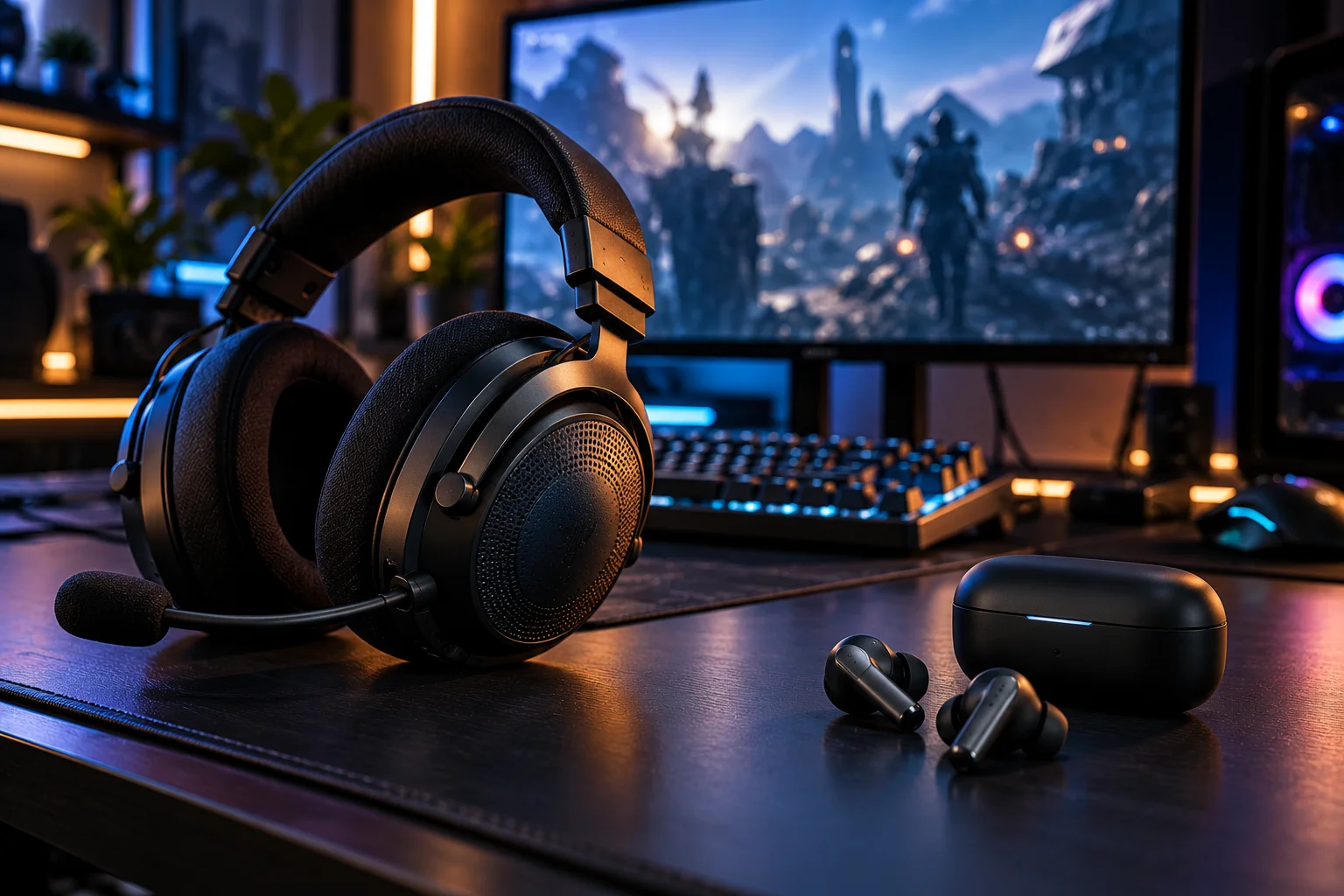
Gaming headsets and gaming earbuds can both deliver good game audio, but they approach the experience very differently.
A gaming headset generally gives you a larger soundstage, a dedicated boom microphone, stronger passive isolation and more physical controls. Gaming earbuds are smaller, lighter and easier to carry, while modern models can offer surprisingly low latency through dedicated 2.4GHz wireless connections. (rtings.com)
For competitive gaming, the decision becomes more complicated. Footstep positioning, audio consistency, microphone quality and latency can matter in games where a fraction of a second can affect what you hear and how quickly you react. Bluetooth earbuds can introduce noticeable latency, while gaming earbuds with a dedicated 2.4GHz dongle can reduce that problem considerably. (rtings.com)
For casual gaming, comfort and convenience may matter more than squeezing out the lowest possible latency.
So the real question isn't simply headset vs earbuds.
It is which format fits the way you play.
What is the difference between gaming headsets and gaming earbuds?
Gaming headsets are usually over-ear or on-ear devices with larger drivers and an integrated microphone, while gaming earbuds sit inside the ear canal and prioritize portability.
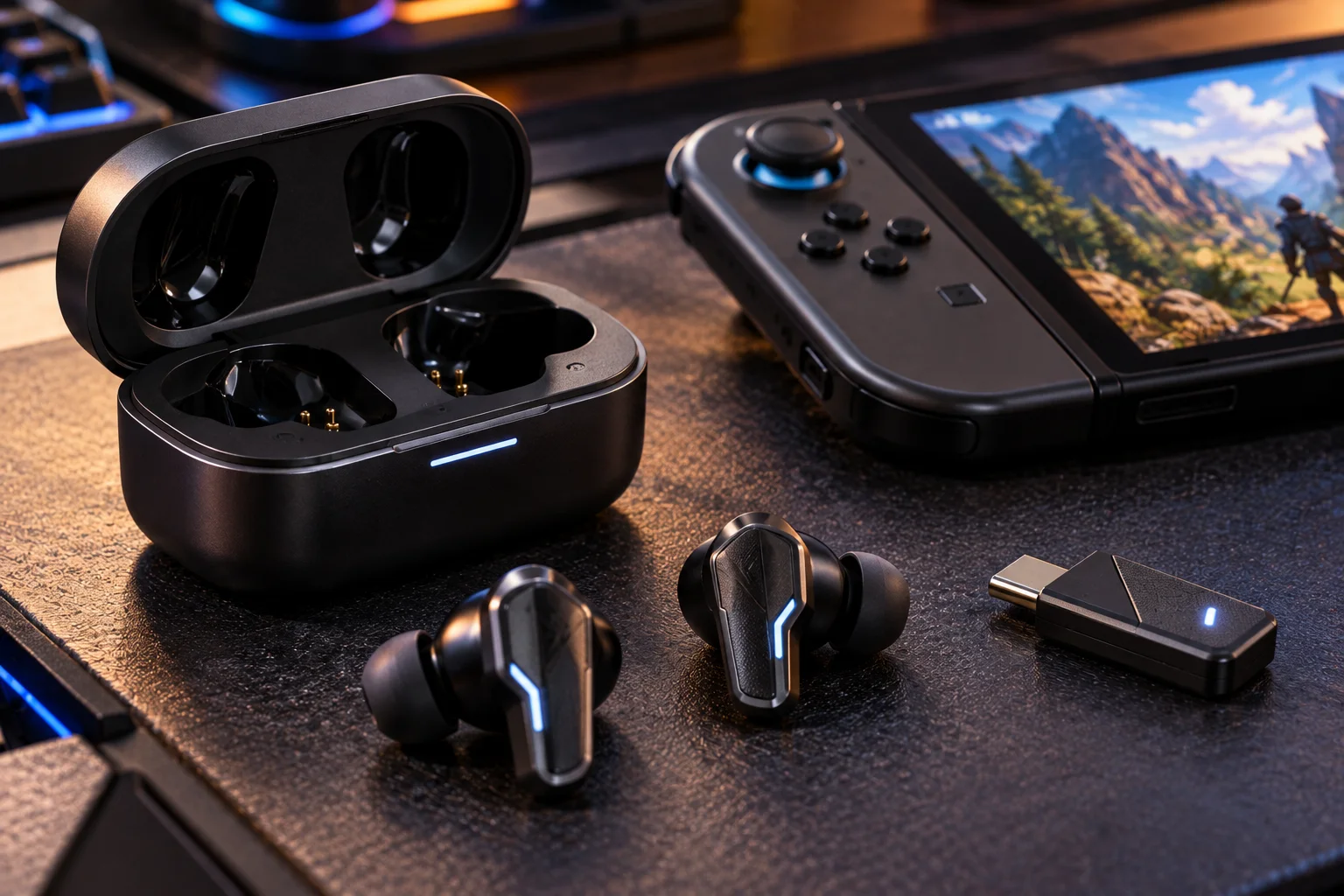
Feature | Gaming Headset | Gaming Earbuds |
|---|---|---|
Size | Larger | Compact |
Weight | Usually heavier | Usually lighter |
Microphone | Often dedicated boom mic | Usually built into earbuds |
Isolation | Strong, especially closed-back | Can be strong with good ear tips |
Soundstage | Often wider | Usually more compact |
Latency | Very low with wired/2.4GHz models | Very low with gaming 2.4GHz models |
Portability | Moderate | Excellent |
Battery | Often longer | Shorter per charge, with charging case |
Long-session comfort | Depends heavily on fit and heat | Depends heavily on ear-tip fit |
Best use | PC/console and long sessions | Portable, casual and hybrid gaming |
The differences have become less dramatic as gaming earbuds have improved.
Current models from companies such as Razer, ASUS and SteelSeries can combine Bluetooth with dedicated low-latency wireless connections, making them much more suitable for serious gaming than ordinary wireless earbuds. (soundguys.com)
Are gaming headsets better for competitive gaming?
Gaming headsets still have practical advantages for competitive players, particularly when positional audio, microphone quality and consistent fit matter.
A good gaming headset can provide:
Low-latency wireless or wired audio
A dedicated boom microphone
Strong left-right imaging
Larger ear cups
Physical controls
Stable positioning around the ears
RTINGS notes that gaming headsets designed for competitive use typically prioritize low-latency connectivity, comfortable long-session wear, accurate sound for locating game cues and clear microphones. (rtings.com)
That doesn't mean earbuds cannot compete.
It means headsets have traditionally been designed around the exact requirements of gaming, particularly PC and console gaming.
Are gaming earbuds good for competitive gaming?
Yes, provided they use a low-latency gaming connection and have good positional audio.
The biggest mistake is treating all wireless earbuds as equivalent.
Regular Bluetooth earbuds can introduce noticeable audio delay during gaming. RTINGS' testing shows that Bluetooth latency can be substantial on ordinary earbuds, while gaming products using dedicated wireless dongles generally perform much better. (rtings.com)
Modern gaming earbuds can use 2.4GHz wireless through a USB dongle instead.
For example, SoundGuys measured the Razer Hammerhead V3 HyperSpeed using its 2.4GHz connection and found no distracting latency during testing. (soundguys.com)
That makes a huge difference.
If you're considering earbuds for competitive gaming, look for dedicated gaming wireless, not simply "Bluetooth 6.0" or another Bluetooth version number.
Which has better positional audio?
A well-designed gaming headset often makes positional cues easier to interpret, but earbuds can also provide accurate imaging when their tuning and fit are good.
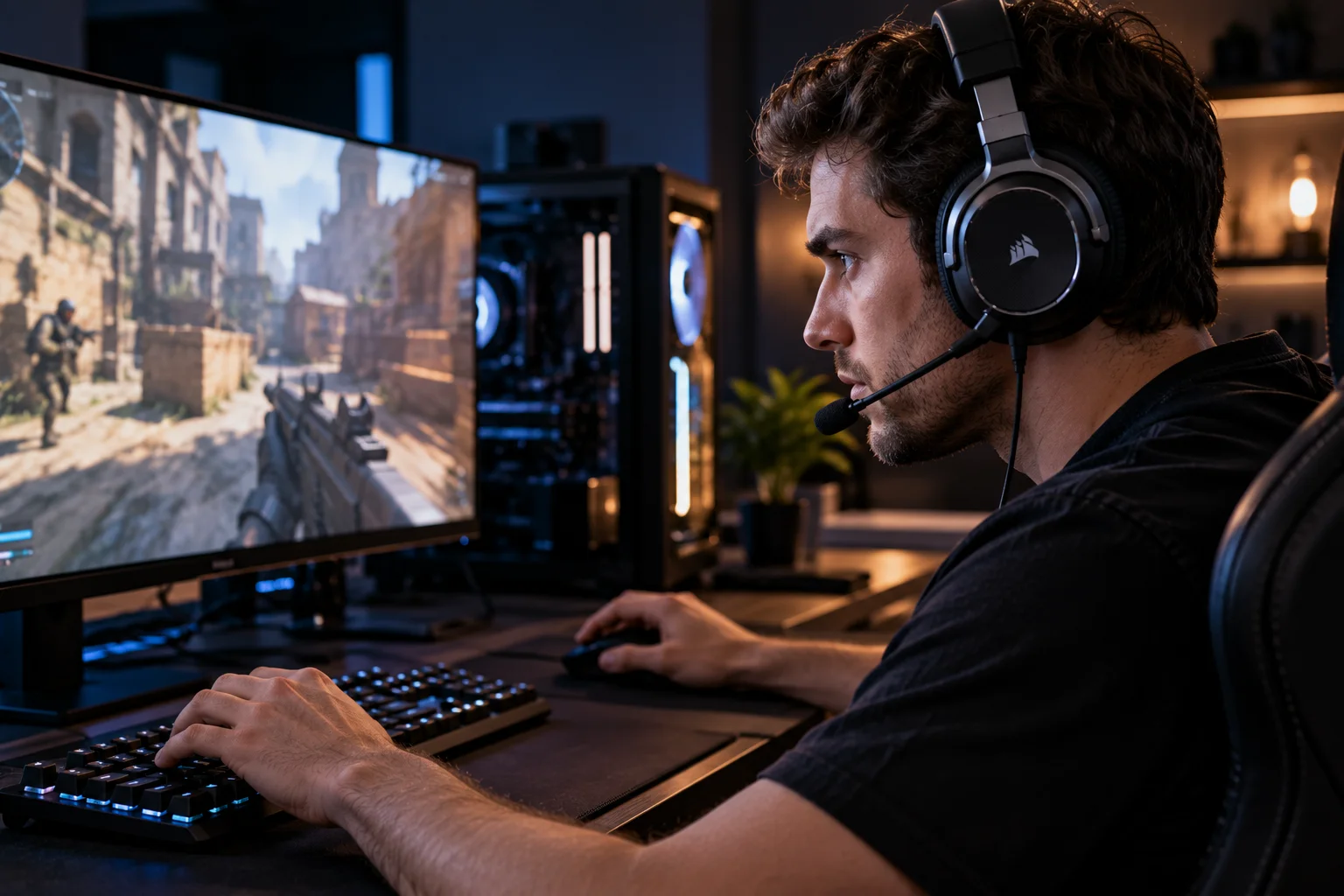
Competitive players often care less about how impressive explosions sound and more about whether they can distinguish:
Footsteps to the left or right
Distance from an opponent
Reload sounds
Direction of gunfire
Movement above or below
Environmental cues
A larger headset does not automatically guarantee better positional accuracy.
Driver tuning, channel matching, frequency response, ear shape and software processing all matter.
RTINGS notes that gaming headsets are often selected for their ability to reproduce spatial cues accurately, while testing of current gaming earbuds also shows models capable of good positional performance. (rtings.com)
In other words, form factor alone does not determine competitive audio performance.
Do gaming headsets have better microphones?
Usually, yes. A dedicated boom microphone generally gives gaming headsets an advantage for voice communication.
The microphone sits closer to your mouth and can be positioned consistently.
That helps with voice clarity.
Earbuds have much smaller microphones positioned farther from the mouth, and their voice quality can vary significantly between models.
This matters if you regularly use:
Discord
Team voice chat
In-game communication
Streaming
Multiplayer coordination
Some premium gaming earbuds have improved considerably, but a good headset's boom microphone remains one of its most practical advantages.
Are gaming earbuds more comfortable than headsets?
They can be, but comfort is highly personal because the two formats create completely different pressure points.
A headset rests around or on your ears.
That can create heat, pressure or discomfort during long sessions, particularly with heavy closed-back models.
Earbuds avoid the headband and ear-cup pressure.
But they put pressure inside the ear canal.
Some players can wear in-ear buds for hours without noticing them. Others find the sensation uncomfortable after a short period.
Fit is therefore more important than simply choosing the lighter product.
A 10-gram earbud is not more comfortable if the ear tip creates pressure.
Which is better for long gaming sessions?
There is no universal winner, but lightweight earbuds can be attractive for players who dislike headbands and ear-cup heat, while well-padded headsets can be more comfortable for others.
Gaming headsets distribute their weight across the head and ears.
A good design can make a surprisingly heavy device comfortable.
The problem is heat.
Closed-back ear cups can become warm during long sessions.
Earbuds eliminate that issue but introduce in-ear pressure.
If you regularly play for three or four hours at a time, comfort should be treated as a major specification rather than a secondary feature.
Do gaming earbuds have worse battery life?
Usually per charge, yes, but their charging cases can provide multiple additional charges.
A wireless headset may offer dozens of hours from a single battery charge.
Earbuds generally provide fewer hours per charge because their individual batteries are much smaller.
But the charging case changes the calculation.
You can put the earbuds back into the case between sessions and have them recharge automatically.
That makes earbuds convenient for people who use the same pair for gaming, commuting and everyday listening.
Headsets are generally simpler if you sit at a desk for long sessions and don't want to think about charging frequently.
Are Bluetooth earbuds good for gaming?
They can work for casual gaming, but ordinary Bluetooth is not the ideal choice when low latency matters.
Bluetooth audio can introduce enough delay for the sound to become noticeably out of sync with what is happening on screen.
RTINGS' testing shows why Bluetooth latency can be problematic for gaming, particularly with standard earbuds. (rtings.com)
Some earbuds include a dedicated low-latency gaming mode.
Others use a USB-C 2.4GHz transmitter.
Those are considerably more appropriate for serious gaming.
So don't confuse:
Wireless earbuds
with
gaming wireless earbuds.
They are not necessarily the same thing.
Which is better for PC gaming?
A gaming headset is usually the simpler choice for PC gaming, especially if you spend long sessions at a desk and use voice chat frequently.
PC gaming provides plenty of connectivity options, and gaming headsets can take advantage of USB, 3.5mm and 2.4GHz wireless connections.
They also tend to offer desktop software for EQ, microphone settings, spatial audio and button customization.
Gaming earbuds can work extremely well too, particularly if you want something smaller or use the same device with a phone or handheld.
The choice largely comes down to portability versus the traditional desktop gaming experience.
Which is better for console gaming?
Both can work, but platform compatibility is particularly important with consoles.
Wireless gaming headsets and earbuds often come in platform-specific versions.
A wireless product designed for PlayStation may not provide the same wireless functionality on Xbox.
Some devices support Bluetooth for secondary use but cannot use Bluetooth for game audio on every console.
Before buying, check whether the exact model supports:
PlayStation
Xbox
Nintendo Switch
PC
Mobile
USB-C wireless
Do not assume that a USB-C dongle guarantees compatibility with every gaming platform.
Which is better for casual gaming?
Gaming earbuds are often more convenient for casual players who want something small, portable and usable outside gaming.
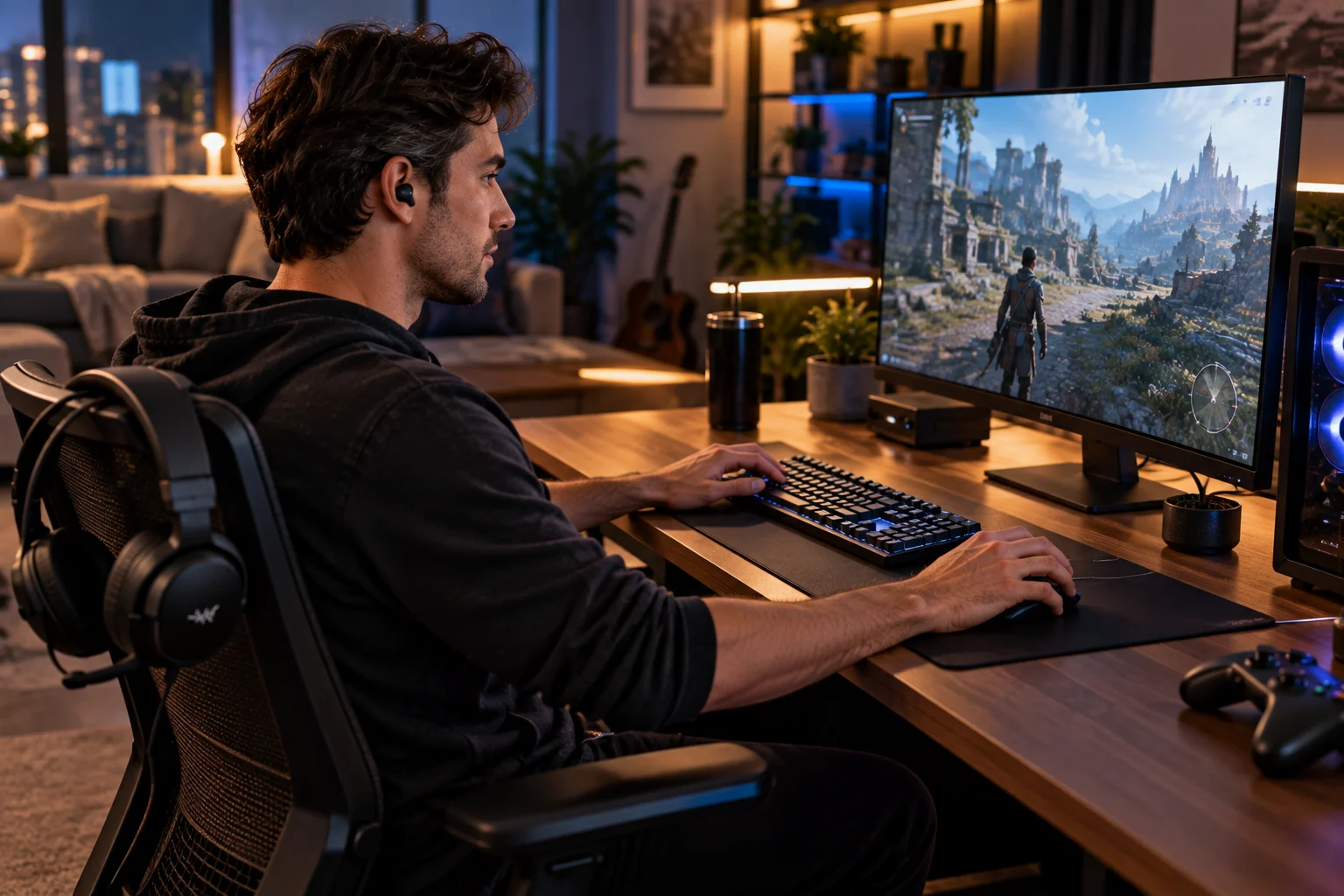
If you play games occasionally on a phone, Steam Deck or laptop, earbuds make a lot of sense.
You can use the same pair for music, calls and gaming.
A headset makes more sense if gaming is your primary use and you spend several hours at a desk or console.
This is where the two categories increasingly overlap.
Modern gaming earbuds are no longer simply tiny alternatives to headphones. They are becoming multipurpose gaming and everyday-audio devices.
Which is better for FPS games?
For competitive FPS games, prioritize low latency, accurate positional audio and microphone quality rather than choosing based solely on headset or earbud design.
A good competitive setup should make it easy to distinguish directional cues.
For either format, look for:
Low-latency wired or 2.4GHz connectivity
Accurate imaging
Clear midrange and treble
Good microphone performance
Stable fit
Useful EQ controls
A flashy bass-heavy sound profile may make explosions more exciting, but excessive bass can sometimes mask quieter details such as footsteps.
That is why competitive gaming audio is about clarity and positioning, not simply maximum sound quality.
Which is better for single-player games?
Either can be excellent, and headsets often have an advantage when immersion and spacious sound are priorities.
Single-player games benefit from environmental sound, music, dialogue and atmospheric effects.
A good headset can create a larger perceived soundstage and make long sessions comfortable.
Earbuds can still provide excellent immersion, particularly when they provide good isolation and spatial processing.
For story-driven games, the difference is often less about competitive performance and more about which form factor you find enjoyable to wear.
Are gaming earbuds worth buying in 2026?
Yes, especially if you want low-latency gaming in a compact format.
The category has matured considerably.
Current gaming earbuds can combine 2.4GHz wireless, Bluetooth, active noise cancellation, gaming-specific EQ and multi-platform compatibility. Current testing of products such as the Razer Hammerhead V3 HyperSpeed and SteelSeries Arctis GameBuds shows that earbuds can now provide serious gaming functionality rather than simply acting as portable headphones. (soundguys.com)
The biggest thing to watch is the connection method.
For competitive gaming, dedicated low-latency wireless or wired connectivity matters more than whether the product is technically an earbud.
Which should you buy: gaming headset or gaming earbuds?
Choose a gaming headset if competitive consistency, microphone quality and long desktop sessions matter most. Choose gaming earbuds if portability, low weight and multipurpose use matter more.
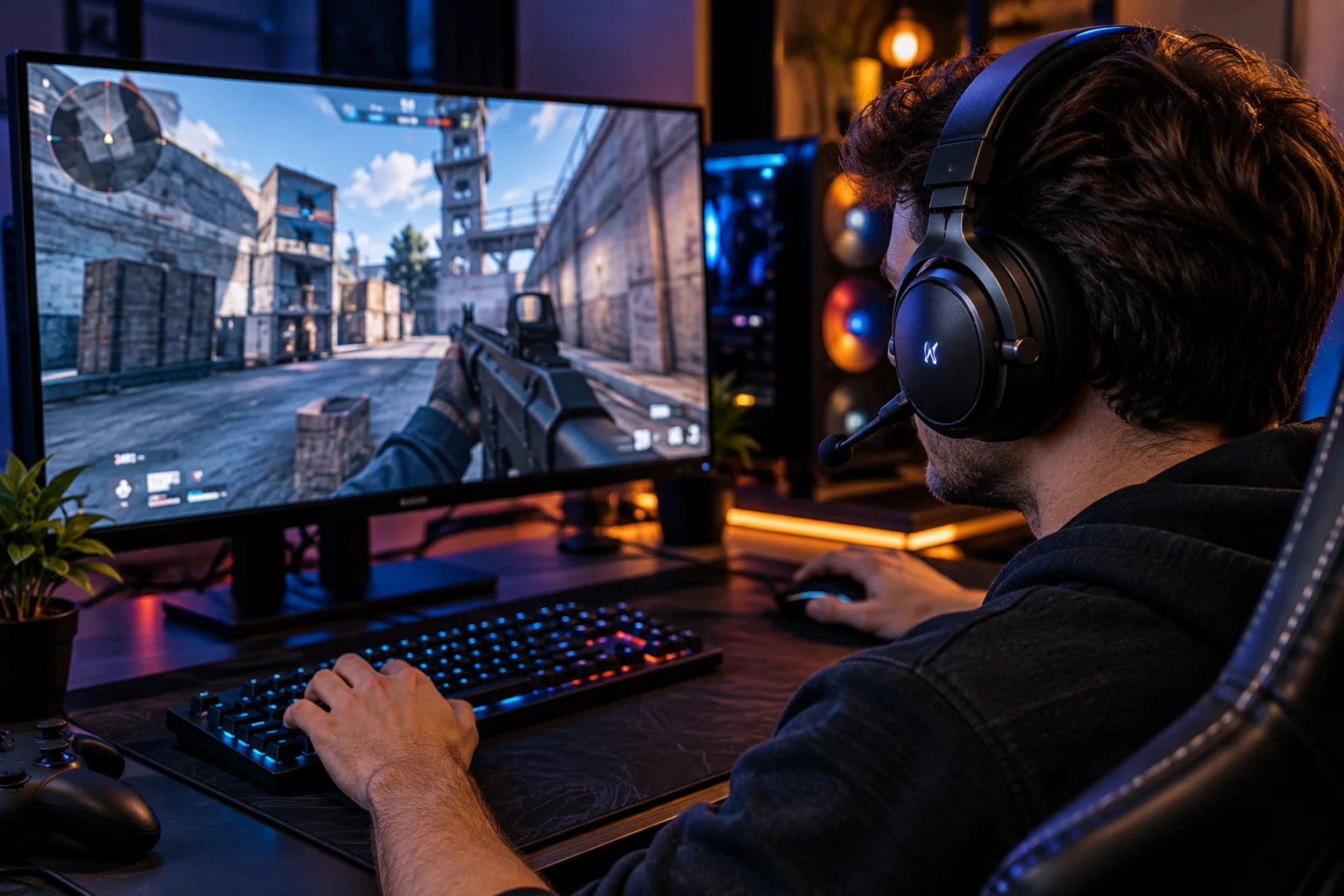
Choose a gaming headset if you:
Play competitive PC or console games
Use voice chat constantly
Want a dedicated boom microphone
Prefer over-ear comfort
Play for several hours
Want strong positional audio
Prefer physical controls
Choose gaming earbuds if you:
Want a compact setup
Play on phones or handhelds
Move between devices
Dislike headbands
Want one pair for gaming and everyday listening
Prefer lightweight hardware
Choose a model with a low-latency gaming connection
The best choice depends less on the shape of the device and more on how you actually play.
Gaming Headset vs Gaming Earbuds FAQs
Are gaming headsets better than gaming earbuds?
Not universally. Headsets generally offer advantages in microphone quality, controls and long-session gaming, while earbuds provide portability and a lighter design.
Are gaming earbuds good for competitive FPS games?
Yes, provided they have low-latency connectivity and accurate positional audio. A 2.4GHz gaming connection is generally preferable to ordinary Bluetooth when latency matters. (rtings.com)
Do gaming earbuds have less latency than headsets?
Not inherently. Latency depends on the connection technology and implementation. Both headsets and earbuds can achieve very low latency with wired or dedicated 2.4GHz wireless connections.
Are Bluetooth earbuds bad for gaming?
Not necessarily, but standard Bluetooth can introduce noticeable audio delay. Dedicated gaming modes and 2.4GHz wireless can substantially reduce latency. (rtings.com)
Do gaming headsets have better microphones?
Generally, yes. A dedicated boom microphone is positioned closer to the mouth and usually provides more consistent voice quality than the small microphones found in earbuds.
Which is more comfortable for gaming, earbuds or headsets?
It depends on the user. Earbuds avoid headband and ear-cup pressure, while headsets avoid putting pressure inside the ear canal. Fit is more important than weight alone.
Are earbuds good for long gaming sessions?
They can be, provided the ear tips fit comfortably. Some people prefer them for long sessions because they are lightweight, while others find in-ear pressure uncomfortable.
What is most important for competitive gaming audio?
Prioritize low latency, accurate positional imaging, clear voice communication and a comfortable, stable fit. The physical format is secondary to how well the specific product delivers those qualities.
The bottom line
For competitive gaming, a good low-latency gaming headset remains a straightforward choice, but modern gaming earbuds have become a legitimate alternative.
The important distinction is no longer simply headset versus earbuds.
It is gaming-focused audio versus ordinary audio hardware.
A wired headset or 2.4GHz gaming headset can provide excellent latency and a strong microphone. A dedicated gaming earbud with 2.4GHz wireless can deliver much of that responsiveness in a considerably smaller package.
For casual gaming, earbuds may be the more convenient all-purpose option.
For competitive FPS gaming, focus on the actual specifications: latency, positional accuracy, microphone performance and fit.
And if you already own good earbuds with a dedicated low-latency gaming mode, you may not need a traditional headset at all.