
A smartphone isn't necessarily a good deal just because a retailer puts a red discount label next to it. The real bargain is the price you pay after comparing the phone's launch price, recent selling price, available bank or credit-card offers, trade-in value and any conditions attached to the promotion.
That distinction matters more than ever in the US smartphone market.
A $999 phone advertised at $799 looks like a $200 saving. But if the same model regularly sold for $749 during the previous few months, $799 isn't particularly impressive. Likewise, a carrier advertising "$1,200 off" may require a qualifying unlimited plan, an eligible trade-in and 36 monthly bill credits. The headline discount isn't the same thing as $1,200 in cash savings at checkout.
The easiest way to evaluate a smartphone sale is to stop asking "How much is it discounted from MSRP?" and start asking:
"What will this phone actually cost me compared with its recent market price, and what am I giving up to get the discount?"
Here's how to calculate that before you buy.
Start With the Original Launch Price, But Don't Stop There
The launch price tells you how much the manufacturer originally charged, but it doesn't tell you whether today's sale price is genuinely attractive.
Manufacturers use the launch price as the reference point for promotions because it creates an easy-looking discount.
Suppose a phone launched at:
$999
and is currently advertised for:
$799
The retailer can describe that as:
Save $200
That's factually correct if $999 is the relevant original price.
But it doesn't answer the more useful question:
Has this phone actually been selling for $799, or has it been available for $749 several times already?
That's why launch price should be your first reference point, not your final benchmark.
For example, Apple's iPhone 18 Pro launched in the US at $1,199 for 256GB, while the iPhone 18 Pro Max started at $1,299. Those are useful reference prices when evaluating later promotions.
But six months after launch, comparing a sale only with those original prices can make an ordinary promotion look unusually generous.
Check the Phone's Recent Price History Before Calling It a Deal
Recent price history is one of the strongest ways to determine whether a smartphone's current sale price is actually low.
Imagine the following simplified history:
Period | Phone price |
|---|---|
Launch | $999 |
Month 2 | $949 |
Month 3 | $899 |
Major sale | $799 |
Month 5 | $849 |
Today's sale | $829 |
Today's retailer might say:
$999 → $829: Save $170
But the more useful comparison is:
Previous low: $799
Now you know that today's $829 price isn't the lowest the phone has reached.
That doesn't automatically make $829 a bad purchase. The phone could have additional benefits today, such as a better trade-in promotion, free storage upgrade or credit-card rebate.
The point is simply to compare against what consumers have actually been paying recently.
What Price History Should You Look At?
Ideally, compare the current price with the 30-, 90- and 365-day price history rather than relying on a single previous price.
A 30-day low tells you whether today's price is competitive with recent promotions.
A 90-day view shows whether the phone has entered a lower pricing phase.
A 365-day view can reveal seasonal patterns and major sale events.
Tools such as Amazon's price-history information, Google Shopping price insights and dedicated Amazon trackers can help establish these benchmarks. The important thing is to compare the same model, storage capacity and condition.
A 256GB version isn't directly comparable with a 512GB version just because both carry the same model name.
Compare the Exact Storage Version
A smartphone deal is only meaningful when you're comparing the same storage configuration.
This is one of the easiest ways for a discount to look better than it really is.
Suppose:
128GB launched at $699
256GB launched at $799
512GB launched at $999
A retailer might advertise the phone starting at $599.
But if the $599 version is the 128GB model and you actually need 256GB, your real comparison should be against the 256GB pricing.
The same principle applies to:
RAM configuration
Carrier versus unlocked model
New versus refurbished
US versus international model
Different colors when availability changes
Manufacturer warranty
Retailer-specific configurations
Always compare like for like.
Bank Offers Can Turn an Average Sale Into a Better Deal
A bank or credit-card promotion should be treated as an additional discount only when you would use the card anyway and can meet its conditions without paying extra costs.
US smartphone retailers frequently combine sale prices with card-linked promotions, instant discounts, cashback or financing incentives.
For example:
Phone sale price: $799
Eligible card offer: $50
Effective purchase price: $749
That changes the calculation considerably.
But check the terms.
A "10% cashback" offer may have:
A maximum cashback amount
Minimum spending requirements
Activation requirements
Eligible-card restrictions
Limited promotional periods
Statement-credit delays
And a financing promotion isn't necessarily a discount.
0% APR for 24 months changes how you pay.
It doesn't automatically reduce the phone's price.
Separate Instant Discounts From Future Credits
An instant discount reduces the purchase price immediately, while a future credit may require you to complete additional conditions.
This distinction becomes particularly important with carrier deals.
Consider a promotion advertised as:
"$1,200 off with trade-in."
The next question should be:
How do I receive the $1,200?
If the answer is:
"$33.33 per month for 36 months as bill credits,"
you aren't receiving $1,200 immediately.
You're receiving the benefit over time.
Current US carrier promotions illustrate the difference. For example, current iPhone 18 Pro offers can provide up to $1,200 through qualifying carrier arrangements, while the terms can involve eligible trade-ins and installment billing.
That's not necessarily a bad deal.
It simply needs to be evaluated differently from an unlocked phone that is $300 cheaper at checkout.
Trade-In Value Can Change the Entire Calculation
Your old phone's trade-in value should be treated as part of the transaction, not as a reason to ignore the new phone's actual price.
Suppose you're buying a $999 smartphone.
You have three possible trade-in offers:
Option | Trade-in value |
|---|---|
Manufacturer | $450 |
Retailer | $500 |
Carrier promotion | $800 in bill credits |
At first glance, the carrier offer looks dramatically better.
But the carrier's $800 might depend on:
A qualifying plan
Keeping the line active
Financing the phone
Receiving credits over 36 months
Meeting device eligibility requirements
The manufacturer might give you $450 immediately without changing your wireless plan.
So don't compare:
$800 > $500 > $450
and automatically choose the $800 option.
Compare the total economic value and the conditions attached to each offer.
Calculate Your Real Effective Price
The simplest way to compare smartphone deals is to calculate the effective cost after immediate discounts and realistic trade-in value.
Use:
Effective phone cost = Purchase price − instant discount − guaranteed trade-in credit − applicable cashback
For example:
Phone price: $899
Sale discount: $100
Credit-card discount: $50
Trade-in: $300
Your effective cost is:
$899 − $100 − $50 − $300 = $449
That's much more useful than simply saying:
"The phone is $100 off."
However, keep carrier bill credits separate when they depend on future service commitments.
For those offers, calculate:
Total phone payments − future bill credits + required additional costs
That gives you a much more realistic number.
Don't Forget the Value of the Phone You're Trading In
A trade-in is not free money because your old phone has value that you could potentially realize elsewhere.
This is one of the most overlooked parts of smartphone deal calculations.
Suppose:
New phone: $799
Retailer trade-in: $300
The apparent effective price is:
$499
But suppose you could sell the old phone privately for $400.
Your economic cost of choosing the retailer trade-in is closer to:
$799 − $400 = $399
before considering the extra time, risk and hassle of a private sale.
That doesn't mean private selling is always better.
A trade-in can be worth accepting because it's:
Faster
Easier
More predictable
Safer
Integrated into the purchase
The important thing is knowing what you're actually giving up.
Check Whether the Trade-In Value Is Guaranteed
A quoted trade-in value may depend on the device matching the condition you reported.
Apple, for example, says its online trade-in estimate is subject to verification after the device is received, and the final credit can differ if its condition doesn't match the description.
That means you shouldn't treat every trade-in estimate as guaranteed cash.
Before sending your old phone, check:
Screen condition
Body damage
Battery condition if relevant
Whether the phone powers on
Activation lock status
Storage capacity
Carrier status
Required accessories, if any
Inspection terms
Keep a record of the phone's condition before shipping it.
Watch Out for Carrier Deals That Look Like Free Phones
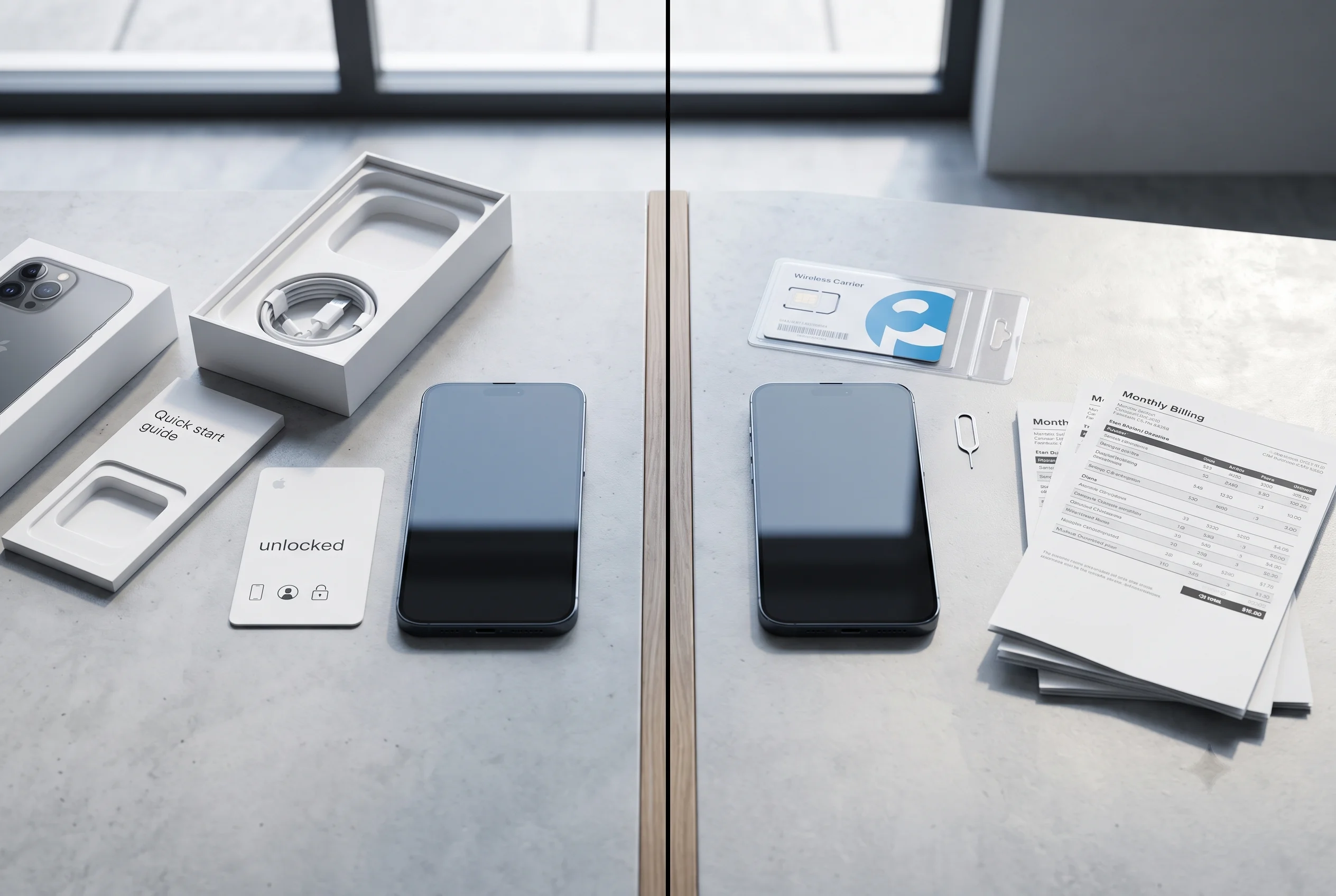
A "free phone" promotion can still involve a real financial commitment because the discount may be delivered through monthly bill credits.
This is especially common in the US carrier market.
For example, current iPhone promotions from major carriers can advertise up to $1,200 off. But the maximum offer can depend on an eligible trade-in, plan and other requirements, with credits spread over the financing period.
Before accepting one, ask:
How much do I pay upfront?
How much do I finance?
How much is each monthly credit?
How many months do credits continue?
What happens if I leave the carrier?
What happens if I upgrade early?
Is a new line required?
Is a specific plan required?
Is the phone locked for a period?
Are activation or upgrade fees involved?
A phone that costs "$0/month" under a promotion isn't necessarily equivalent to an unlocked phone that costs $0.
Compare Unlocked and Carrier Prices Separately
An unlocked phone gives you a cleaner price comparison because its hardware cost is easier to separate from your wireless-service costs.
This is particularly useful when evaluating a sale.
Compare:
Unlocked purchase
Phone price − sale discount − trade-in − bank offer
versus:
Carrier promotion
Phone payments − bill credits + required plan costs + fees
The second calculation can become much more complicated.
That's why a carrier deal can be financially attractive for someone who already plans to stay on that carrier, but less attractive for someone who values flexibility.
Check Whether the "Sale" Is Actually an Old Model Being Cleared Out
A large discount can be perfectly legitimate when a newer generation has replaced the phone.
This is especially common immediately after major flagship launches.
For example, Apple's iPhone 18 Pro and 18 Pro Max became available in September 2026, so older iPhone generations naturally become candidates for retailer and carrier promotions.
The same pattern occurs with Android phones after Samsung, Google or other manufacturers launch new flagships.
A discounted previous-generation phone can be an excellent value.
But don't judge it solely by the percentage discount.
Ask:
What do I lose by buying the older generation?
Check:
Processor
Camera hardware
Battery
Display
Software-support period
AI features
Modem
Connectivity
Repairability
Remaining warranty
Sometimes $200 saved is worth it.
Sometimes paying $100 more for the newer model makes more sense because you'll keep it longer.
Compare the Deal With the Phone's Current Market Price
The best benchmark isn't always the manufacturer's MSRP; it's what multiple reputable retailers are charging for the same phone today.
Suppose you find:
Retailer | Price |
|---|---|
Manufacturer | $899 |
Retailer A | $849 |
Retailer B | $799 |
Retailer C | $829 |
A store advertising:
"Save $100 — now $799"
may genuinely have a competitive price.
But if another retailer is already selling the same configuration for $799, the "sale" itself isn't unique.
That's why checking at least three reputable retailers can quickly reveal whether you're looking at a genuine market-wide discount or simply a retailer's preferred comparison price.
Look at the Total Package, Not Just the Phone
A deal can become more valuable when it includes useful extras that you would otherwise purchase separately.
Examples include:
Free storage upgrade
Case
Charger
Earbuds
Gift card
Extended warranty
Subscription
Cloud storage
Accessory credit
But assign these benefits a realistic value.
If a retailer says:
"$100 off + $150 worth of accessories,"
don't automatically count the accessories as $150 of savings.
Ask:
Would I have bought those accessories anyway?
If the answer is no, their practical value to you may be much lower.
Use a Simple Smartphone Deal Scorecard
A five-part checklist can make almost any smartphone promotion easier to evaluate.
Check | Question |
|---|---|
Launch price | What was the original MSRP for this exact configuration? |
Price history | What has the phone actually sold for recently? |
Current market | What are other reputable retailers charging today? |
Bank/card offer | What discount or cashback can I actually receive? |
Trade-in | What is my old phone worth after considering alternatives? |
Then add a sixth category:
Conditions
That's where many apparently huge discounts become less impressive.
Check for:
Carrier lock
Required plan
New-line requirement
Monthly bill credits
Financing period
Activation fees
Membership requirements
Cashback limits
Trade-in restrictions
Return-window limitations
A Worked Example: Is $799 Really a Good Deal?
The best way to understand smartphone pricing is to run the numbers on a hypothetical purchase.
Imagine a phone launched at $999.
Today's promotion says:
$799
You find that its recent low was $749.
You also have:
$50 credit-card cashback
and your old phone is worth:
$250
through the retailer.
Your effective cost becomes:
$799 − $50 − $250 = $499
That's the number you should compare with alternatives.
But if another retailer offers the same phone for $749 with the same trade-in value and card offer, the effective cost there is:
$749 − $50 − $250 = $449
Now the supposedly impressive $799 sale isn't the best available transaction.
The lesson is simple:
Discount percentage is not the same thing as deal quality.
When Is a Smartphone Sale Actually a Good Deal?
A smartphone sale becomes much more compelling when the current price is close to or below the phone's recent low, the configuration matches what you need, and the discounts don't require expensive commitments.
A strong deal usually has several characteristics:
The price is below or close to the recent market low.
The exact storage configuration is discounted.
The phone is sold by a reputable retailer.
The discount is immediate rather than dependent on years of credits.
The trade-in value is competitive.
The bank or card offer doesn't introduce extra costs.
The phone still has a useful software-support lifespan.
You're not buying more storage or accessories you don't need.
The promotion doesn't force you into an unsuitable wireless plan.
You don't need every box checked.
But the more of them that line up, the easier it is to distinguish a genuine bargain from clever marketing.
FAQ: Smartphone Sale Prices and Real Deals
How do I know if a smartphone sale is actually a good deal?
Compare the current price with the phone's launch MSRP, recent 30- and 90-day prices, current prices at other retailers, available bank offers and the value of your existing phone. Then calculate the effective cost after legitimate discounts.
Should I compare a phone with its launch price?
Yes, but only as a starting point. Launch MSRP shows how much the manufacturer originally charged, while recent price history tells you what consumers have actually been paying.
What is more important: MSRP or price history?
For evaluating a current sale, recent price history is generally more informative because it shows whether today's price is unusually low or simply normal for that stage of the product cycle.
Are carrier "free phone" deals really free?
Not necessarily in the everyday sense. Many US carrier promotions provide the discount through monthly bill credits and require an eligible trade-in, plan or new line. Current promotions can advertise up to $1,200 off while spreading credits over the financing period.
Should I trade in my old phone or sell it privately?
Compare the actual trade-in value with realistic private-sale value. A trade-in may be worth less but can save time and reduce selling risk.
Does a bank offer count as part of the phone's sale price?
It can be included when calculating your effective cost if you qualify and would receive the benefit without taking on unnecessary fees or interest.
Is 0% financing the same as a discount?
No. 0% financing reduces or eliminates interest charges; it doesn't necessarily reduce the phone's purchase price.
Should I wait for Black Friday to buy a smartphone?
Not automatically. Some phones reach their lowest prices during major shopping events, but a phone can also hit a competitive price outside those periods. Compare the current price with its recent history instead of assuming the next sale will be better.
How much should I save before calling a smartphone a good deal?
There's no universal percentage. A $100 discount can be significant on a $500 phone, while a $200 discount on a $1,500 phone may be less impressive if the model has repeatedly sold for less.
What's the fastest way to check a smartphone deal?
Find the exact model and storage configuration, check its recent price history, compare three or more reputable retailers, calculate your trade-in value separately, then subtract any genuine instant discounts or cashback. Finally, read the conditions attached to carrier or financing promotions.
The smartest way to shop for a smartphone in 2026 is to stop treating the sale banner as the answer.
The number that matters is your effective cost relative to the phone's real recent market price.
A retailer can say "$300 off." A carrier can say "$1,200 off." A bank can offer another $50 back. Your old phone can be worth $400.
Those numbers can all be true at the same time.
But they don't necessarily describe the same deal.
Before buying, write down five numbers:
Current price → recent low → bank/card savings → trade-in value → required commitments.
Once those are in front of you, smartphone pricing becomes much easier to understand.
And that is the difference between finding a phone that's advertised as a deal and finding one that actually costs less than it should.