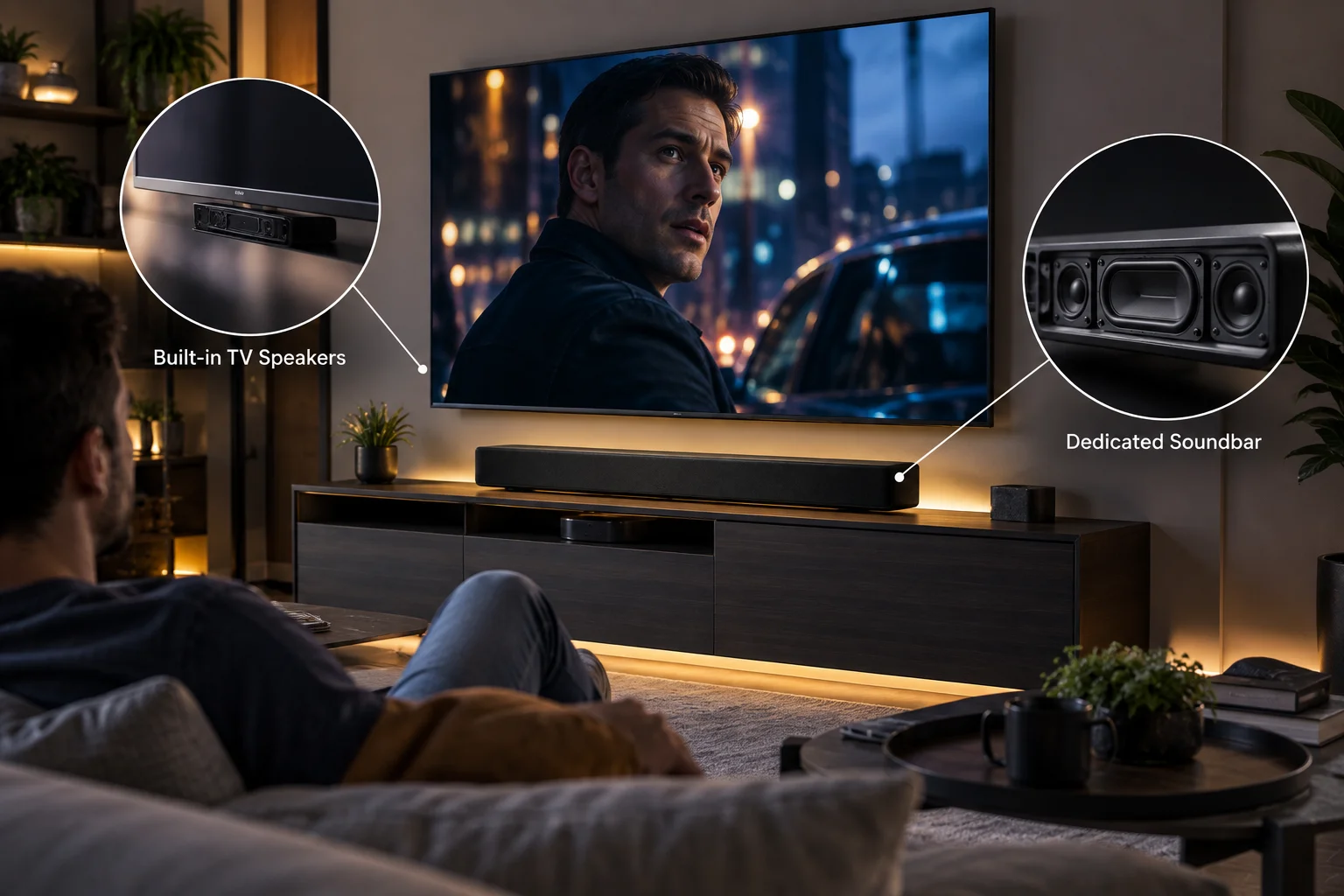
Modern TVs can produce a spectacular picture while still sounding surprisingly ordinary.
That is largely a consequence of their design. As screens have become thinner, manufacturers have had less physical space to work with for larger speaker hardware. The result can be perfectly acceptable sound for everyday viewing, but dialogue may lack clarity and action scenes can feel flat compared with the size of the picture.
A soundbar is designed to solve that problem without turning your living room into a full home theatre.
For most people, a good soundbar makes a clearly noticeable difference over built-in TV speakers, particularly for dialogue, bass, volume and the sense of a larger soundstage.
The question is whether that improvement is worth paying for in your particular setup.
Soundbar vs TV speakers: What difference will you actually notice?
The biggest improvements are usually clearer dialogue, stronger bass and a wider, more immersive presentation.

Category | TV Speakers | Soundbar | Winner |
|---|---|---|---|
Dialogue clarity | Usually adequate | Often clearer | Soundbar |
Bass | Limited | Much stronger | Soundbar |
Maximum volume | Limited | Higher | Soundbar |
Soundstage | Narrow | Wider | Soundbar |
Dolby Atmos | Limited or simulated | Much better support | Soundbar |
Surround sound | Limited | Available on some systems | Soundbar |
Simplicity | Excellent | Very good | TV Speakers |
Cost | Included | Additional purchase | TV Speakers |
Space required | None | Small | TV Speakers |
Upgrade potential | None | Excellent | Soundbar |
A basic soundbar is not going to transform every TV into a cinema.
But even a relatively simple model can make voices easier to follow and give films, sports and games considerably more impact.
Why do TV speakers sound weak?
Thin televisions simply do not leave much room for substantial speaker hardware.
A traditional speaker benefits from physical space for drivers and the movement of air. A modern flat-panel television has to prioritise an extremely thin display, leaving a much smaller enclosure for audio components.
This does not mean expensive TVs necessarily sound bad.
It means manufacturers face physical limitations that a separate soundbar does not.
A soundbar can put multiple drivers into a dedicated enclosure positioned directly below or beside the television. That gives it substantially more room to create a broader presentation than the tiny speakers built into many TVs.
Does a soundbar make dialogue easier to hear?
Yes, and this is arguably the most useful everyday upgrade for many people.
A dedicated soundbar can position a speaker directly towards the listening area rather than relying on small drivers hidden inside the television.
Testing by RTINGS found that soundbars can be a solid upgrade for dialogue because many include dedicated centre-channel hardware and dialogue-enhancement processing.
That matters when you're watching dramas, news, documentaries or films with busy soundtracks.
You may notice the difference most when there is music, explosions or ambient noise happening at the same time as conversation.
A good soundbar does not necessarily make voices louder.
It can make them easier to distinguish from everything else.
Does a soundbar give you better bass?
Almost always, particularly compared with the built-in speakers of a thin TV.
Television speakers are constrained by their tiny physical enclosures.
A larger soundbar can produce more substantial low frequencies, and systems that include a separate wireless subwoofer go much further.
That can completely change how an action movie feels.
A vehicle crash has more weight. Music has more body. A film soundtrack feels less like sound coming from a flat screen and more like sound filling the room.
You do not need a huge subwoofer to appreciate the difference either.
Even a compact soundbar can provide more convincing low-end performance than most TV speakers.
Is Dolby Atmos worth paying for?
It can be, particularly if you watch a lot of films and shows with Dolby Atmos soundtracks.
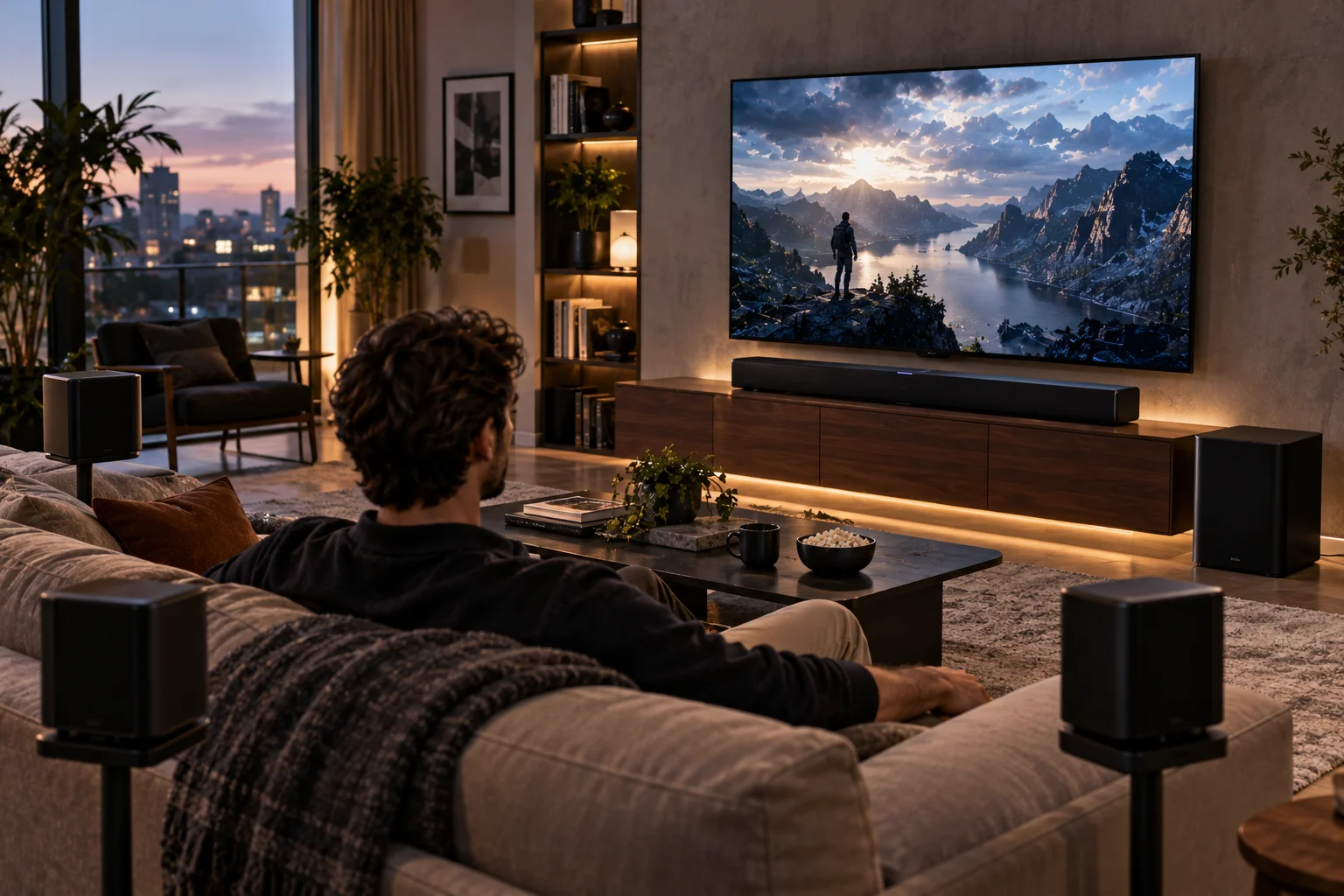
Dolby Atmos is an object-based audio format that can add a sense of height and movement to compatible content. Soundbars with dedicated upward-firing drivers can bounce sound from the ceiling to create a stronger impression of three-dimensional audio.
But there is an important distinction between a soundbar that supports Atmos and a complete surround system.
A basic Atmos soundbar may create a wider sense of space.
A system with upward-firing drivers, a dedicated subwoofer and separate rear speakers can produce a much more convincing surround effect.
Samsung's current HW-Q990H, for example, is an 11.1.4-channel system with a subwoofer and rear speakers, wireless Dolby Atmos and SpaceFit Sound Pro room optimisation.
That is a very different proposition from simply adding a compact two-channel soundbar to a TV.
Can a soundbar actually create surround sound?
Yes, but the quality of the effect depends heavily on the soundbar and its configuration.
A standalone soundbar uses processing and strategically positioned drivers to make the sound appear wider than the physical speaker.
Some premium models add upward-firing drivers for height effects.
The most convincing systems add wireless rear speakers and a subwoofer.
This is why looking only at a product's channel number can be misleading. A genuine multi-speaker system physically surrounding you will generally create a more convincing surround field than a single bar attempting to simulate one.
Is a cheap soundbar better than TV speakers?
Usually, but not every inexpensive soundbar is automatically a major upgrade.
A basic soundbar can improve speech clarity, volume and soundstage, but there is a point where the benefits become more modest.
The quality of the drivers, centre-channel design, processing and room interaction all matter.
Independent testing from RTINGS currently includes budget soundbars specifically recommended as upgrades for dialogue, while its broader testing also shows that premium systems can deliver much more convincing immersive sound.
So rather than asking whether a soundbar is cheap, ask what problem you are trying to solve.
If your biggest complaint is dialogue, prioritise a soundbar with strong centre-channel performance and voice enhancement.
If your goal is cinema-style surround sound, you need a more capable system.
Do you need a subwoofer?
No, but a subwoofer is one of the clearest upgrades for anyone who wants stronger cinematic bass.

A soundbar without a separate subwoofer can still sound much better than a television.
Adding a dedicated subwoofer extends the low-frequency range and takes the bass workload away from the main bar.
That is particularly noticeable with:
Action films
Science-fiction
Concerts
Video games
Sports broadcasts
Music with strong low-end content
For someone mainly watching sitcoms, news and YouTube, a subwoofer may not be worth the extra space.
For movie enthusiasts, it can be transformative.
Is a premium soundbar worth the money?
Only when you will actually use its advantages.
A premium standalone bar such as the Sonos Arc Ultra includes 14 drivers, upward-firing speakers, Dolby Atmos, Trueplay room calibration and HDMI eARC. Sonos currently recommends it for TVs 50 inches and larger.
That is considerably more sophisticated than a basic soundbar.
But a premium standalone bar can still be limited compared with a complete system that has separate rear speakers.
For example, Samsung's HW-Q990H adds both rear speakers and a dedicated subwoofer to its 11.1.4-channel configuration.
So the premium question is not simply "How much better does it sound?"
It is "How much better does it sound for the way I watch TV?"
What about a compact soundbar?
A compact soundbar is often the best solution for smaller rooms and people who mainly want better dialogue without creating a complicated setup.
A smaller system can fit below a 43-, 50- or 55-inch television without dominating the room.
The trade-off is physical.
Larger soundbars generally have more room for drivers and can create a wider presentation, although clever acoustic design can make compact models surprisingly capable.
Sonos currently positions its Beam Gen 2 for TVs up to 65 inches, while the Arc Ultra is aimed at TVs 50 inches and larger.
TV size is therefore a useful guideline rather than an absolute rule.
Room size and listening distance matter too.
Which soundbar features are actually worth paying for?
Prioritise features that directly change the listening experience rather than collecting specifications.
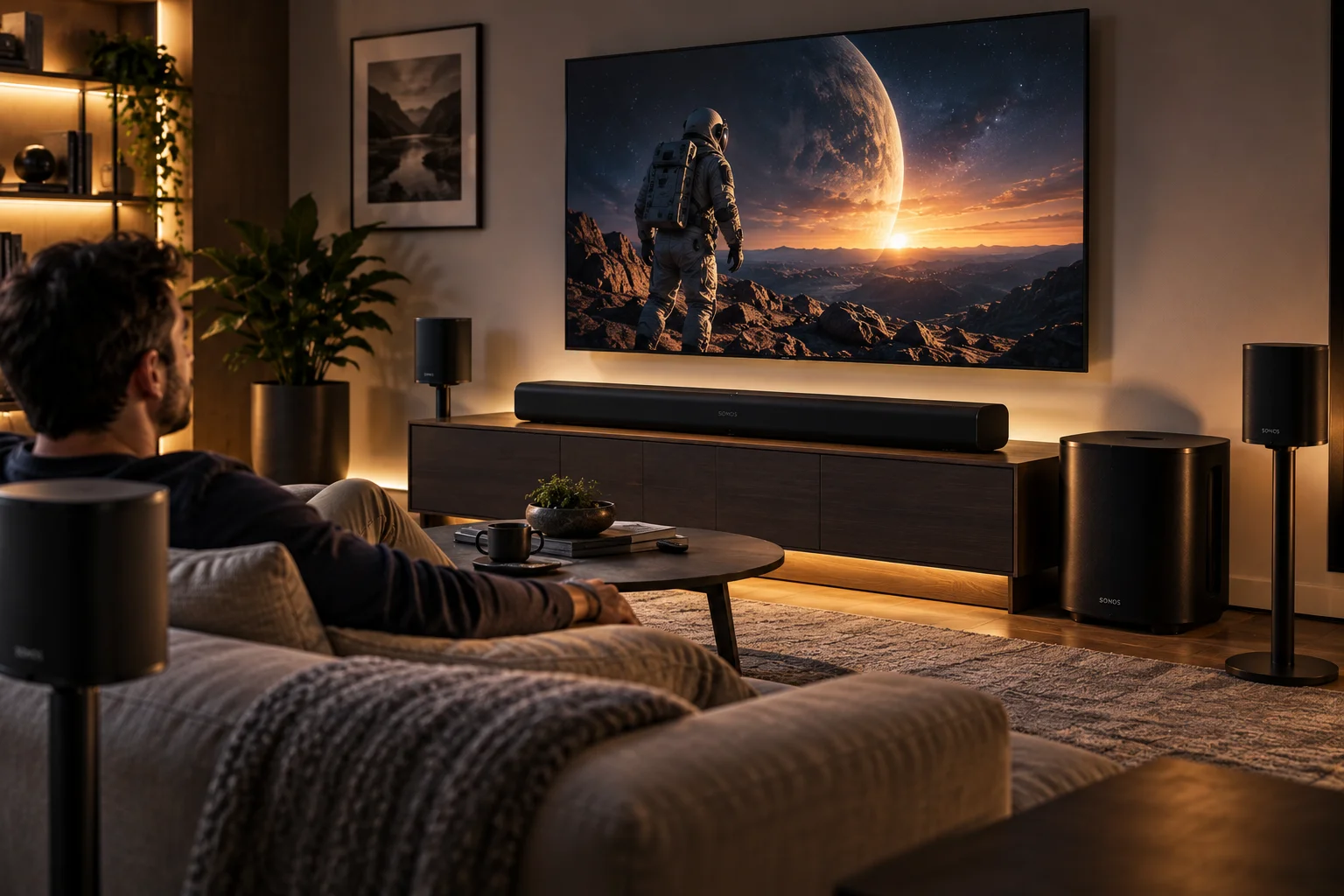
The most useful upgrades are usually:
Dedicated centre channel: helpful for dialogue.
HDMI eARC: useful for high-quality audio formats and convenient TV integration.
Dolby Atmos: worth considering for compatible movies and shows.
Upward-firing drivers: more useful than Atmos branding alone if you want height effects.
Subwoofer: worthwhile for stronger cinematic bass.
Rear speakers: the biggest step towards convincing surround sound.
Room calibration: useful because rooms have different acoustics.
Dialogue enhancement: particularly valuable if speech clarity is your main concern.
Sonos Arc Ultra includes Trueplay calibration and speech enhancement, while Samsung's Q990H includes SpaceFit Sound Pro for room optimisation.
Do you need HDMI eARC?
It is worth having on a modern home-theatre soundbar, particularly if you want to take advantage of advanced audio formats.
HDMI eARC can carry higher-bandwidth audio between compatible TVs and sound systems.
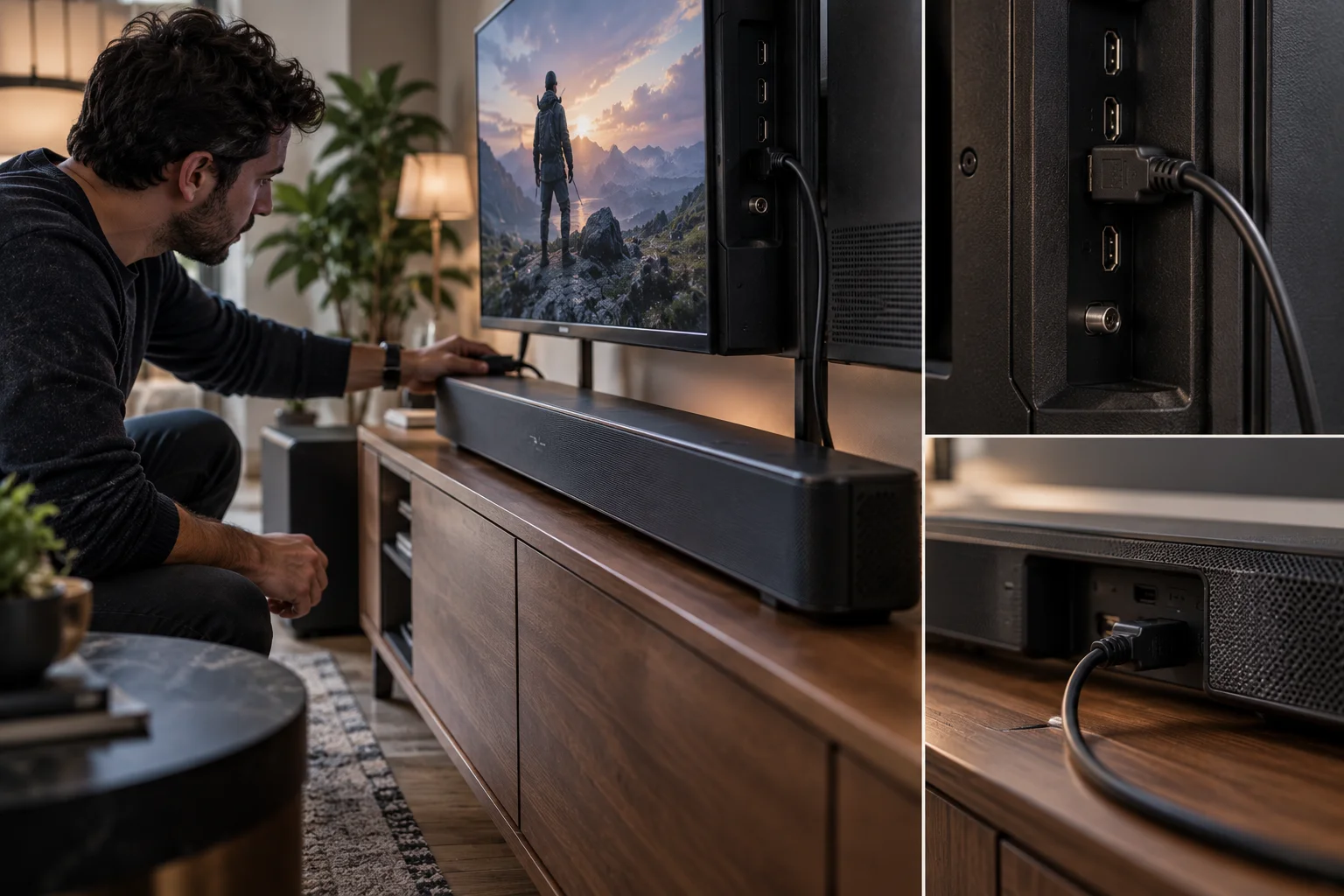
A soundbar such as Sonos Arc Ultra uses HDMI eARC as its primary TV connection.
Older TVs may instead use HDMI ARC or optical audio.
Before buying, check the ports on your television.
A fantastic soundbar is less useful if your TV cannot provide the connection features you expect.
Does the TV brand matter?
Sometimes, especially when the TV and soundbar are designed to work together.
Samsung's Q-Symphony, for example, allows compatible Samsung TVs and soundbars to operate together using the TV's speakers and the soundbar. Samsung also includes SpaceFit Sound Pro on its current Q990H system.
But you do not have to buy the same brand as your television.
A Sonos soundbar can be used with compatible TVs from a range of manufacturers, while other brands offer their own ecosystem features.
Connection compatibility is more important than matching logos.
Can a soundbar replace a home theatre system?
For many people, yes, but a full surround system still has the advantage when immersion is the priority.
A single soundbar is considerably easier to install.
You do not need to position rear speakers around the room or find somewhere to place a large AV receiver.
That makes soundbars attractive for apartments, smaller living rooms and people who want a clean-looking setup.
A premium soundbar with a subwoofer and rear speakers can go much further and approach a traditional home-theatre experience, but the setup still remains simpler than assembling a full component-based system.
What is the best soundbar setup for most people?
A mid-range soundbar with a dedicated centre channel, HDMI eARC and a subwoofer is a sensible sweet spot for many households.
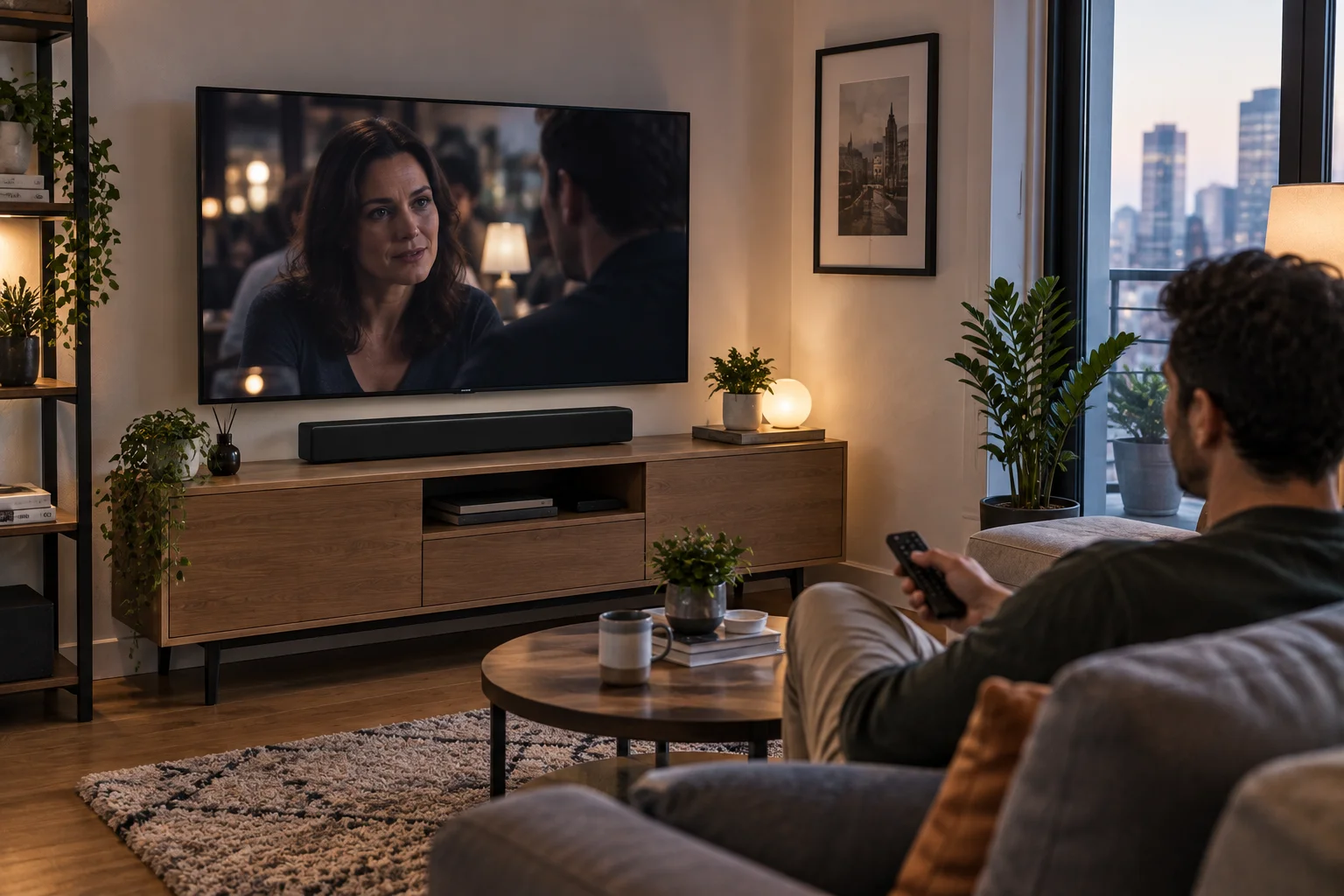
You get better dialogue, stronger bass and a wider soundstage without paying for every premium feature.
If space is limited, a standalone bar can be enough.
If you have a large living room and regularly watch films, a soundbar with separate rear speakers becomes more compelling.
At the premium end, current options such as Samsung's HW-Q990H and Sonos Arc Ultra show the difference between a simple TV audio upgrade and a serious home-cinema system.
Soundbar vs TV speakers FAQs
Is a soundbar really better than TV speakers?
For most modern TVs, yes. A soundbar can provide clearer dialogue, stronger bass, higher volume and a wider soundstage than the television's built-in speakers.
Will a soundbar make dialogue clearer?
Often. Models with dedicated centre channels and dialogue-enhancement features are particularly useful for speech-heavy content.
Is Dolby Atmos worth it on a soundbar?
It can be, especially for compatible films and shows. The strongest Atmos systems use upward-firing drivers and can include rear speakers to create a more convincing three-dimensional effect.
Do I need a subwoofer with a soundbar?
No. A soundbar can improve TV audio on its own. A subwoofer becomes worthwhile when you want deeper bass for films, games and music.
Is a cheap soundbar better than expensive TV speakers?
Often, but quality varies. A good entry-level soundbar can improve dialogue and soundstage, but premium soundbars offer much greater immersion and bass.
Can a soundbar give true surround sound?
A soundbar can create an impressive surround effect, but separate rear speakers generally provide a more convincing surround field than a single bar.
Do I need HDMI eARC?
It is not mandatory, but it is a valuable feature on a modern soundbar and compatible TV, particularly for advanced audio formats.
Should I buy a soundbar from the same brand as my TV?
Not necessarily. Brand matching can provide useful ecosystem features, but compatibility and sound quality should come first.
Is a premium soundbar worth it?
It can be, particularly if you watch a lot of movies and have a suitable room. For casual TV viewing, a good mid-range soundbar often provides a better balance.
What is the biggest improvement a soundbar makes?
For many people, it is the combination of clearer dialogue and a much larger, fuller soundstage. Bass is another major improvement compared with typical built-in TV speakers.
Final Thoughts
A soundbar does not magically turn every television into a cinema.
But the difference between built-in TV speakers and a good soundbar is usually much bigger than the difference between two similarly priced TVs.
TV speakers are fine when simplicity is your priority. A soundbar is worth buying when you care about clearer dialogue, stronger bass, louder and fuller sound, or a more immersive experience.
You also do not have to spend a fortune.
A compact soundbar can address the basic weaknesses of TV audio. A mid-range model with a centre channel and subwoofer can deliver a more substantial upgrade, while premium systems with Dolby Atmos, room calibration and rear speakers are designed for people who want their living room to feel more like a dedicated entertainment space.
The real question is therefore not whether a soundbar is better.
It is whether your TV's audio is currently good enough for the way you watch.
For most people who regularly watch films, sports, games or dialogue-heavy shows, the answer is eventually no.