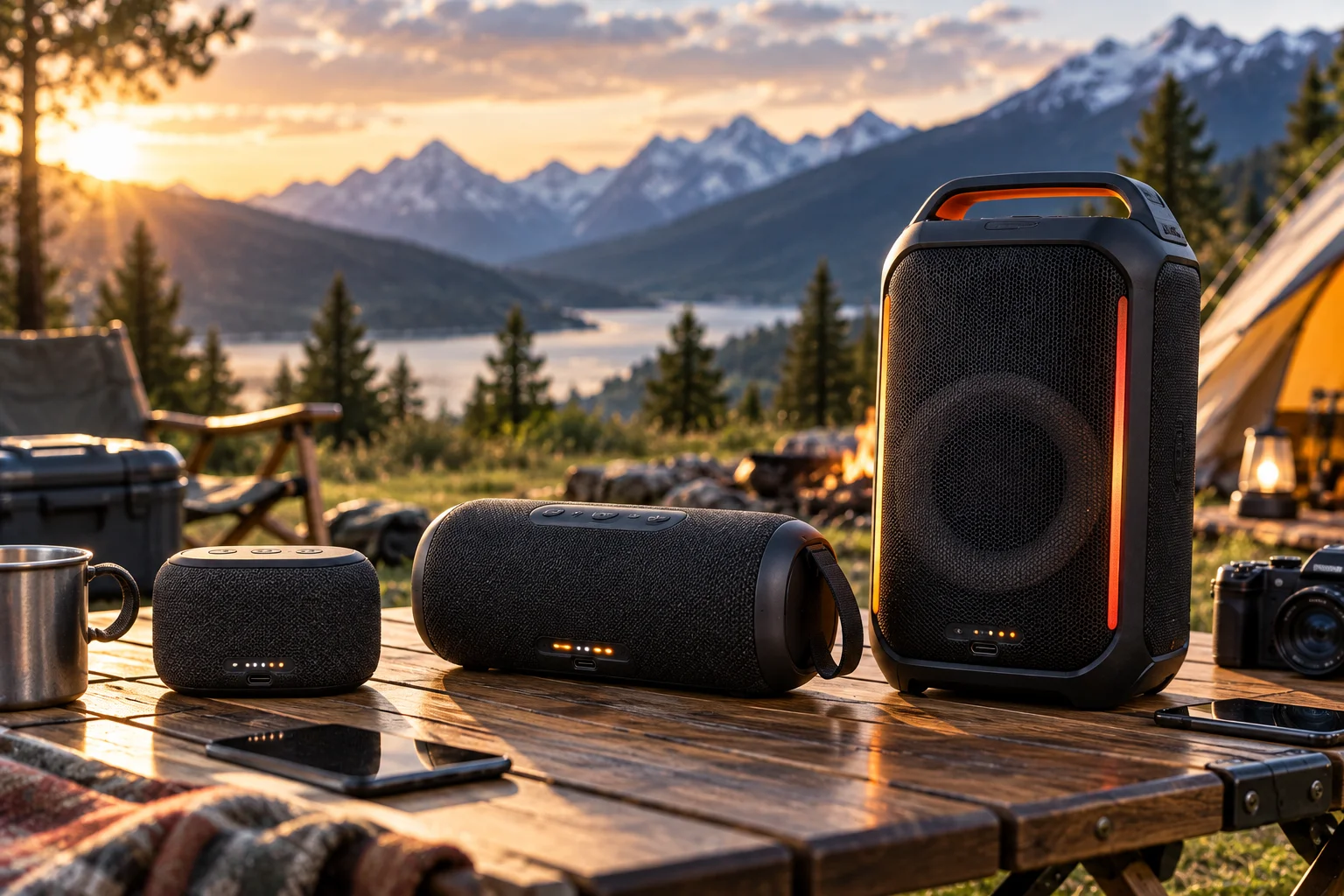
A Bluetooth speaker advertised with 20 or 24 hours of battery life can sound like an obvious winner over one rated for five or six hours.
But battery capacity alone doesn't explain the difference.
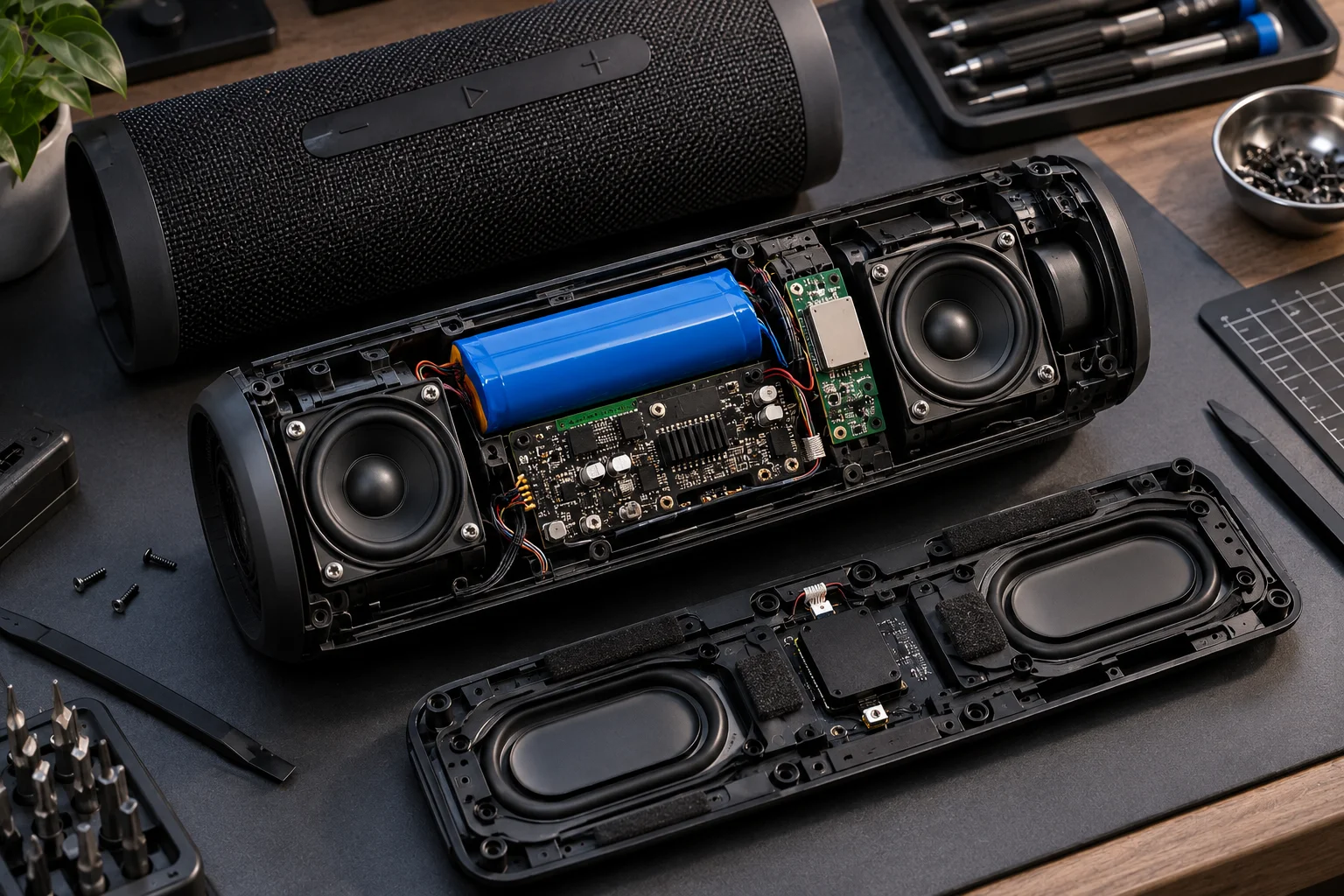
A portable speaker is essentially a small battery-powered audio system. The battery has to supply energy to the Bluetooth radio, amplifier, digital signal processing, speaker drivers and sometimes microphones, lights, Wi-Fi hardware or other electronics.
Then there's the biggest variable of all:
How loudly are you playing it?
A manufacturer may quote its maximum playtime at a particular volume and configuration. Turn the speaker up, increase bass-heavy content or activate power-hungry features and actual runtime can fall considerably.
That's why two speakers with similarly sized batteries can have very different battery lives.
And there's an interesting development in newer Bluetooth technology. Bluetooth LE Audio and its LC3 codec are designed to improve power efficiency, although actual battery savings depend on the implementation and how the manufacturer chooses to balance efficiency, audio quality and features.
What Determines a Bluetooth Speaker's Battery Life?
Battery capacity, amplifier efficiency, speaker design, listening volume and software features all contribute to how long a Bluetooth speaker runs.
Think of the speaker as a complete electrical system rather than just a battery.
Its energy goes toward:
Bluetooth connectivity
Audio decoding
Digital signal processing
Amplification
Woofer and tweeter movement
Bass enhancement
Noise processing
LEDs
Voice assistants
Wi-Fi, on some models
Charging other devices, if supported
A speaker with a large battery can still have short runtime if its amplifier and drivers demand substantial power.
Conversely, a smaller speaker optimized for moderate volume may run for many hours from a relatively small battery.
The manufacturer's quoted runtime is therefore a system-level figure, not a measurement of battery capacity alone.
Why Does Speaker Size Affect Battery Life?
Larger speakers often have larger batteries, but they also have larger drivers and amplifiers that can consume more power.
This creates an interesting balance.
A small speaker might contain:
Small battery + small amplifier + small driver
A larger portable speaker might contain:
Large battery + larger amplifier + larger woofer + more DSP
The second speaker has more energy available, but it also has more hardware consuming that energy.
That's why physical size doesn't translate directly into battery life.
JBL's current range illustrates this variation: its Flip 6 is rated for up to 12 hours, while the Charge 5 is rated for 20 hours and the Xtreme 4 for up to 24 hours.
The larger speakers aren't simply carrying larger batteries.
They're designed around different output levels and use cases.
Why Does Volume Drain a Bluetooth Speaker So Quickly?
Higher volume generally means the amplifier has to deliver more power to the speaker drivers, increasing energy consumption.
This is particularly noticeable with bass.
Bass frequencies require substantial physical movement from a woofer.
If you play bass-heavy music loudly, the amplifier may have to deliver significantly more power to maintain that output.
That's why a speaker can last much longer at moderate volume than it does at maximum volume.
Consider two listening sessions:
Session A
30–40% volume
Moderate bass
No lighting
Normal room temperature
Session B
90–100% volume
Heavy bass
Maximum processing
Outdoor use
The same speaker can produce very different battery runtimes.
This is one reason manufacturer battery figures should never be treated as a universal number.
Does Bass Use More Battery Than Treble?
Heavy bass reproduction can increase power demand because low-frequency sound requires substantial driver excursion and amplifier output.
A compact speaker can't simply reproduce deep bass at high volume without moving its driver significantly.
Modern speakers often use DSP to manage this problem.
The electronics may dynamically adjust bass, limit driver excursion or modify the frequency response as volume rises.
That can help the speaker produce a louder perceived output without continuously demanding as much power as a purely mechanical approach might require.
Some manufacturers now use more sophisticated signal processing for exactly this reason.
JBL's Xtreme 4, for example, uses its AI Sound Boost system to analyze incoming audio and predict speaker movement and power response, with the company saying this helps optimize loudness and bass output.
Does the Bluetooth Version Affect Battery Life?
Bluetooth technology can affect power consumption, but the Bluetooth version number alone isn't a reliable predictor of speaker battery life.
A newer Bluetooth version doesn't automatically mean:
"This speaker will last twice as long."
The radio is only one part of the power budget.
Bluetooth LE Audio is more interesting from an efficiency perspective.
LE Audio operates over Bluetooth Low Energy and uses the LC3 codec, which was specifically designed to provide high audio quality at lower data rates and power consumption.
Bluetooth SIG says LC3 can deliver similar or slightly better audio quality than SBC at less than half the bitrate, potentially allowing manufacturers to trade that efficiency for longer battery life. Actual savings depend on the product implementation.
So Bluetooth technology can matter.
But the amplifier and drivers usually have a much larger influence on a speaker's total power consumption.
Does the Bluetooth Codec Change Battery Life?
A codec can influence power consumption because it determines how audio is encoded, transmitted and decoded, but its effect on total speaker runtime varies by implementation.
A codec isn't the same thing as the amplifier.
The speaker still has to physically reproduce the music.
Bluetooth LE Audio's LC3 is designed to operate efficiently at lower bitrates, reducing the amount of radio activity required for a given audio stream. Bluetooth SIG says developers can use those efficiency gains either for longer battery life or for other design priorities such as a smaller battery or additional features.
That means a more efficient Bluetooth connection can help.
But don't buy a speaker purely because it supports a particular codec and expect a dramatic battery-life advantage.
How Much Battery Capacity Does a Bluetooth Speaker Have?
Manufacturers don't always make the actual battery capacity easy to compare, which is why watt-hours can be more useful than simply looking for a large mAh number.
Battery capacity is often expressed in:
mAh = milliamp-hours
But mAh by itself doesn't tell you the total energy unless you also know the battery voltage.
For example:
Battery energy ≈ voltage × amp-hours
A 5,000mAh battery at one voltage isn't necessarily equivalent in energy to a 5,000mAh battery at another voltage.
That's why Wh, or watt-hours, is a more useful unit when comparing battery energy across different designs.
Unfortunately, portable speaker manufacturers often emphasize playtime instead.
For consumers, the manufacturer's tested runtime is usually more practical than trying to reconstruct battery capacity from incomplete specifications.
Why Can Two Speakers With Similar Batteries Have Different Runtime?
Because their power consumption can be dramatically different.
Imagine:
Speaker A
Efficient amplifier
Moderate output
Small driver
No lighting
Conservative DSP
Speaker B
High-power amplifier
Large woofer
Strong bass
Multiple drivers
RGB lighting
Advanced DSP
Even with similarly sized batteries, Speaker B can consume energy much faster.
It's similar to comparing two cars with the same fuel-tank capacity.
The tank tells you how much fuel is available.
It doesn't tell you how efficiently the engine uses it.
Do RGB Lights Drain Bluetooth Speaker Batteries?
Yes, integrated lighting consumes additional electrical power and can reduce runtime, although the impact depends on the lighting system and brightness.
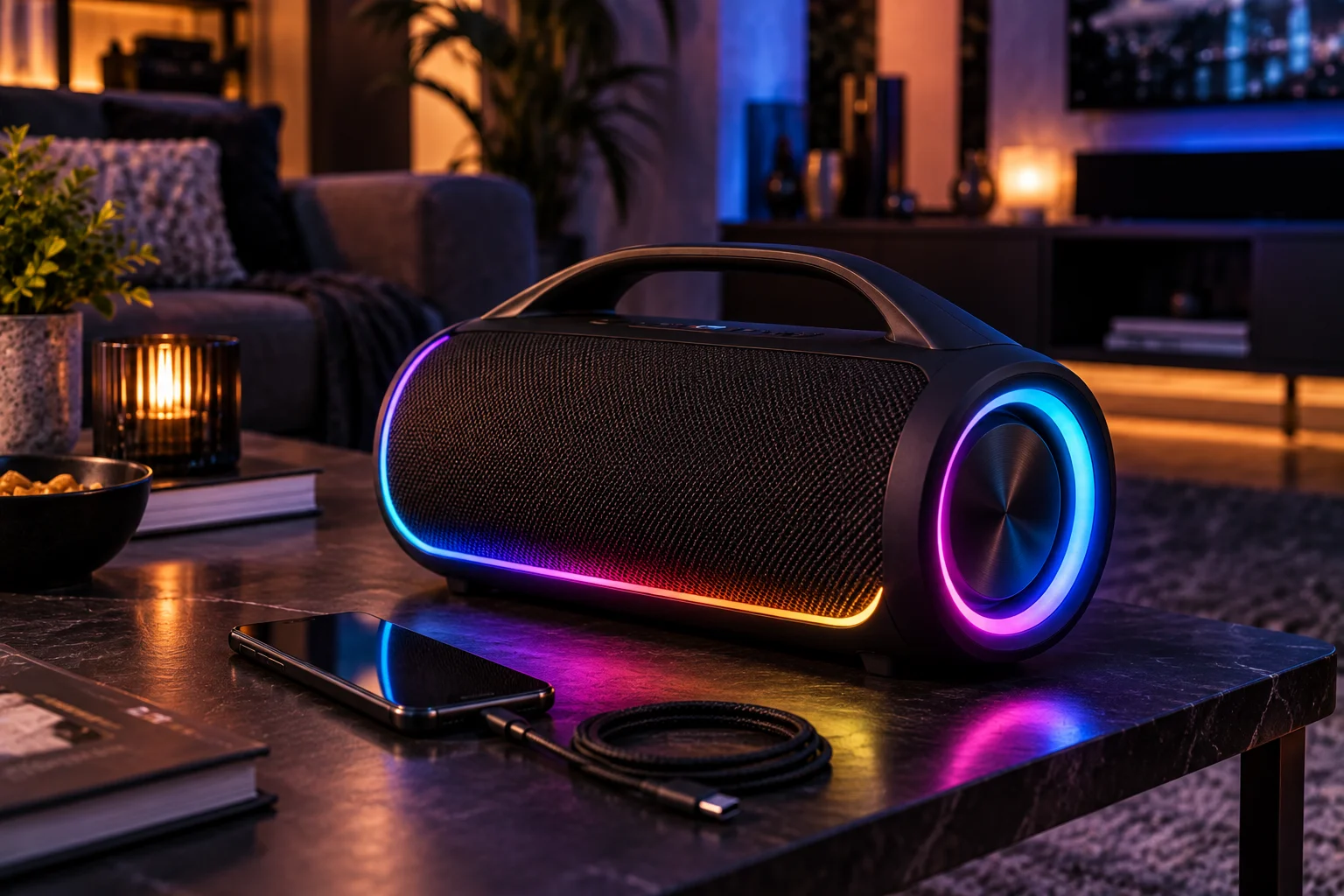
A speaker with animated RGB lighting is running additional LEDs and control electronics that a basic speaker doesn't need.
This doesn't mean lighting will cut battery life in half.
The effect depends on the design.
But if you're trying to maximize runtime, turning off unnecessary lighting is an easy place to start.
The same principle applies to:
Always-on displays
Voice assistants
Wi-Fi
Party-link systems
Extra microphones
Power-bank functionality
Every active subsystem has an energy cost.
Does Using a Bluetooth Speaker as a Power Bank Reduce Battery Life?
Yes. If the speaker can charge your phone, energy is being transferred from the speaker's battery to another device.
This can dramatically reduce the remaining playback time because you're effectively using the speaker as both:
Audio system + portable battery
That's convenient at a party or outdoor event.
But if maximum playback time is the priority, don't use the speaker to charge your phone unless necessary.
Does Temperature Affect Bluetooth Speaker Battery Life?
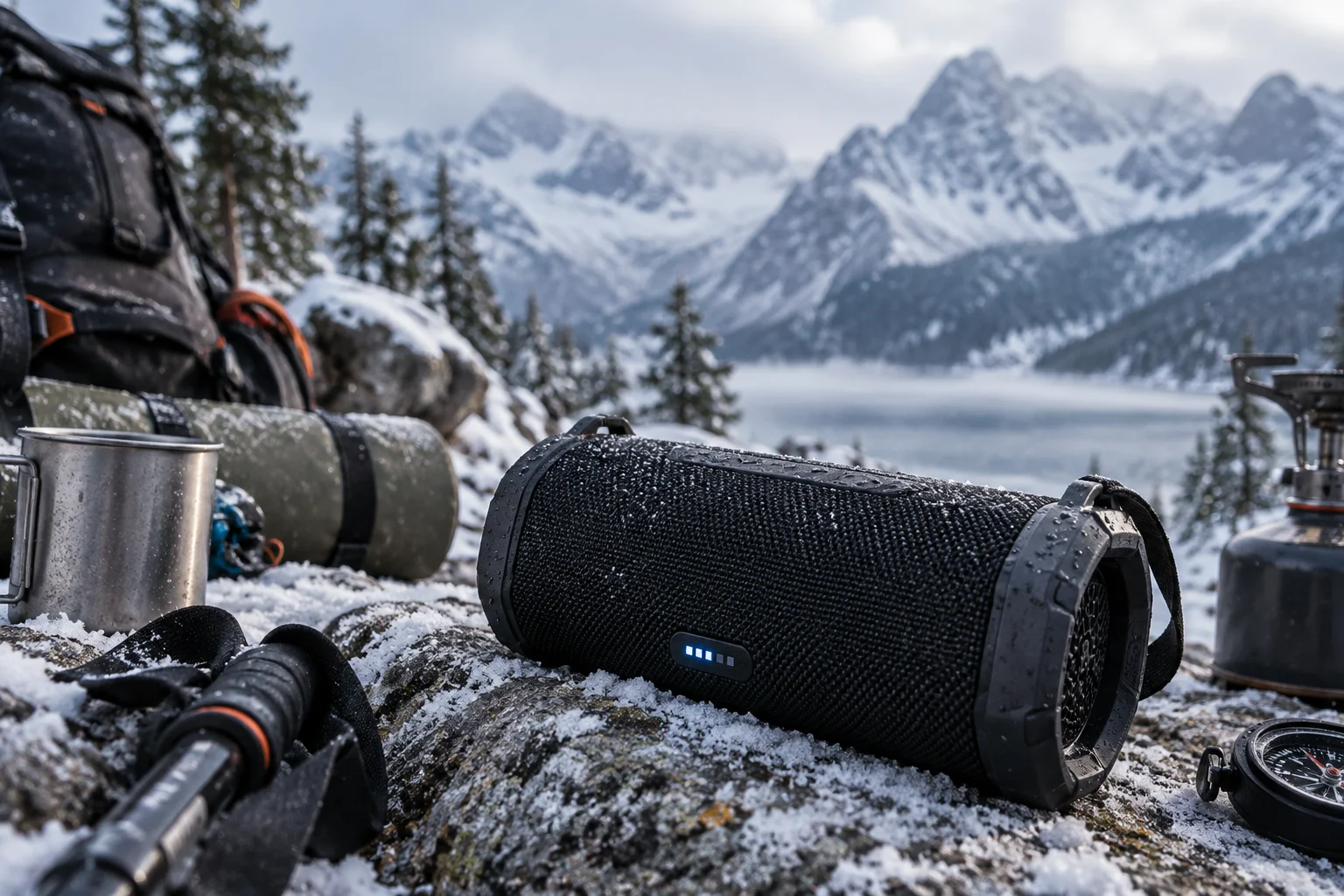
Yes. Lithium-ion batteries generally perform differently outside moderate temperature ranges, and very cold or very hot conditions can affect both runtime and battery health.
Outdoor speakers are often used in conditions that are less friendly to batteries.
Cold temperatures can temporarily reduce available battery performance.
Heat can accelerate battery aging.
The battery may therefore provide less runtime outdoors in extreme conditions than it does in a comfortable indoor environment.
This is one reason real-world battery life can vary even when your volume setting hasn't changed.
Why Does Battery Life Drop as a Speaker Gets Older?
Lithium-ion batteries gradually lose capacity through normal use and aging.
A new speaker might deliver close to its advertised runtime under the manufacturer's test conditions.
After years of charging cycles, the battery may hold less energy.
Eventually:
Same speaker + same volume + same music = shorter runtime
because the battery's usable capacity has declined.
Battery aging depends on factors such as:
Number of charge cycles
Temperature
Charging behavior
Storage conditions
Time
Battery chemistry
If the battery is permanently built into the speaker, replacement may be difficult or uneconomical.
That's worth considering when buying a premium portable speaker.
Why Don't Manufacturers Give One Universal Battery-Life Number?
Because playback time changes dramatically with the conditions under which the speaker is used.
A manufacturer needs a reproducible test.
JBL, for example, advertises the Charge 6 at up to 28 hours, with the additional Playtime Boost mode providing up to four extra hours.
But your actual result depends on:
Volume
Content
Bass level
Equalizer settings
Lighting
Bluetooth connection
Temperature
Battery age
Additional features
That's why “up to 20 hours” doesn't mean “20 hours in every situation.”
The phrase "up to" matters.
How Do You Get the Longest Battery Life From a Bluetooth Speaker?
Keep the volume moderate, disable unnecessary features and avoid extreme temperatures.
The easiest changes are:
Reduce volume
This is usually one of the biggest practical differences.
Turn off lighting
If the speaker has RGB or decorative lighting, disable it when you don't need it.
Reduce unnecessary bass enhancement
Extreme bass processing can increase power demand.
Disable unused features
Turn off voice assistants or other features if the speaker allows it.
Keep the speaker cool
Avoid leaving it in direct sunlight or a hot car.
Maintain the battery
Don't store the speaker completely empty for long periods.
Use the manufacturer's recommended charger
This helps avoid charging-related problems and maintains the intended charging behavior.
Is a 20-Hour Bluetooth Speaker Really Better Than a 6-Hour Speaker?
Not necessarily. The right runtime depends on how you use the speaker.
If you mostly listen for:
1–2 hours at home
a compact six-to-ten-hour speaker may be perfectly adequate.
If you're taking it:
Camping
To the beach
On road trips
To parties
To outdoor events
then a 20-hour-plus rating becomes much more useful.
You also need to consider charging options.
A speaker that supports USB-C charging and can quickly recover useful runtime during a short charging session may be more practical than one with a huge headline battery figure but slow charging.
How Much Battery Life Should a Bluetooth Speaker Have?
For everyday portable use, around 10–15 hours is generally enough for most listening sessions, while 20 hours or more is valuable for travel and extended outdoor use.
A useful way to think about it:
Claimed runtime | Best suited to |
|---|---|
3–6 hours | Short sessions, ultra-compact speakers |
6–10 hours | Casual everyday use |
10–15 hours | General portable use |
15–20 hours | Travel and long days |
20–30+ hours | Camping, parties, extended outdoor use |
These aren't performance grades.
A six-hour speaker can still sound excellent.
A 24-hour speaker can still have mediocre sound.
Battery life and audio quality are separate measurements.
What Should You Check When Comparing Bluetooth Speaker Battery Life?
Look at the manufacturer's runtime claim alongside charging speed, battery capacity where available, speaker size and expected listening volume.
Before buying, check:
Claimed playback time
Conditions used for the claim
USB-C charging
Fast-charge capability
Battery capacity or Wh, if published
Maximum output
Bass/DSP features
Lighting
Power-bank functionality
Replaceability or serviceability of the battery
Don't compare:
Speaker A: 20 hours
against
Speaker B: 12 hours
and stop there.
The 20-hour speaker might be measured at moderate volume, while the 12-hour model could be designed for substantially higher output.
Bluetooth Speaker Battery Life Explained
Factor | Effect on runtime |
|---|---|
Battery capacity | More stored energy generally means longer runtime |
Volume | Higher output generally uses more power |
Bass | Heavy low-frequency output can increase amplifier/driver demand |
Amplifier efficiency | More efficient designs waste less energy |
Driver size/output | Higher acoustic output can require more power |
DSP | Processing consumes power but can also improve efficiency |
Bluetooth radio | Wireless connection consumes energy |
Codec | Efficient codecs can reduce radio/processing demand |
RGB lighting | Adds additional power consumption |
Voice assistant | Requires additional processing/radio activity |
Power-bank use | Transfers energy to another device |
Temperature | Extreme conditions can reduce battery performance |
Battery age | Capacity decreases over time |
Frequently Asked Questions About Bluetooth Speaker Battery Life
Why does my Bluetooth speaker battery drain so fast?
High volume, heavy bass, lighting, battery age, extreme temperatures and power-hungry features can all reduce runtime. A degraded battery can also hold substantially less charge than when new.
Does higher volume reduce Bluetooth speaker battery life?
Yes. Higher volume generally requires more amplifier power and greater driver output, which increases energy consumption.
Does bass drain a Bluetooth speaker faster?
Heavy bass can increase power demand because low-frequency reproduction requires substantial driver movement and amplifier output, particularly at high volume.
Do Bluetooth codecs affect battery life?
They can. Bluetooth LE Audio and the LC3 codec are designed for efficient audio transmission and can reduce power consumption, although actual battery savings depend on the product implementation.
Is Bluetooth 5 better for battery life?
The Bluetooth version number alone doesn't determine speaker battery life. The radio implementation, Bluetooth mode, codec, amplifier and the rest of the hardware all contribute to total power consumption.
Does turning off RGB lights save battery?
Yes. The LEDs and their control electronics consume additional power, so disabling them can extend runtime.
Why does my speaker last less than the advertised number of hours?
Manufacturers normally specify maximum or "up to" runtime under particular test conditions. Higher volume, bass-heavy music, lighting, temperature and battery age can all produce shorter real-world results.
How long should a Bluetooth speaker battery last?
For most everyday users, 10–15 hours of claimed playback is a practical target. Around 20 hours or more becomes useful for long outdoor sessions and travel.
Does a bigger Bluetooth speaker always have better battery life?
No. Larger speakers often have larger batteries, but they also tend to use larger amplifiers and drivers. Actual runtime depends on the complete design.
Can I improve the battery life of an old Bluetooth speaker?
You can reduce volume, disable unnecessary features and avoid heat, but if the battery has significantly degraded, software settings won't restore its original capacity. Battery replacement may be possible on some models.
The Bottom Line
Bluetooth speaker battery life is a balance between stored energy and how quickly the speaker consumes it.
A 20-hour speaker isn't necessarily using a dramatically better battery than a five-hour model.
It may simply have a different combination of:
Battery capacity + amplifier efficiency + driver design + volume + DSP + Bluetooth hardware + features.
Modern Bluetooth technology can contribute too. LE Audio and LC3 are specifically designed to improve power efficiency, potentially allowing manufacturers to trade lower power consumption for longer runtime or additional features.
But the biggest practical lesson is simpler:
Battery capacity tells you how much energy the speaker has. Speaker design determines how quickly it spends that energy.
So when comparing portable speakers, don't look only for the biggest battery-life number.
Look at how the speaker is designed, how loudly you actually listen and which features you plan to use.
That's what determines whether a speaker really lasts all day or needs its charger halfway through the afternoon.