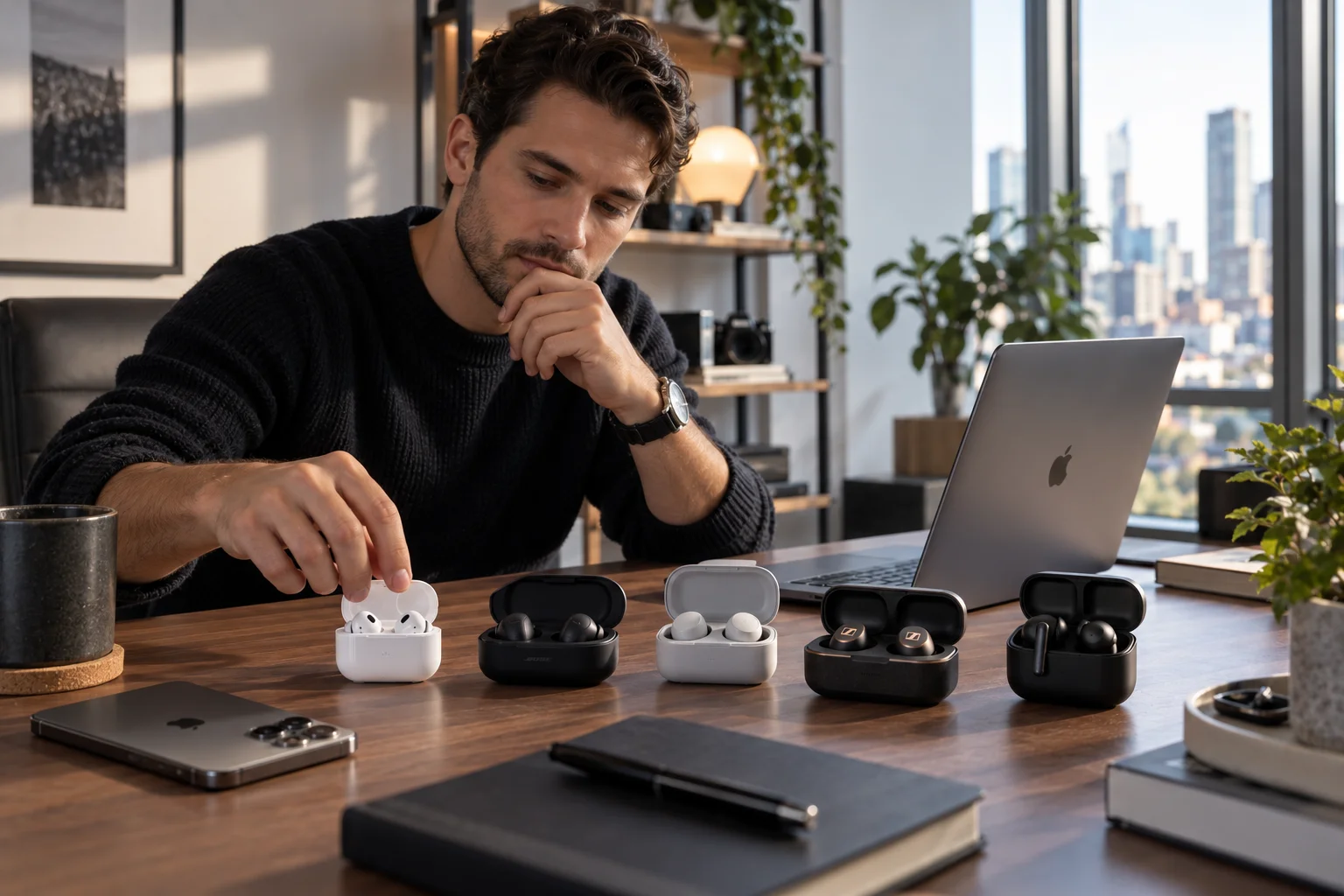
"AirPods or wireless earbuds?"
It sounds like a simple choice until you start shopping.
Then you see noise cancellation, transparency modes, spatial audio, multipoint Bluetooth, different codecs, IP ratings, microphone arrays, battery estimates and enough model names to make a pair of earbuds feel like a serious technology purchase.
There's also one important misconception to clear up.
AirPods are wireless earbuds.
The real comparison is between Apple's AirPods ecosystem and the much broader world of wireless earbuds from brands such as Sony, Bose, Samsung, Google, Jabra and others.
Modern AirPods are highly capable. Apple's current lineup includes AirPods 5, AirPods Pro 3 and AirPods Max 2, with features ranging from Active Noise Cancellation and Personalized Spatial Audio to Live Translation and, on AirPods Pro 3, heart-rate sensing during workouts.
But that doesn't automatically make AirPods the right choice for everyone.
The better question is:
Which features will actually make a difference to the way you listen, work, travel and use your phone?
What is the difference between AirPods and wireless earbuds?
AirPods are Apple's version of true wireless headphones, while "wireless earbuds" describes the entire category.

That means an AirPods comparison isn't really Apple versus a technology.
It's Apple versus competing implementations of the same basic idea.
Feature | AirPods | Other wireless earbuds |
|---|---|---|
Completely wireless | Yes | Yes |
Bluetooth | Yes | Yes |
Active Noise Cancellation | Selected models | Common on mid-range and premium models |
Transparency/ambient mode | Selected models | Common on ANC models |
Spatial audio | Strong Apple integration | Available on many premium models |
Multipoint | Limited/model-dependent | Common on many competing models |
Android compatibility | Basic Bluetooth functions | Usually broad |
iPhone integration | Excellent | Varies |
Sound customization | Available | Often extensive through apps |
Hardware variety | Limited to Apple's lineup | Very wide |
Price range | Apple-focused | Budget to premium |
So if you're using an iPhone, AirPods offer some advantages that have nothing to do with raw sound quality.
If you're using Android, the equation changes.
Do AirPods sound better than other wireless earbuds?
Not automatically. Sound quality depends on the specific earbuds, their tuning, fit and the listener.
This is one of the biggest mistakes people make when comparing earbuds.
A $250 pair of AirPods Pro isn't competing with "wireless earbuds."
It's competing with other premium earbuds.
And there are excellent options at different prices.
Sound quality depends on things such as:
Driver design
Tuning
Ear-tip seal
Equalizer options
Codec support
Digital signal processing
Fit
Personal preference
AirPods Pro 3, for example, use a custom high-excursion driver and high-dynamic-range amplifier, along with Adaptive EQ and Personalized Spatial Audio.
Another pair might offer a warmer sound, stronger bass or more extensive EQ controls.
There isn't a universal "best sound."
There is a sound signature you prefer.
Is AirPods' noise cancellation better?
AirPods can offer excellent Active Noise Cancellation, but ANC performance should be compared model by model rather than brand against brand.

Apple's current AirPods lineup includes ANC on AirPods 5 and AirPods Pro 3. Apple says AirPods Pro 3 provide up to three times the ANC of AirPods 5.
Premium competitors from Sony, Bose and other manufacturers also offer sophisticated ANC systems.
The practical difference comes down to how well the earbuds reduce the sounds around you.
For commuting and air travel, ANC is particularly useful for:
Aircraft engines
Train noise
Bus and subway rumble
Air-conditioning
Office background noise
But fit matters enormously.
A perfectly sealed earbud can sometimes block more outside sound passively than a poorly fitting earbud with excellent electronics.
So don't look only at the ANC marketing.
Look at the fit.
What is transparency mode, and does it matter?
Transparency or ambient mode lets outside sound reach your ears without removing the earbuds.
It's one of those features that sounds optional until you actually use it.
Imagine you're wearing earbuds at a coffee shop and someone starts talking to you.
Instead of taking them out, you can switch to transparency mode and hear the conversation.
AirPods call this Transparency mode, with newer models adding Adaptive Audio that dynamically balances noise cancellation and outside sound.
Other premium earbuds offer similar ambient listening modes.
For everyday use, this feature can be more useful than another small improvement in bass response.
Are AirPods better for phone calls?
AirPods can be particularly convenient for calls because Apple combines microphones, voice processing and iPhone integration closely.
AirPods Pro 3, for example, include beamforming microphones, Voice Isolation and Conversation Awareness.
But competing premium earbuds can also have excellent call quality.
If you spend hours in Zoom, Teams, Google Meet or regular phone calls, pay attention to microphone performance.
A good music experience doesn't guarantee a good voice-call experience.
And noisy environments are where the difference becomes noticeable.
Are AirPods better with an iPhone?
Yes, this is one of the strongest reasons to choose AirPods if you already use Apple devices.
AirPods aren't simply Bluetooth headphones when they're connected to an iPhone.
Apple builds additional features around the ecosystem.
Depending on the model, you can get features such as:
Automatic pairing
Siri integration
Find My support
Personalized Spatial Audio
Seamless switching
Live Translation
Hearing-health features
Camera-related controls
Current AirPods also support Live Translation on compatible devices and in selected languages and regions.
The experience is particularly compelling if you also own a Mac, iPad or Apple Watch.
That doesn't mean other earbuds won't work with an iPhone.
They will.
They simply may not provide the same level of Apple-specific integration.
Are AirPods good with Android phones?
They work with Android, but you don't get the full Apple experience.

You can use AirPods as Bluetooth earbuds for listening and calls.
The problem is that some of the features that make AirPods distinctive are tied to Apple's ecosystem.
If you're using Android as your primary phone, a competing pair of earbuds designed around Android may offer more useful features.
Samsung Galaxy Buds, for example, can make particular sense within Samsung's ecosystem.
Google's Pixel Buds can make sense for people heavily invested in Google's services.
And many third-party earbuds work across both platforms.
So the question isn't simply:
"Do AirPods work with Android?"
They do.
The better question is:
"Am I paying for Apple-specific features that I can't fully use?"
Which has better battery life?
Battery life varies much more by model than by whether the earbuds are AirPods.
For example, Apple rates AirPods 4 for up to five hours of listening on a single charge and up to 30 hours with the charging case.
AirPods Pro 3 are rated for up to eight hours with ANC enabled and up to 24 hours with the case and ANC enabled.
Other wireless earbuds can offer longer or shorter figures.
When comparing battery life, look at three numbers:
Earbuds alone
How long can you listen before returning them to the case?
Charging case
How many additional charges does the case provide?
Fast charging
How much listening time do you get from a short charge?
For travel, that third number can be surprisingly important.
Five minutes of charging before leaving your hotel can be more useful than an extra hour of theoretical battery life.
Do wireless earbuds have better Bluetooth features than AirPods?
Some competing earbuds offer more flexible connectivity, particularly multipoint Bluetooth.
Multipoint allows compatible earbuds to maintain connections with two devices and switch between them.
For example:
Laptop → phone
You might be listening to music on your laptop when a call arrives on your phone.
The earbuds can switch connections without requiring you to manually disconnect and reconnect.
AirPods offer excellent automatic switching within Apple's ecosystem, but the experience is different from traditional Bluetooth multipoint.
If you regularly move between a Windows laptop and an Android or iPhone, check the exact connectivity features before buying.
This can matter more than spatial audio.
Which earbuds are better for travel?
For frequent travelers, prioritize ANC, comfort, battery life and reliable controls before chasing advanced audio features.
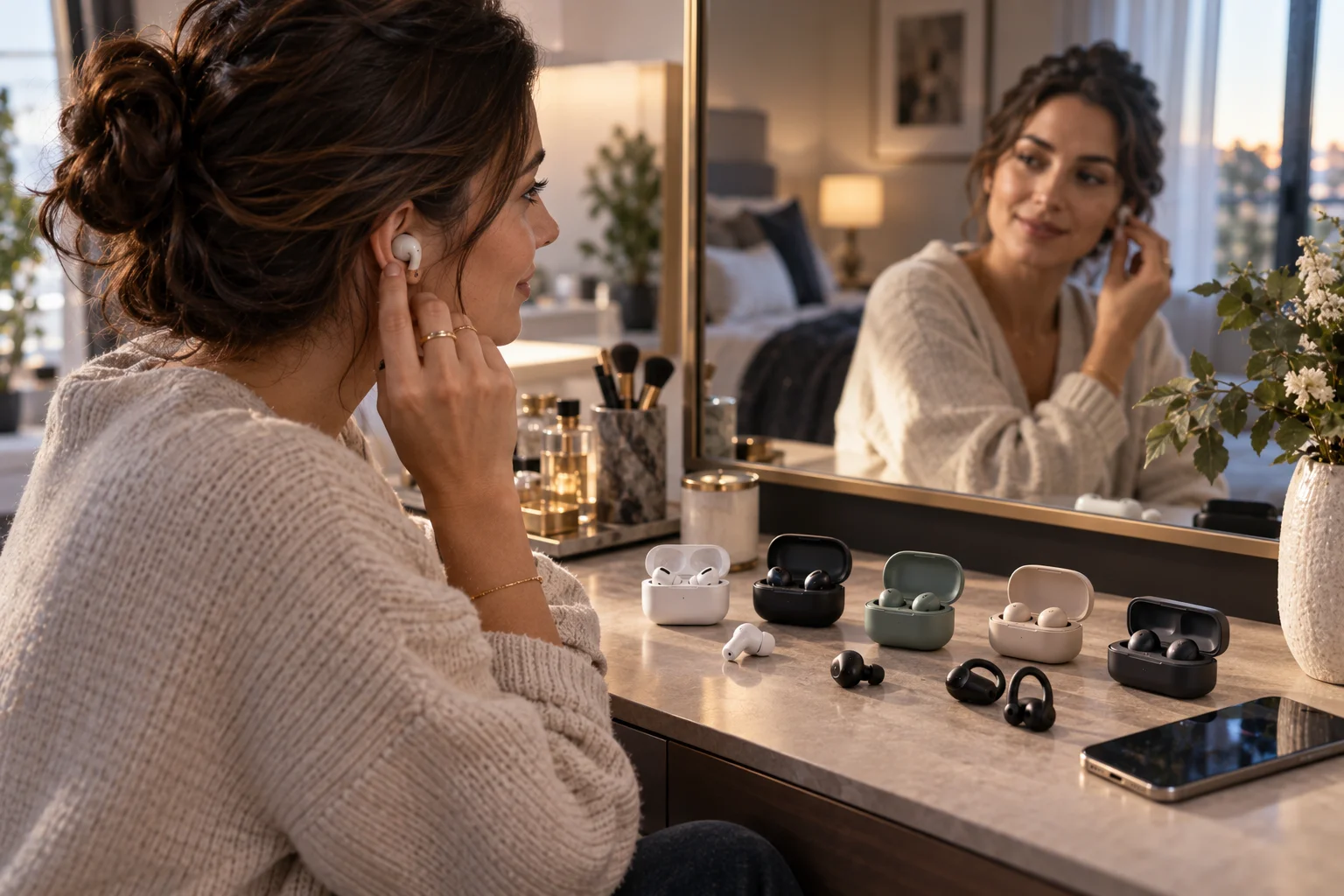
A good travel pair should give you:
Strong noise cancellation
Comfortable fit for several hours
Reliable transparency mode
Good call quality
Fast charging
A compact charging case
AirPods Pro 3 currently combine ANC, Adaptive Audio, Transparency, up to eight hours of ANC listening and an IP57 dust/sweat/water resistance rating.
But plenty of competing earbuds are designed specifically around travel.
If you're flying frequently, ANC is probably more valuable than another feature you'll never use.
Does the earbud fit really matter?
Yes. Fit can affect sound quality, noise cancellation, comfort and even battery perception.
An earbud that doesn't seal properly can sound thin because bass escapes.
You may also turn the volume up to compensate.
A poor fit can make ANC less effective.
And if the earbuds become uncomfortable after 30 minutes, impressive specifications don't matter much.
AirPods 4 use an open-style design without silicone ear tips, while AirPods Pro 3 use silicone tips in multiple sizes, including an XXS option.
That difference alone can determine which model suits you.
Some people strongly prefer the less sealed feeling of open earbuds.
Others want the secure seal of in-ear tips.
Try before buying if possible.
Which is better for workouts?
Choose based on fit, sweat resistance, stability and controls rather than brand.

Your workout earbuds need to stay in place when you're moving.
They also need appropriate protection against sweat and moisture.
AirPods Pro 3 currently have an IP57 rating, while AirPods 4 are IP54-rated for dust, sweat and water resistance.
But IP ratings aren't interchangeable.
The first number refers to solids such as dust, while the second relates to water protection.
If you exercise outdoors regularly, check the exact rating rather than assuming every "water-resistant" earbud is equally protected.
Do wireless earbuds give you more customization?
Often, yes. Many competing earbuds provide extensive app-based controls and EQ settings.
Depending on the manufacturer, you may be able to change:
Equalizer settings
ANC strength
Ambient sound
Touch controls
Sound profiles
Multipoint behavior
Firmware settings
Automatic pause
Spatial audio
AirPods offer customization too, but Apple's approach is generally more controlled.
If you enjoy tweaking your sound and controls, look closely at the manufacturer's companion app before buying.
The app can be almost as important as the earbuds.
Which is better for privacy and ecosystem features?
The important difference is often how deeply the earbuds integrate with the devices and services you already use.
AirPods are tightly connected to Apple's ecosystem.
Features such as Find My, Siri, Personalized Spatial Audio and some hearing-health capabilities rely on Apple hardware and software support.
Other manufacturers take different approaches.
Some prioritize Android integration.
Others emphasize cross-platform compatibility.
For most people, this isn't about one company being inherently more private.
It's about understanding what data, permissions and account connections the companion app requires.
Are expensive wireless earbuds worth it?
Only if you're actually going to use the features you're paying for.
A premium pair can be worthwhile if you:
Travel frequently
Take lots of calls
Listen for several hours every day
Need strong ANC
Exercise regularly
Care about sound customization
Already use a compatible ecosystem
If you mostly listen to podcasts for 30 minutes during your commute, a $250-plus pair may not transform your life.
The jump from poor earbuds to good earbuds can be dramatic.
The jump from good earbuds to premium earbuds is often much more subtle.
AirPods vs wireless earbuds: which should you buy?
The simplest way to think about the decision is this:
If you care most about... | Look for |
|---|---|
Deep iPhone integration | AirPods |
Android compatibility | Cross-platform earbuds |
Apple ecosystem | AirPods |
Maximum EQ customization | Feature-rich third-party earbuds |
Frequent flying | Strong ANC |
Long listening sessions | Comfortable fit + strong battery |
Gym use | Secure fit + suitable IP rating |
Multiple devices | Multipoint |
Phone calls | Strong microphone system |
Immersive movies | Spatial audio |
Lowest price | Compare across brands |
Hearing-health features | Supported models with relevant features |
The most important thing is to compare specific models, not categories.
"AirPods" includes several very different products.
And "wireless earbuds" includes everything from inexpensive basic Bluetooth buds to highly sophisticated premium models.
So, are AirPods better than wireless earbuds?
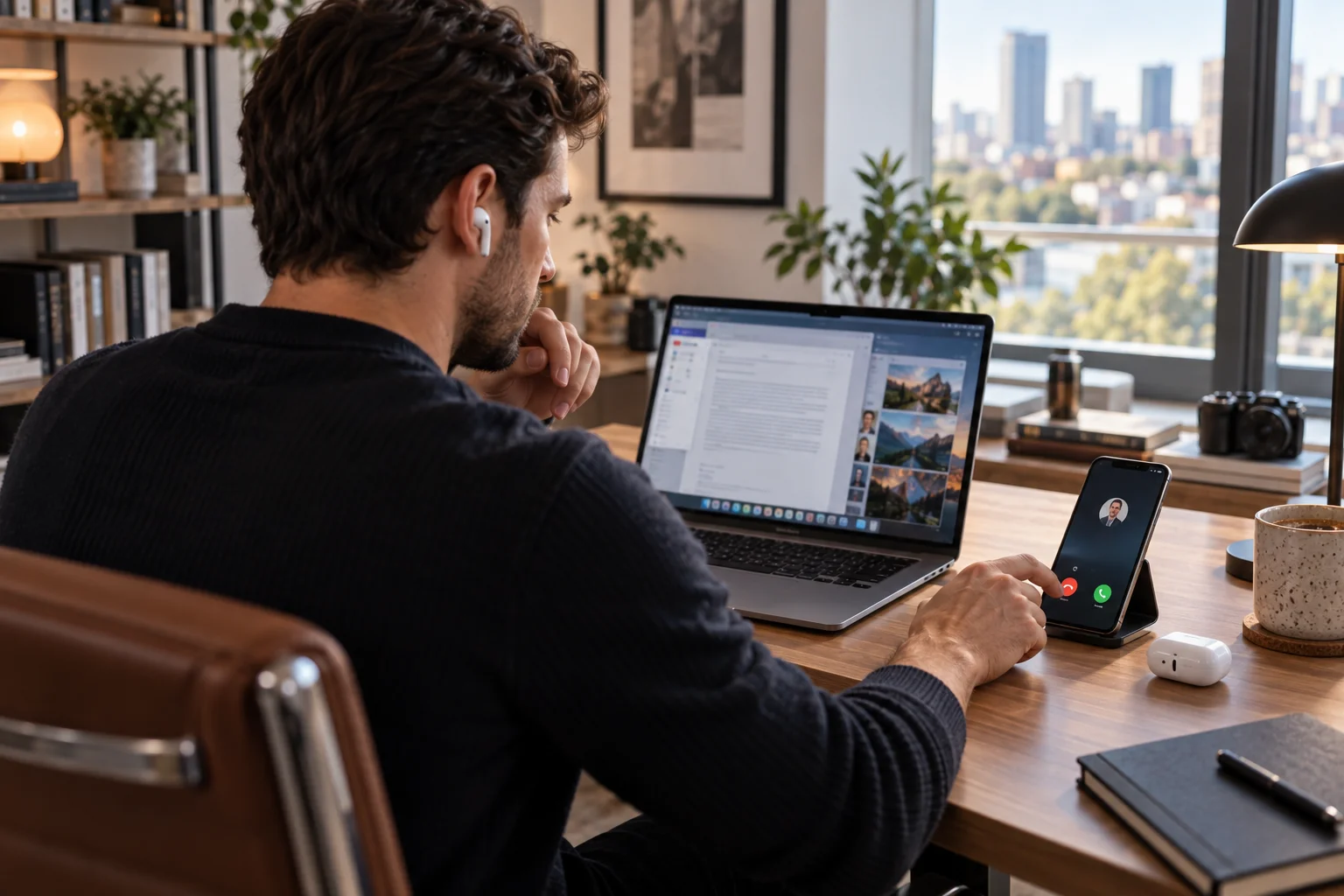
AirPods aren't a separate class of technology.
They're one of the most recognizable products within the wireless-earbud category.
Their biggest advantage is how well they fit into Apple's ecosystem. Current models also offer sophisticated features such as ANC, Adaptive Audio, Personalized Spatial Audio, Live Translation and, on AirPods Pro 3, heart-rate sensing and hearing-health features.
But a competing pair may be more appropriate if you use Android, need multipoint connections, want extensive EQ control, prefer a particular sound signature or simply want to spend less.
The smartest way to buy isn't to ask:
"Are AirPods the best wireless earbuds?"
Ask:
"Which features will I actually use every day?"
If you're an iPhone user who values effortless integration, AirPods can make a lot of sense.
If you're switching between a Windows laptop, Android phone and tablet, connectivity flexibility may matter more.
And if you're a frequent traveler, strong ANC and comfortable fit might be worth prioritizing over everything else.
The best wireless earbuds aren't necessarily the ones with the longest specification sheet. They're the ones whose useful features match your everyday life.